

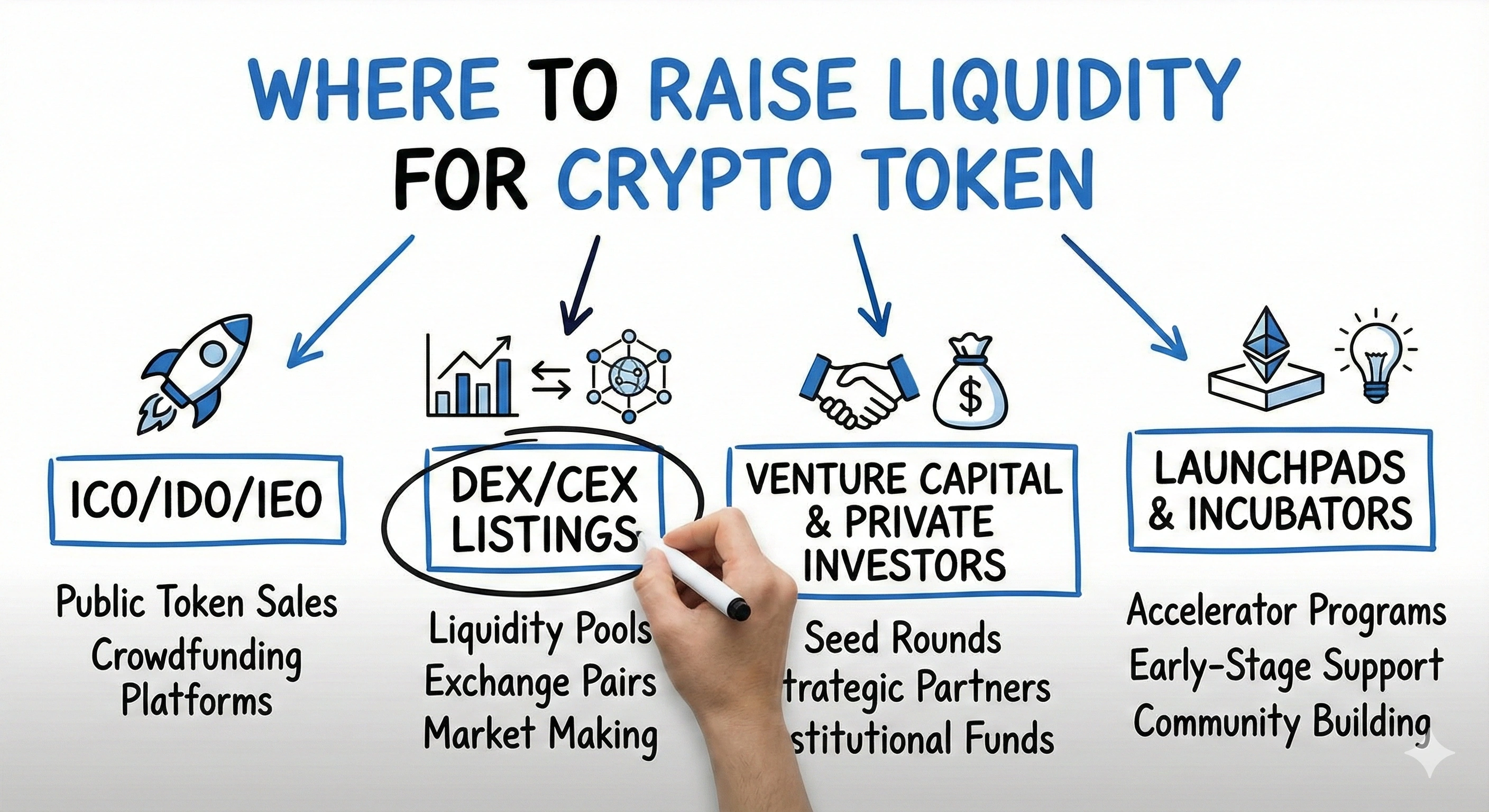
Liquidity is the difference between a token that survives and a token that slowly dies. You can have strong technology, a clear use case, and a large community, but without liquidity the market will punish you with volatility, manipulation, and loss of confidence.
Raising liquidity is not about hype or announcements. It is about engineering capital depth in a way that supports price stability while the ecosystem grows.
Founders who understand liquidity early win. Founders who treat liquidity as an afterthought usually fail.
What Liquidity Really Means In Crypto
Liquidity is the amount of capital available for buying and selling your token without causing sharp price movements. High liquidity allows large trades with minimal slippage. Low liquidity causes extreme price swings even on small trades.
Liquidity is infrastructure. It determines whether serious investors, market makers, and exchanges will engage with your token.
Where Token Liquidity Actually Comes From
Liquidity comes from only a few real sources. There are no shortcuts.
Professional liquidity provider funds deploy stablecoins or base assets into liquidity pools or order books. These firms typically deploy between $250,000 and $5,000,000 per position and focus on risk adjusted yield rather than hype.
Market makers provide continuous buy and sell pressure and sometimes deploy inventory or credit to support depth. They care about predictable supply, sufficient capital, and disciplined tokenomics.
Strategic investors and funds may deploy capital directly into liquidity if it supports long term exposure and comes with structured incentives.
Community liquidity providers can contribute meaningful depth when incentives are simple, transparent, and locked for defined periods.
Every successful token uses a mix of these sources.
Why Most Liquidity Raises Fail
Most founders try to raise liquidity by selling tokens on the open market or by offering unsustainable rewards. This creates short term depth but long term damage.
Selling tokens to fund liquidity increases supply and pushes price down. High APR incentives attract mercenary capital that leaves as soon as rewards drop. Unclear rules destroy trust.
Liquidity must be raised off market and structured for retention.
Step 1 Define Clear Liquidity Targets
Before raising liquidity, define what success looks like. You must set targets for daily trading volume, acceptable slippage, and visible depth near mid price.
For example, you may want to support $1,000,000 in daily volume, keep slippage under 2 percent for a $25,000 trade, and maintain enough depth to absorb a $50,000 order without chaos.
Without numeric targets, liquidity efforts remain reactive.
Step 2 Choose A Primary Liquidity Pair
Liquidity should be concentrated, not fragmented. Choose a primary pricing pair such as your token against USDT or USDC. This becomes the anchor for price discovery.
Secondary pairs can be added later, but only after the primary pool or order book is deep and stable.
Fragmented liquidity increases slippage and weakens stability.
Step 3 Use Proven Liquidity Sizing Models
There are two practical models founders use.
One model sizes liquidity as a percentage of circulating market cap. A common benchmark is 5 percent to 15 percent. If circulating market cap is $20,000,000, target liquidity ranges from $1,000,000 to $3,000,000.
Another model sizes liquidity to slippage tolerance. To keep price impact under 1 percent for a $25,000 trade, pool TVL should be near $2,500,000.
These models help you plan capital needs realistically.
Step 4 Raise Liquidity From Professional LP Providers
Professional LP funds are your strongest source of stable liquidity. They deploy capital when they see disciplined tokenomics, clear reporting, and predictable incentives.
To attract them, you need a short liquidity brief showing circulating supply, unlock schedules, current depth, target depth, expected volume, LP yield structure, lock options, and exit mechanics.
LP funds do not respond to hype. They respond to numbers.
Step 5 Structure LP Incentives That Create Sticky Capital
Liquidity stays only when incentives are aligned with time. The most effective programs use lock based rewards.
Short locks such as 30 days offer baseline yield. Longer locks such as 90 days or 180 days offer higher rewards and priority access. This converts short term LPs into long term partners.
As a reference, attracting $1,000,000 of liquidity at 18 percent APR requires roughly $15,000 per month in incentives. If your treasury cannot support this, targets must be adjusted.
Step 6 Use Market Makers To Multiply Liquidity Impact
Market makers amplify liquidity effectiveness by tightening spreads and smoothing volatility. They are not a replacement for liquidity, but a force multiplier.
A proper market making setup includes defined KPIs such as maximum spread, minimum depth within 1 percent, and quoting uptime. You pay for outcomes, not promises.
Market makers also help connect you with LP funds and exchange partners.
Step 7 Reinforce Liquidity Over Time
Liquidity is not static. As circulating supply grows, liquidity must grow too.
Some projects use revenue based reinforcement where a percentage of fees, for example 20 percent of $100,000 monthly revenue, is allocated to liquidity support.
Others allocate a fixed treasury budget such as $600,000 spread over 12 months, reinforcing liquidity with $50,000 per month. This creates discipline and predictability.
Step 8 Raise Dedicated Liquidity Capital
Liquidity can be raised separately from general funding.
Some founders raise private liquidity rounds where capital is contractually tied to LP deployment and locked for a defined period. Others partner with strategic funds that deploy capital specifically for market depth.
The key rule is simple. Liquidity capital must be locked into liquidity, not converted into sell pressure.
Step 9 Publish A Liquidity Policy And Report Regularly
Serious LPs expect transparency. Publish a liquidity policy that explains how capital is deployed, how incentives work, and how long liquidity is expected to stay.
Provide weekly or biweekly reporting on pool TVL, volume, slippage, and changes. Transparency builds trust and retention.
Common Mistakes To Avoid When Raising Liquidity
Do not sell tokens on market to fund liquidity. Do not change incentive rules mid program. Do not open too many pools too early. Do not hide unlock schedules.
Markets punish surprises faster than bad news.
Liquidity As A Long Term Strategy
Liquidity is not a launch task. It is a continuous strategy tied to supply, demand, and adoption. Tokens that treat liquidity as infrastructure attract long term investors, stable price action, and exchange interest.
Tokens that ignore it become volatile and irrelevant.
Why Expert Guidance Makes Liquidity Raising Easier
Raising liquidity requires understanding tokenomics, incentives, treasury management, market making, and investor psychology. Small mistakes compound quickly.
This is why founders work with Mahesh Chand to design liquidity strategies, structure LP deals, coordinate liquidity with unlock schedules, and build investor ready documentation.
If you are launching a token or struggling with liquidity depth, getting expert advice early can prevent long term damage.
You can contact Mahesh Chand through C# Corner Consulting here
https://www.c-sharpcorner.com/consulting/
Join the conversation! Your thoughts help the community grow.