

If you have ever found yourself juggling several development projects at once and bouncing from solution-to-solution making minor fixes, changes and improvements, then you know how easily it can be to just get overwhelmed or off-task in situations like these. Everyone has their own methods of handling these scenarios and as with most things simple software products can make dealing with these much easier.
Trello is a online product management and collaboration system from the folks over at Fog Creek Software that utilizes the Kanban paradigm to help break down tasks into individual items and improve productivity. It is commonly used within agile-centric development environments and I believe that it can be quite an effective tool to allow groups to collaborate and ultimately get things done.
Enter the Kanban
The Kanban system was a system introduced by Toyota in the 1950s to help improve productivity and uses a system of "boards" and "cards" to help break tasks and scheduling into smaller components which can be handled more easily. An inherent benefit of the system is that it help reveal bottlenecks within the development process that have ultimately been slowing things down, which allows the organization to address the issue and achieve what all organizations are looking for: improved productivity.
Trello: Kanban of the Future
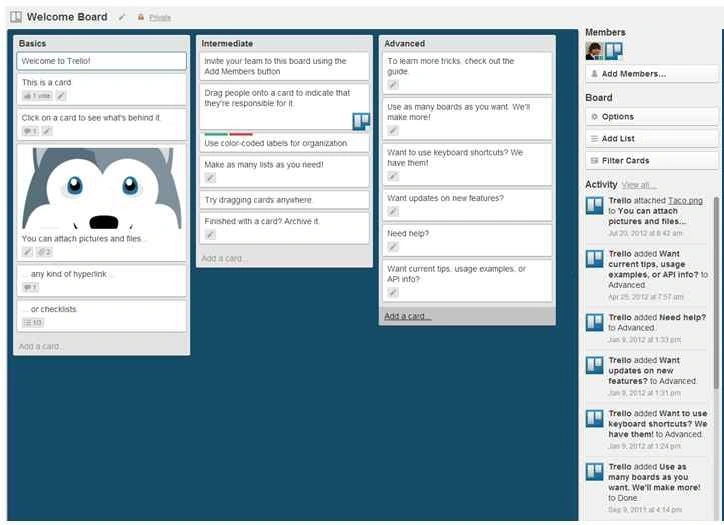
Trello easily eliminates those marker fumes and piles of crumpled-up Post-It notes in exchange for a very simple web application that allows its users to easily log in, create, update, assign and manage projects and tasks to which they are assigned. Some of the many benefits that it offers are as follows:
- Easy Access - Trello is easily accessible from the web and works in a responsive manner so it can easily be used on tablets and mobile devices as well. It supports drag-and-drop and uses inline-editing to make the interface very user-friendly.
- Free - Several Project Management suites out there offer similar functionality and a Kanbanequse area, however a large percentage of those are not free.
- Collaboration - A Role-based system allows a Project Manager or Administrator to assign tasks to specific users for projects. User’s access can be limited based on the Projects that they are assigned. The system also permits commits, notes and uploads to make collaborating easier.
- Notifications - Seamless notifications through the application will alert users when items have been assigned to them or tasks related to them have been updated, commented or moved.
- Eco-Friendly - Eliminates the need for those marker fumes and eventual piles of crumpled and discarded Post-It notes.
- Time Management and Accountability - By separating each of the stages of a Project, this allows users to see what their teammates are working on and when. Trello also time-stamps each action which creates a very basic audit trail which can be helpful if things go wrong.


Muhammad Aqib ShehzadPosted Nov 6, 2015, 4:48 AM
good share
Gowtham KPosted Oct 29, 2015, 1:35 PM
Thanks for sharing
Manoj KulkarniPosted Oct 29, 2015, 11:19 AM
After reading your article. I started to use it. Thank you for sharing.
Mahesh ChandPosted Oct 29, 2015, 7:14 AM
Love it. Thanks for sharing. Many developers do not know these tools. I use Trello, Basecamp, Asana and couple of other tools, depending on the client but Trello seems to provide more than those. Cheers!
Sibeesh VenuPosted Oct 29, 2015, 1:33 AM
I have used this. It was a great experience :)