

Abstract / Overview
LangChain Code is an open-source toolkit for building composable AI-driven applications using large language models (LLMs). Designed to streamline the process of connecting models, prompts, and data sources, LangChain simplifies retrieval-augmented generation (RAG), agent systems, and automated reasoning workflows.
The GitHub repository zamalali/langchain-code provides practical implementations of LangChain pipelines, showcasing how developers can rapidly prototype conversational agents, question-answering systems, and data-aware assistants using minimal code.
This article provides an end-to-end understanding of LangChain Code: architecture, core components, and integration methods, plus step-by-step examples for real-world AI projects.
Conceptual Background
LangChain emerged to bridge the gap between LLM capability and application usability. Instead of directly calling OpenAI or Hugging Face APIs, LangChain offers structured components:
Chains: Modular sequences combining prompts, models, and outputs.
Agents: Decision-making modules that use tools dynamically.
Memory: Context persistence for stateful conversations.
Retrievers: Interfaces for knowledge retrieval from vector databases.
Callbacks: Logging and event hooks for real-time monitoring.
The langchain-code project demonstrates these components in action — connecting models like GPT-4 with local tools, custom data, and APIs to create dynamic AI apps.
Step-by-Step Walkthrough
1. Installation
git clone https://github.com/zamalali/langchain-code.git
cd langchain-code
pip install -r requirements.txt
Requirements typically include:
langchainopenaichromadbtiktokenfaiss-cpudotenv
Create a .env file:
OPENAI_API_KEY=YOUR_API_KEY2. Basic Chain Example
A chain in LangChain connects an input prompt to an LLM, optionally enriched with data.
from langchain.llms import OpenAI
from langchain import PromptTemplate, LLMChain

prompt = PromptTemplate(
    input_variables=["topic"],
    template="Explain {topic} in simple terms."
)

llm = OpenAI(model_name="gpt-4")
chain = LLMChain(llm=llm, prompt=prompt)

print(chain.run(topic="quantum computing"))
This script constructs a simple query pipeline.
3. Using a Retriever (RAG Pattern)
Retrieval-Augmented Generation combines LLMs with vector databases for factual grounding.
from langchain.chains import RetrievalQA
from langchain.vectorstores import Chroma
from langchain.embeddings import OpenAIEmbeddings
from langchain.text_splitter import CharacterTextSplitter
from langchain.document_loaders import TextLoader

loader = TextLoader("docs/guide.txt")
documents = loader.load()

splitter = CharacterTextSplitter(chunk_size=1000, chunk_overlap=200)
texts = splitter.split_documents(documents)

embeddings = OpenAIEmbeddings()
db = Chroma.from_documents(texts, embeddings)

retriever = db.as_retriever()

qa_chain = RetrievalQA.from_chain_type(
    llm=OpenAI(model_name="gpt-4"),
    chain_type="stuff",
    retriever=retriever
)

print(qa_chain.run("What are the benefits of LangChain?"))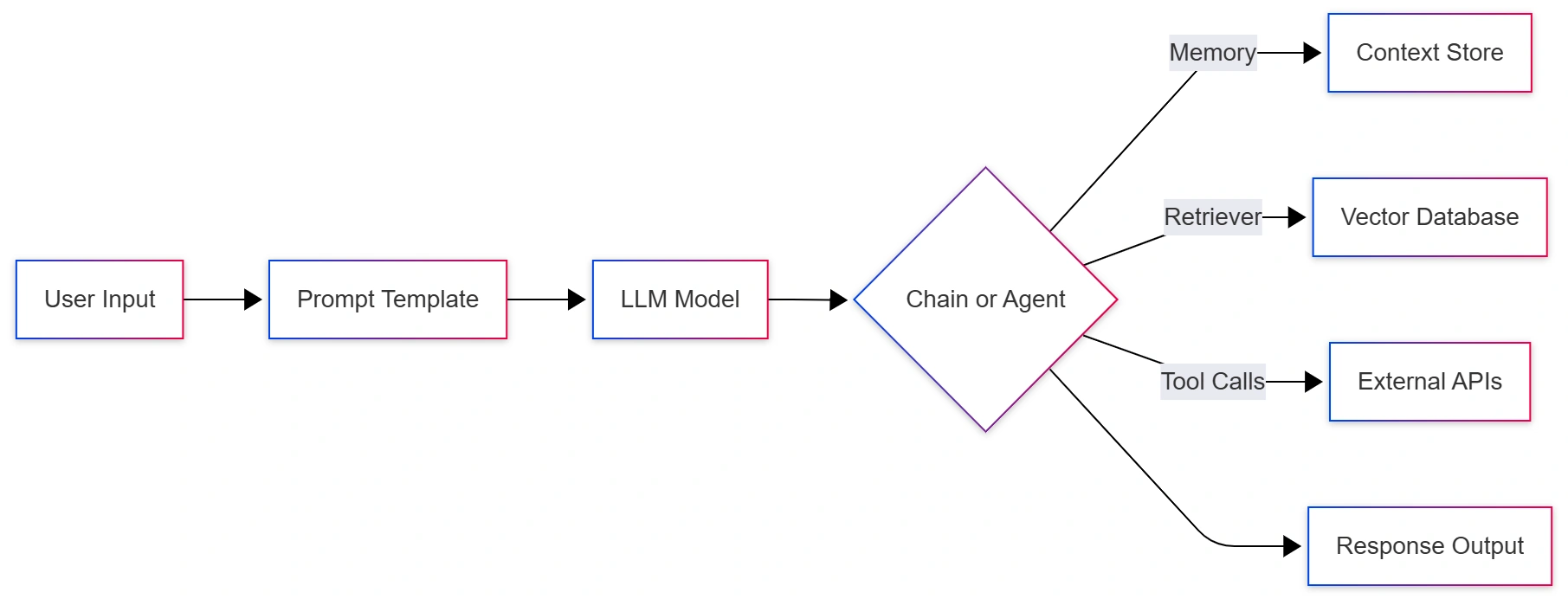
Join the conversation! Your thoughts help the community grow.