

🧱 Introduction
When building an enterprise-grade eCommerce backend, it’s not enough to just write working code — you need an architecture that scales, evolves, and remains maintainable over time.
In this lesson, we’ll deep dive into Clean Architecture, Layered Design, and the Separation of Concerns — three pillars that form the foundation of any production-ready system.
We’ll visualize the system using architecture diagrams and set the stage for scalable backend development before we move toward frontend integration.
🧱 Why Architecture Matters
In startups, architecture is often ignored — but in enterprise systems, it determines your application’s lifespan and stability. A poor architecture might work today, but will collapse under scaling, maintenance, or team expansion pressures.
A well-structured architecture helps you achieve:
✅ Scalability: handle more users, data, and requests
✅ Maintainability: new developers onboard easily
✅ Flexibility: integrate new technologies without breaking existing features
✅ Testability: independent layers make unit and integration testing simple
🧩 Clean Architecture — Simplified for Real-World Projects
Clean Architecture doesn’t mean overengineering.
It means organizing your system so business logic is independent from frameworks, databases, or external dependencies.
Here’s our simplified adaptation — practical, production-ready, and easy to maintain:
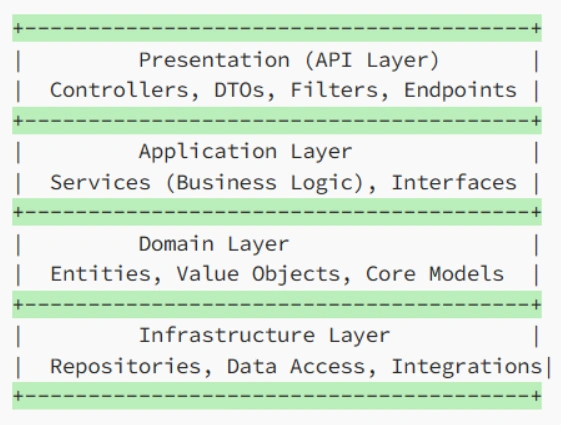
This approach keeps the essence of clean design — but fits naturally into real-world enterprise projects.
🏗️ Project Overview
🔹 Phase 1 — Backend (Core Focus)
This is our primary focus initially.
We’ll build:
ASP.NET Core 8 Web API
Application, Domain, and Infrastructure layers
Database integration with PostgreSQL (then SQL Server & MySQL)
Caching (Redis)
Messaging (RabbitMQ)
Logging & monitoring (Serilog, Seq)
CI/CD pipelines (Jenkins)
Cloud deployment setup (Azure or AWS)
Once this is stable and containerized, we’ll move to Phase 2.
🔹 Phase 2 — Frontend (After Backend Completion)
We’ll build the Ecomros Backoffice using Angular, which will:
Manage Products, Categories, Orders, and Users
Integrate directly with our production-ready API
Use shared DTOs and consistent response models
Be containerized with Nginx for deployment
Ecommerce Tech Stack
| Category | Technology |
|---|---|
| Backend | .NET 8, ASP.NET Core Web API |
| Databases | PostgreSQL (primary), SQL Server, MySQL |
| Caching | Redis |
| Messaging | RabbitMQ |
| Logging | Serilog + Seq |
| CI/CD | Jenkins |
| Containerization | Docker, Docker Compose |
| Deployment | Azure / AWS Cloud Services |
| Frontend (later) | Angular 20 |
Source Code Backend: https://github.com/farrukh1212cs/ECommerce-Backend.git
Source Code Frontend: https://github.com/farrukh1212cs/ECommerce-Frontend.git
🏁 Next Step
Start with Lesson 2A — Creating the base solution, API project, folder structure, dependency injection, environment configuration, where we’ll define the project structure, plan core modules, and prepare the development environment.
Join the conversation! Your thoughts help the community grow.