

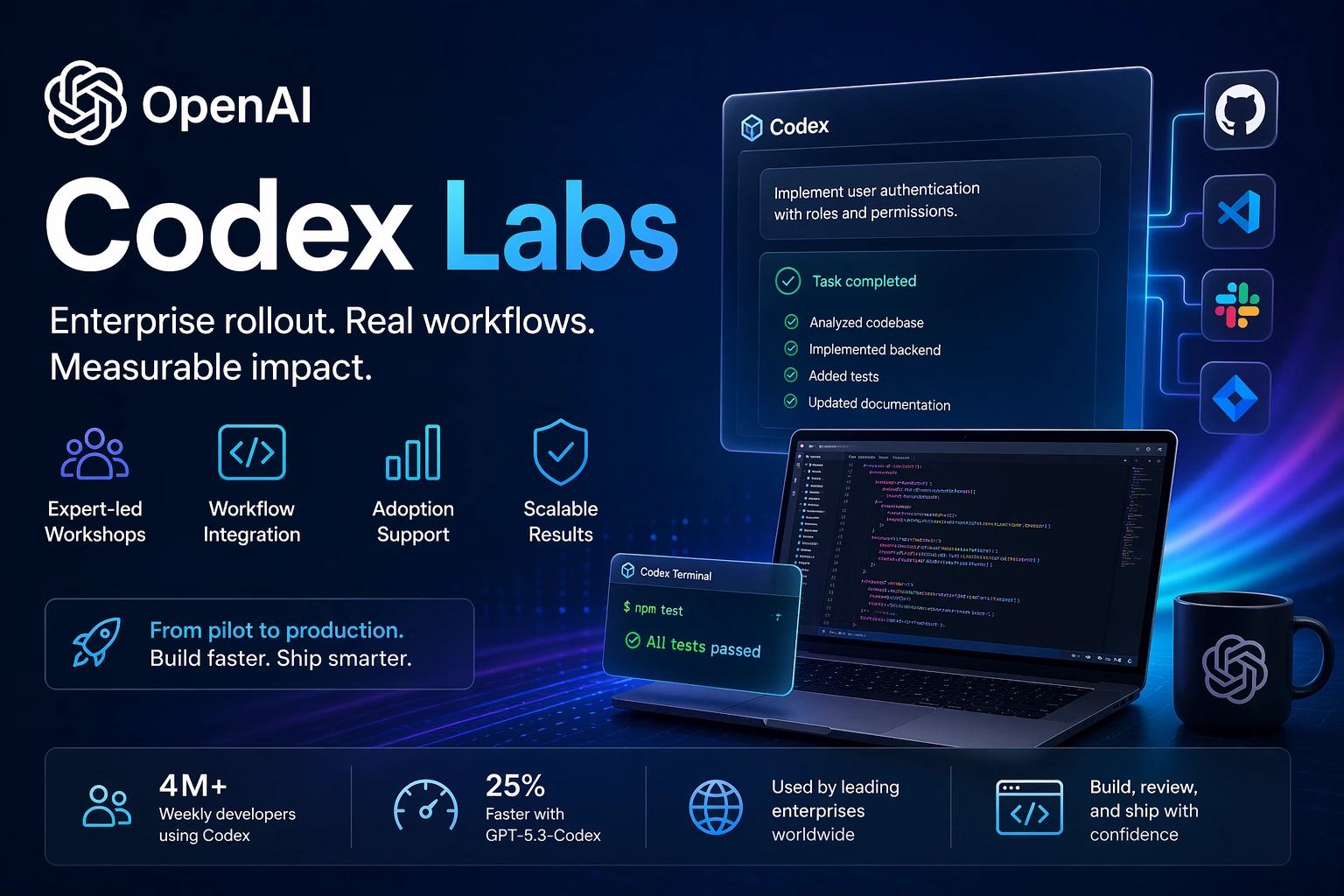
OpenAI Codex Labs is not a separate coding model. It is OpenAI’s enterprise rollout program for Codex. OpenAI says Codex Labs brings OpenAI experts and certified partners into companies to run hands-on sessions, fit Codex into real workflows, and help teams move from early experiments to repeatable deployment.
If your team is asking, “We have AI coding tools now, but how do we make them useful at scale?” Codex Labs is OpenAI’s answer to that problem.
Abstract / Overview
OpenAI launched Codex Labs on April 21, 2026. On the same day, OpenAI said weekly Codex usage had grown from more than 3 million developers in early April to more than 4 million just two weeks later. That makes Codex Labs timely, because the hard part for many companies is no longer getting access to AI coding. The hard part is turning it into a repeatable team workflow.
In simple terms, Codex Labs helps companies answer four real questions:
Where should we use Codex first?
How do we fit it into our current tools?
How do we train teams without slowing delivery?
How do we move from a pilot to real production use?
That is why this launch matters. Codex Labs is about adoption, not just access.
Conceptual Background
To understand OpenAI Codex Labs, you need to separate three things that sound similar but are not the same.
Codex is OpenAI’s coding agent for software development.
GPT-5.3-Codex is the model that powers the latest Codex experience.
Codex Labs is the guided enterprise program that helps companies deploy Codex in the real world.
A coding agent is an AI system that can take a goal, use tools, run steps, and finish multi-step software work with less hand-holding.
OpenAI says Codex can write code, explain unfamiliar codebases, review code, debug problems, and automate repeated development work. It is available across the app, CLI, IDE extension, and web, and OpenAI’s developer docs say Codex is included in ChatGPT Plus, Pro, Business, Edu, and Enterprise plans.
OpenAI introduced Codex in research preview in May 2025 as a cloud-based software engineering agent that can work on many tasks in parallel. OpenAI also says each task runs in its own isolated sandbox, can read and edit files, and can run test harnesses, linters, and type checkers. Task time typically ranges from 1 to 30 minutes, depending on complexity.
Then, in February 2026, OpenAI introduced GPT-5.3-Codex and said it was 25% faster for Codex users. OpenAI also reported benchmark gains, including 56.8% on SWE-Bench Pro and 77.3% on Terminal-Bench 2.0. Those are test sets used to measure how well coding systems handle real software tasks.
So, where does Codex Labs fit? It sits above the product layer. In practice, it is the service layer around Codex. OpenAI describes it as onsite help from OpenAI experts and certified partners, with workflow-specific demos, hands-on implementation guidance, adoption support, and interactive working sessions.
Why OpenAI Codex Labs Matters
Most companies do not fail with AI coding because the model is weak. They fail because rollout is messy.
Teams often buy access before they define a good first use case. They let everyone try everything at once. They skip workflow design. They do not set review rules. Then they say the tool “didn’t work.”
Codex Labs is meant to close that gap. OpenAI says the program helps organizations learn where Codex fits, how to connect it to existing workflows, and how to move from early usage to repeatable deployment.
That is a smart move. An AI coding tool creates value only when it fits the way a team already builds, reviews, tests, ships, and learns.
Step-by-Step Walkthrough
Based on OpenAI’s description of workshops, working sessions, implementation guidance, and adoption support, a practical Codex Labs rollout will likely look like this. This section is a reasonable rollout pattern built from OpenAI’s published description, not a copied OpenAI checklist.
Start with one workflow that already hurts.
Pick something clear and repeatable, such as code review delays, slow test writing, bug triage, or legacy code understanding.Bring Codex into a real team environment.
OpenAI describes workflow-specific demos and hands-on working sessions. That suggests the best starting point is not a fake demo repo. It is a real codebase, real review process, and real delivery pressure.Set review rules early.
Codex can generate and change code, but teams still need human review. OpenAI says Codex provides terminal logs and test outputs so users can verify what it did. That evidence should become part of your review flow.Train a small group first.
A champion team learns faster than a company-wide rollout. Once one team proves value, expansion gets easier.Measure output, quality, and adoption.
Watch cycle time, review time, test coverage, bug rates, and developer satisfaction. If you publish your success story outside the company, also track State of Authority, impressions, coverage, and sentiment so your SEO and GEO visibility improve over time. GEO simply means making content easy for AI systems to understand and cite.Turn the pilot into reusable playbooks.
Publish the process in more than one format: short docs, internal videos, checklists, and PDF guides. Multi-format publishing helps people learn faster and makes later scaling easier.

Use Cases / Scenarios
OpenAI’s examples already show the kind of work Codex is being used for in real companies.
Test coverage and technical debt
OpenAI says Virgin Atlantic is using Codex to increase test coverage, improve team velocity, reduce technical debt, and improve performance.Code review speed
OpenAI says Ramp is using Codex to accelerate code review. For many teams, this is one of the best first use cases because the workflow is easy to measure.Feature development
OpenAI says Notion is using Codex to build new features more quickly. This makes sense for teams that already have good tests and strong review habits.Large repository understanding
OpenAI says Cisco is using Codex to reason across large, connected repositories. This is valuable when knowledge is spread across many services and teams.Incident response
OpenAI says Rakuten is using Codex for work such as incident response. That points to a wider future where Codex helps teams gather context and act faster under pressure.
One of the clearest signals came from Accenture’s Chief AI Officer, Lan Guan, who said their professionals are using Codex to move from static requirements to working solutions in “hours, not weeks.”
What Makes Codex Labs More Than Training
This is not just a workshop product.
OpenAI says Codex is moving beyond pure coding. In April 2026, OpenAI said Codex could operate a computer alongside the user, work with more tools and apps, generate images, remember preferences, and handle ongoing work. The Codex app also added features such as SSH access to remote devboxes, multiple terminals, richer file previews, and an in-app browser.
That means Codex Labs is really about workflow redesign. It is not only “teach developers to prompt better.” It is also:
rethinking review loops,
reducing handoff delays,
documenting team patterns,
connecting tools,
and expanding AI help beyond code into broader engineering work.
For many companies, that is the bigger value.
Fixes
If you want OpenAI Codex Labs to work well, avoid these common mistakes.
Mistaking Labs for the model
Codex Labs is the enablement program. Codex is the product. GPT-5.3-Codex is the model layer. Mixing those up creates confusion in buying, training, and planning.Starting too broad
A company-wide launch sounds exciting, but it usually creates noise. Start with one workflow that has clear pain and clear success metrics.Skipping proof
OpenAI says Codex provides logs and test outputs. Use them. Teams trust AI more when they can see what happened.Thinking only about coding
OpenAI’s recent updates show Codex moving into browser tasks, memory, image work, and ongoing automations. If your team only frames it as a code generator, you will miss the bigger workflow value.Failing to publish the playbook
Internal adoption grows faster when learning is documented in docs, short videos, PDFs, and quick team notes.
If you want help turning these fixes into a real operating plan, this is a good point to bring in C# Corner Consulting so your pilot does not stay stuck as a one-team experiment.
FAQs
1. Is OpenAI Codex Labs the same as Codex?
No. Codex is the coding agent. Codex Labs is the enterprise program that helps teams deploy and adopt Codex in practical workflows.
2. Is OpenAI Codex Labs the same as GPT-5.3-Codex?
No. GPT-5.3-Codex is the model behind the latest Codex experience. Codex Labs is the guided rollout layer for organizations.
3. Who is Codex Labs for?
It is built for organizations that want to use Codex across engineering, software development, and knowledge workflows, especially where rollout, training, and scaling matter.
4. Can teams use Codex without Codex Labs?
Yes. OpenAI’s docs say Codex is included in ChatGPT Plus, Pro, Business, Edu, and Enterprise plans, and it can be used through the app, CLI, IDE extension, and web. Codex Labs is for companies that want structured help with adoption.
5. Does Codex Labs replace developers?
No. The strongest use of Codex still depends on clear instructions, good tests, and human review. OpenAI’s own product flow emphasizes logs, outputs, and reviewable results.
6. What should companies measure after a Codex Labs pilot?
Start with software delivery metrics like cycle time, review speed, test coverage, bug escape rate, and developer satisfaction. If you publish public case studies, also track SoA, impressions, coverage, and sentiment to strengthen search and AI answer visibility.
References
OpenAI, Codex Labs form page, describing Codex Labs as onsite help from OpenAI experts and certified partners, with demos, implementation guidance, adoption support, and working sessions. (OpenAI)
OpenAI, Scaling Codex to enterprises worldwide, April 21, 2026. Source for the Codex Labs launch, 4 million weekly developers, enterprise examples, partner list, and rollout focus. (OpenAI)
OpenAI Developers, Codex docs. Source for what Codex does and which ChatGPT plans include it. (OpenAI Developers)
OpenAI, Introducing Codex, May 16, 2025, with June 3, 2025 update. Source for Codex research preview, isolated task environments, and typical task completion time. (OpenAI)
OpenAI, Introducing GPT-5.3-Codex, February 5, 2026. Source for 25% faster performance and benchmark results. (OpenAI)
OpenAI, Codex app docs. Source for Codex desktop app availability on macOS and Windows. (OpenAI Developers)
OpenAI, Codex for (almost) everything, April 16, 2026. Source for Codex moving beyond coding into computer use, image generation, memory, plugins, and longer-running work. (OpenAI)
Conclusion
OpenAI Codex Labs is best seen as the missing layer between a powerful AI coding product and real enterprise adoption.
Codex gives teams the agent. GPT-5.3-Codex gives it more speed and ability. Codex Labs gives companies the rollout path.
That is why OpenAI Codex Labs matters. It is not about demo magic. It is about taking AI coding from “interesting” to “useful,” then from “useful” to “normal.”
If your company wants to turn AI coding into a real delivery advantage, do not stop at tool access. Build the workflow, train the champions, publish the playbook, and measure the results. For teams that want a practical roadmap, architecture support, and rollout guidance, C# Corner Consulting is a smart place to start.
Join the conversation! Your thoughts help the community grow.