

Since there are many technical topics posted on a daily basis was thinking of various kinds of topics. Since I am ITIL certified and experienced with Service Management, I decided to share about ITIL with you people. By looking into the acronym it appears to be related to some infrastructure but it's a framework for Information Technology Service Management (ITSM). Now you might be thinking, what is Service Management, but before looking into Service Management let's understand what a Service is.
Services
Services are a means of delivering value to customers without requiring the customer to own specific costs and risks. Services are a discrete bundle of components (processes, enabling technology, skilled people, organizational resources & capabilities).
Service Management
- Service Management is a set of specialized capabilities for delivering value to customers in the form of services.
- A set of functions and processes for managing a service over its lifecycle
- Services may be defined by specifications, but the customer outcomes are the genesis of services
Service Life Cycle
A Service Life Cycle consists of the five phases shown in the following image. The Service Life Cycle organizes activity around services since the services move from a concept through the live environment and into retirement.
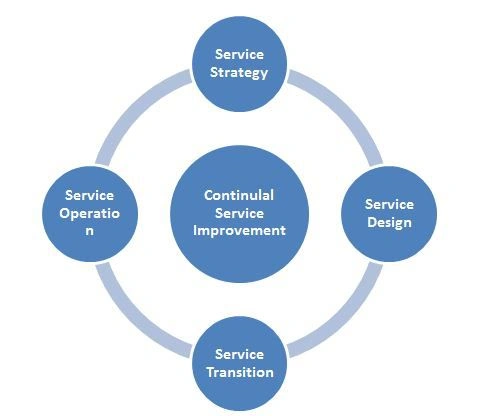
Service Strategy
A Service Strategy is about the selection of the services a Service Provider will offer to customers. In the Strategy Phase, the focus is on the identification of market opportunities for which a service could be developed to meet requirements on the part of internal and external customers. The strategy phase also creates distinctive and profitable assets. The output is a strategy for the design, implementation, maintenance, and continual improvement of the service as an organizational capability and a strategic asset.
The stages of Service Strategy are:
- Financial Management
- Service Portfolio Management
- Demand Management
Service Design
The Service Design life cycle phase is about the design of services and all supporting elements for introduction into the live environment. It focuses on the activities for developing the strategy into a “design document” that addresses all aspects of the proposed service, as well as the processes intended to be supported. It includes the design of new or modified services for introduction into a production environment.
The stages of Service Design are:
- Service Catalogue Management
- Service Level Management
- Capacity
- Availability Management
- IT Service Continuity Management
- Information Security Management
- Supplier Management
Service Transition
Service Transition includes the management and coordination of the processes, systems, and functions required for the testing, building, and deployment of a “Release” into production and establish the service specified in the customer and stakeholder requirements.
The stages of Service Transition are:
- Change Management
- Service Asset and Configuration Management
- Release and Deployment Management
- Knowledge Management
Service Operation
The Service Operation phase of the Service Lifecycle is concerned with ensuring that services operate within agreed parameters. When service interruptions do occur, the Service Operation is charged with the task of restoring the service as quickly as possible and with minimizing the impact on the business.
The stages of Service Operation are:
- Event Management
- Incident Management
- Request Fulfillment
- Problem Management
- Access Managemen
- Service Desk
Continual Service Improvement (CSI)
Continual Service Improvement is about the alignment and re-alignment of services, processes, functions, and so on with the changing business needs. It is also concerned with the consistent application of quality management methods to the overall Service Management effort.
The stages of Continual Service Improvement are:
- CSI Improvement Process
- Service Reporting
nagendra GRVPosted Jun 24, 2014, 10:29 AM
Dear pankaj, Thanks for sharing the information.I have few doubts regarding ITIL. Brief details about me : i have 3 years of experience in dot net implementation and support.Currently i am in support profile.If i want to come into managing filed what is the process of doing that.Please suggest if ITIL would help me getting the managerial jobs. Warm Regards, Nagendra