

Introduction
Modern web applications power banking, healthcare, education, e-commerce, and enterprise systems. But as applications grow, so do security threats.
Most data breaches don’t happen because of advanced hacking —they happen because of basic security mistakes in code.
To help developers avoid these mistakes, a global organization called OWASP publishes the industry-standard list of critical web application risks.
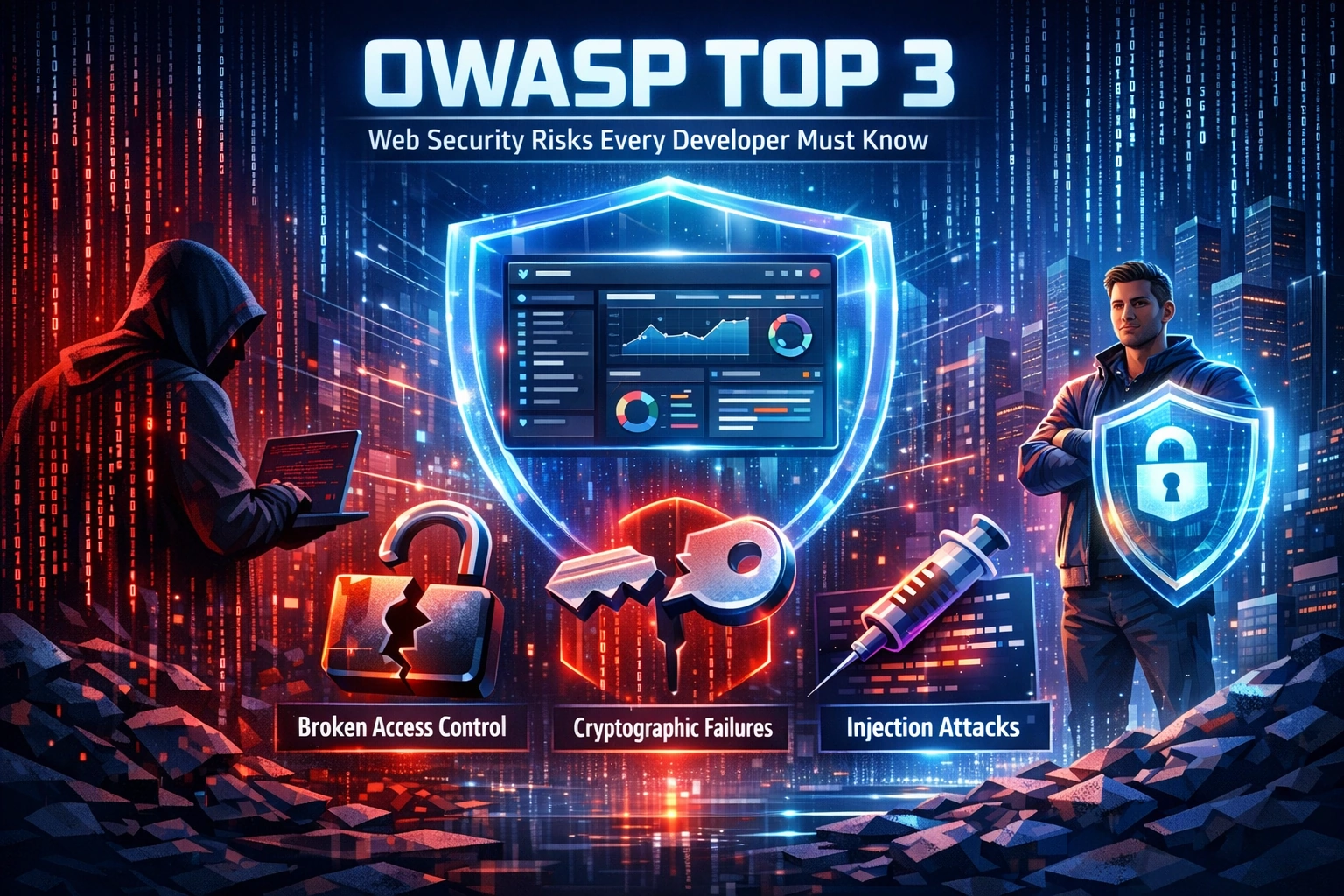
Among them, the OWASP Top 3 cause the majority of real-world security incidents.
For developers in India and across the global tech industry, understanding these risks is now a fundamental professional skill.
What Is OWASP?
OWASP stands for Open Web Application Security Project.
It is a global non-profit organization that:
Researches web security vulnerabilities
Defines security best practices
Publishes the OWASP Top 10 risk list
Guides developers on secure coding standards
Enterprises, startups, and government systems worldwide use OWASP as a security benchmark.
Risk 1: Broken Access Control
Broken Access Control happens when:
Users gain access to features they shouldn’t
Unauthorized users reach admin panels
Sensitive data becomes visible to the wrong person
Example:
A normal user changes a URL and accesses an admin page.
Impact:
Data leaks
Account takeovers
Full system compromise
How to prevent it:
Implement role-based access control
Always validate permissions on the server
Never trust frontend-only security
Broken Access Control is currently the most exploited web vulnerability worldwide.
Risk 2: Cryptographic Failures
Cryptographic Failures occur when sensitive data is:
Stored without encryption
Encrypted using outdated algorithms
Transmitted without secure protocols
Example:
Storing passwords in plain text or using weak hashing.
Impact:
Password leaks
Identity theft
Regulatory compliance violations
How to prevent it:
Use strong hashing (bcrypt, Argon2)
Use HTTPS everywhere
Encrypt sensitive stored data
Never store passwords in readable form
As India and global markets adopt digital payments and identity systems, cryptographic security has become business-critical.
Risk 3: Injection Attacks
Injection vulnerabilities happen when:
User input is directly used in database queries
Input is not validated or sanitized
Most known example:
SQL Injection.
Impact:
Full database access
Data manipulation
System takeover
How to prevent it:
Use parameterized queries
Use ORM frameworks
Validate and sanitize user input
Injection attacks remain one of the fastest ways attackers breach web systems.
Why Developers Must Take OWASP Seriously
Every modern developer builds:
APIs
Web applications
Cloud-based services
Mobile backends
Security is no longer a “later-stage” task.
It is part of professional software responsibility.
A single overlooked vulnerability can:
Expose millions of users
Destroy company trust
Lead to legal and financial loss
Secure coding is now a career-defining skill.
India and Global Demand for Secure Developers
India’s software industry is expanding rapidly in:
Fintech
E-commerce
Health-tech
SaaS products
Globally, companies are investing heavily in:
Cybersecurity compliance
Secure cloud infrastructure
Data protection frameworks
Developers who understand OWASP standards gain:
Higher employability
Better global project opportunities
Trust in enterprise development roles
Final Thoughts
Web security is not about hacking tools.
It is about writing responsible code.
By understanding just these three OWASP risks, developers already eliminate the majority of real-world attack vectors.
Secure code is professional code.
For developers in India and worldwide, mastering OWASP principles today means building safer, future-ready software tomorrow.
Join the conversation! Your thoughts help the community grow.