
Introduction
Pattern matching is idiomatic in functional programming. It's an important tool in F# programming, general constructs that combines decompositions and control. Pattern matching provides a concise but clear and highly expressive way of writing conditional logic. Pattern matching allows you to look at the values of an identifier and then make different computations depending on its value. Pattern matching is like a switch statement in C and C# but its more powerful and flexible than a switch statement.
Pattern matching is used for control flow, it allows a programmer to look at a value, test it against a series of conditions and perform certain computations depending on whether that condition is met. While pattern matching is conceptually the same as a series of If-then statements in other languages, pattern matching is used to test whether the piece under test has a desired state, find relevant information or substitute parts with other parts. Programs that are written in the functional style tend to be written as a series of transformations applied to the input data.
Pattern matching allows you to analyze the input data and decide which transformation is to be applied to it. Essentially pattern matching takes an input and a set of rules. Each rules tests the input against a pattern and returns a result if they match. If you want to use pattern matching with explicit values, you can use the match and with keywords. This allows you to match with a particular parameter with some conditions. So for just starting out in F# it's important to know your way around patterns and pattern matching.
Syntax for Pattern Matching
//Syntax for Pattern Matching
match expr with
| pat1 -> result1
| pat2 -> result2
| pat3 when expr2 -> result3
| _ -> defaultResult
In the above syntax every (|) defines a condition and the symbol (->) means "if the given condition is true, return the value" and the symbol (_) means it matches with everything as it's the default pattern.
Match Expression
The match expression is introduced by the keyword match, followed by the expression to be matched, followed by the with keyword. Every condition is then written on a separate line, beginning with (|) and indented until the match keyword. Match is an expression not a statement like switch. In F# match conditions are not values, they are patterns. Constant values like 1, 2 and 3 are simple patterns. It also contains some other patterns like a Wildcard Pattern represented by an Underscore. When a match expression is evaluated it runs through the list of conditions checking the arguments matches with a given pattern.
Pattern Matching Example
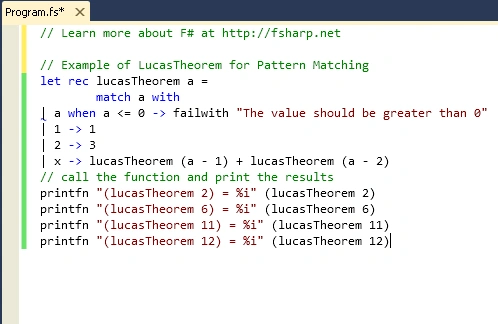
// Example of LucasTheorem for Pattern Matching
let rec lucasTheorem a =
match a with
| a when a <= 0 -> failwith "The value should be greater than 0"
| 1 -> 1
| 2 -> 3
| x -> lucasTheorem (a - 1) + lucasTheorem (a - 2)
// call the function and print the results
printfn "(lucasTheorem 2) = %i" (lucasTheorem 2)
printfn "(lucasTheorem 6) = %i" (lucasTheorem 6)
printfn "(lucasTheorem 11) = %i" (lucasTheorem 11)
printfn "(lucasTheorem 12) = %i" (lucasTheorem 12)
Output-
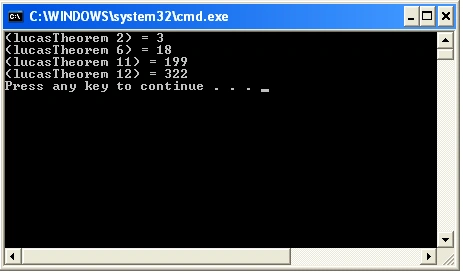
In the above example the second two cases are literals; the values 1 and 2 and these will be replaced with the values 1 and 3 respectively. The fourth case will match any value of x greater than 2 and this will call two further calls to the lucasAlgorithm function.
The rules are matched in the order they are defined, and the compiler will issue an error if pattern matching is incomplete, that is if any possible value that will not match with any value.
Different Ways to form Pattern
| General Form | Type | Example |
| [| pat; ...;pat |] | Array Pattern | [|"cmd"; arg1; arg2 |] |
| pat & pat | "And" pattern | [p] [point(a,b)] |
| {id=pat; ...; id=pat} | Record pattern | {a=1; b=2} |
| [pat; ...;pat] | List pattern | [a;b;c] |
| pat | pat | "Or" pattern | [a] | ["A";a] |
| (pat, ... ,pat) | Tuple pattern | (1,2("3",a)) |
| Null | Null test Pattern | Null |
| id | Variable Pattern | A |
| Any literal | Constant Pattern | 30, "30", 20L, Sysem.DayOfWeek.Monday |
| pat as id | Named Pattern | [a] as inp |
| Tag(pat, ...,pat) | Tagged union or active Pattern | point(a,b) |
| _ | Wildcard Pattern | _ |
| :? Type | Type test Pattern | :? string |
Sam HobbsPosted Jul 18, 2011, 9:51 PM
I had difficulty understanding your first paragraph. I tried to fix the punctuation. So I searched the inernet and found http://books.google.com/books?id=y3kaQxIns0oC&printsec=frontcover Portions of your first paragraph match what is in page 50 in that book. I also found http://hestia.typepad.com/flatlander/2010/07/f-pattern-matching-for-beginners-part-1-getting-started.html Portions of your first paragraph match what is in that article. So I used those to help me determine what you meant to say in your first paragraph and I apologize if I got it wrong.
Sam HobbsPosted Jul 18, 2011, 9:44 PM
How does pattern matching in F# compare to regular expressions? Is F# patterns anything like Backus–Naur Form (BNF)? I think it would be very interesting to know how F# patterns compare to those used in the "String Oriented Symbolic Language" SNOBOL of fifty years ago. For the benefit of others, note that there is a difference between Pattern Matching and Pattern Recognition. Pattern Recognition is an Artificial Intelligence thing and can be very complex.