

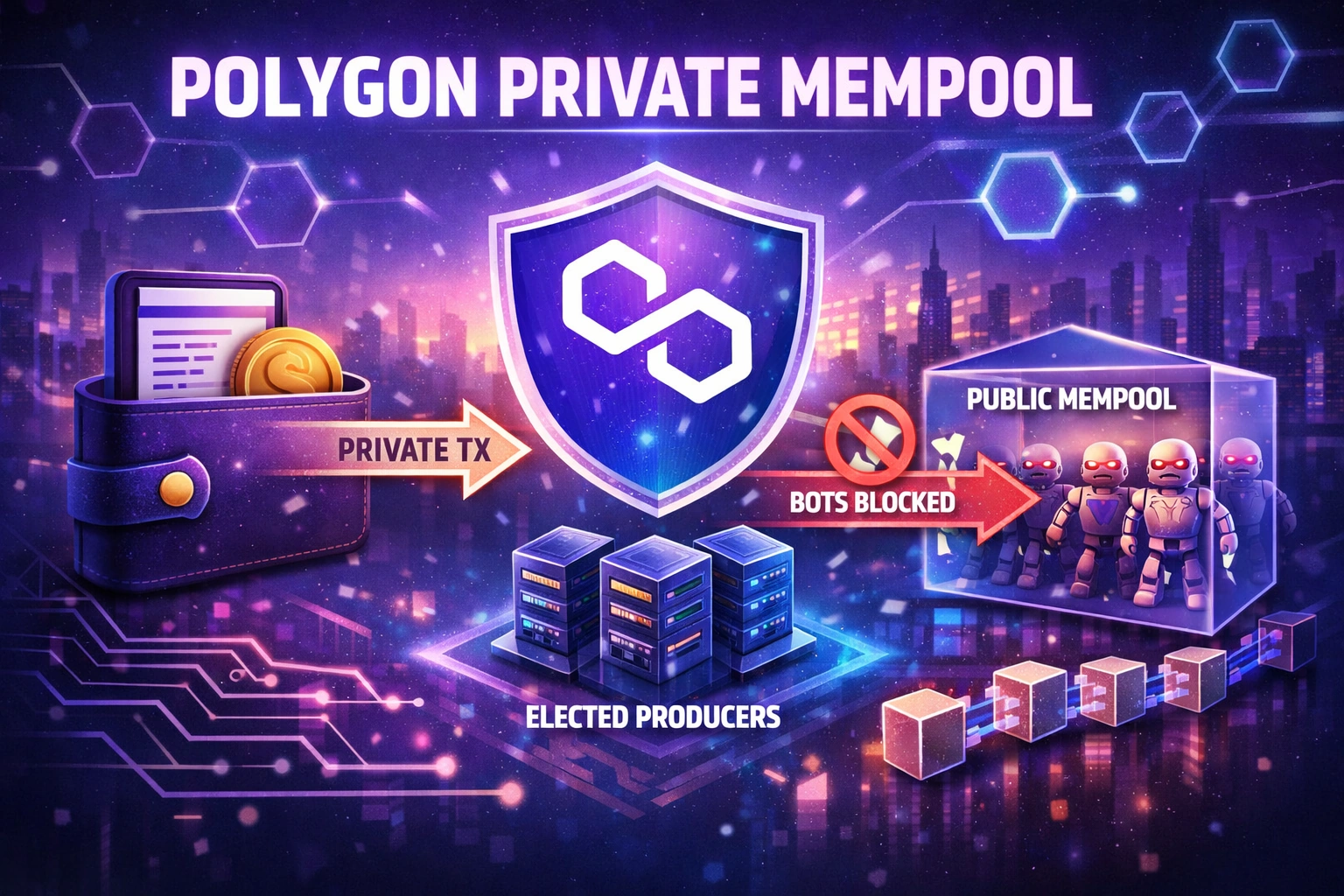
Polygon Private Mempool is a new private transaction submission path on the Polygon Chain. It is built to stop bots from seeing pending transactions in the public mempool and jumping ahead of them. Polygon launched it on April 2, 2026, and says teams can start with a simple write-RPC change while keeping reads on their current provider.
This guide treats the user phrase “memepool” as “mempool,” which is the standard blockchain term.
Abstract / Overview
A mempool is the waiting room for pending transactions. On public chains, bots can watch that waiting room, copy valuable trades, pay more gas, and get in first. Ethereum’s own docs explain that MEV comes from changing transaction order, and that generalized frontrunners watch the mempool for profitable transactions.
Polygon’s answer is a private submission endpoint. Instead of broadcasting a write transaction into the public mempool, the transaction goes straight to elected block producers. Polygon says this protects transactions from frontrunning and sandwich attacks, and that integration can be as simple as swapping one RPC URL for transaction submission.
As of April 4, 2026, this matters because Polygon positions the feature as live now, with a free tier for all Polygon apps and paid enterprise tiers for higher throughput, rate limits, SLAs, and redundancy.
Conceptual Background
What is a mempool?
A mempool is the pool of pending transactions that nodes have heard about but have not yet put into a block. Ethereum describes this flow clearly: a signed transaction is added to a local mempool and broadcast to other nodes, which also add it to their local mempools.
What is MEV?
MEV stands for maximal extractable value. Ethereum defines it as the extra value that can be extracted by including, excluding, or reordering transactions in a block. In plain language, it is the money someone can make because they can act on your pending transaction before it lands.
Why does a private mempool help?
Because the attack starts with visibility. Ethereum’s docs say generalized frontrunners watch the mempool for profitable transactions. Flashbots explains the same idea from the protection side: private transaction systems work by hiding transactions from the public mempool.
Polygon says its private mempool sends transactions directly to elected producers under its VeBloP model, bypassing the public mempool entirely. That means arbitrage bots do not see the pending transaction before inclusion.
Polygon sums up the market shift well: “MEV protection is now table stakes.”
Flashbots says it even more simply: “Transactions are hidden from the public mempool away from front-running and sandwich bots.”
Why Polygon is pushing this now
Polygon is building hard for payments and predictable settlement. In official materials, Polygon says Polygon Chain settles in less than two seconds, average fees are about $0.002, and the network has processed more than $2.3 trillion in stablecoin volume.
Those numbers matter because private transaction routing is most useful when transaction order and reliability matter, such as swaps, payments, treasury moves, and tokenized asset flows. Polygon says that is exactly the target.
Step-by-Step Walkthrough
Step 1: Keep your current read RPC
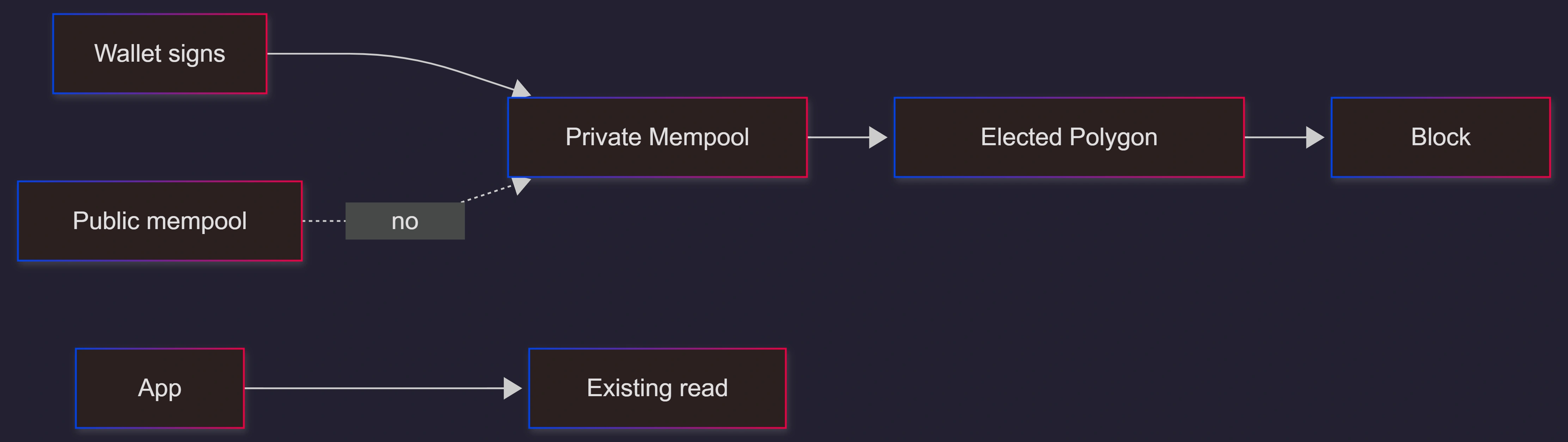
Polygon says the private mempool endpoint is for transaction submission. Read operations should continue through your existing RPC providers. That means you do not need to move every call. You mainly split read traffic from write traffic.
Step 2: Move writes to the private endpoint
Polygon says the basic setup is a one-line integration: swap your transaction submission RPC endpoint to Polygon’s Private Mempool. The official announcement also says full integration docs and endpoint configuration are available in the Polygon docs.
Step 3: Test order-sensitive actions first
Start with actions that are easiest to attack on a public mempool. Good first candidates are large swaps, high-value transfers, treasury movements, auction actions, and approval or authorization changes where transaction order matters. Polygon specifically mentions trading, payments, auctions, Polymarket authorization revocations, and Courtyard’s need for reliable inclusion.
Step 4: Roll out behind a feature flag
Do not flip every write path at once. Route a small slice of transactions first. Track confirmation time, revert rate, stuck transaction rate, and user support tickets. This rollout advice is a best practice based on how private RPC systems change submission flow.
Step 5: Document the split clearly
Your team should know one simple rule: reads go to the standard provider, writes go to the private provider. This avoids accidental misrouting and keeps debugging clean.
Minimal example
The exact endpoint and auth details depend on Polygon’s current docs and plan. The pattern below shows the setup shape.
import { ethers } from "ethers";

const readProvider = new ethers.JsonRpcProvider(process.env.POLYGON_READ_RPC);
const writeProvider = new ethers.JsonRpcProvider(process.env.POLYGON_PRIVATE_MEMPOOL_RPC);

const wallet = new ethers.Wallet(process.env.SIGNER_KEY, writeProvider);

// reads
const balance = await readProvider.getBalance(wallet.address);

// writes
const tx = await wallet.sendTransaction({
  to: "0xYourRecipientAddress",
  value: ethers.parseEther("0.01")
});

console.log(tx.hash);
If your team wants help with RPC split design, wallet flow changes, monitoring, and production rollout, talk to C# Corner Consulting.
Use Cases / Scenarios
DEX swaps
Large swaps are classic MEV targets. Ethereum’s docs explain how sandwich trading works by watching the mempool for large DEX trades. A private submission path reduces that visibility window.
Payments and treasury flows
If a business cares about predictable arrival and reduced interference, a private route makes sense. Polygon says MEV protection belongs on the same checklist as finality, throughput, and fee stability for cross-border payments, payroll, treasury operations, and tokenized asset workflows.
Order-sensitive product actions
Polygon says the bigger value applies anywhere transaction order matters: trading, payments, auctions, and any interaction where the expected result depends on the submitted order staying intact.
Enterprise apps that need reliability
Polygon says the free tier is open to all apps, while paid tiers add higher throughput, rate limits, SLAs, and redundancy for production workloads. That makes the product relevant for both startups and enterprise teams.
Fixes
Fix: You moved reads and writes to the same private endpoint
Do not do that by default. Polygon says read operations should stay on your existing providers. Use the private endpoint for transaction submission.
Fix: Your wallet or app may leak a transaction back to a public path
This is a general rollout risk for private RPC systems. Flashbots warns that MetaMask can resend a transaction to the public mempool if the RPC is switched before confirmation. The lesson is simple: audit wallet failover, resend rules, and provider switching before shipping.
Fix: You need scale and support details before going live
Polygon says paid enterprise tiers include higher throughput, rate limits, SLAs, and redundancy. Use those when a free-tier test turns into a production requirement.
Fix: You cannot find the exact public endpoint right away
Polygon’s announcement says full docs and endpoint configuration are available, and Polygon also has a request-access page for Private Mempool. Use those official channels for the current endpoint and access model.
FAQs
1. Is Polygon Private Mempool live?
Yes. Polygon announced it on April 2, 2026, and says it is live now.
2. Do I need to replace my whole RPC stack?
No. Polygon says only transaction submission needs the private endpoint. Reads should continue through existing providers.
3. Is it only for enterprise teams?
No. Polygon says it launches with a free tier open to all Polygon apps. Enterprise tiers add more production features.
4. What problem does it solve best?
It is built for frontrunning and sandwich-attack protection, especially where transaction ordering matters.
5. Is this the same as making the whole blockchain private?
No. This is about private transaction submission before inclusion, not about turning Polygon into a fully private chain. That distinction follows from Polygon’s description of a private submission endpoint and standard block inclusion flow.
6. What should teams publish after they integrate it?
Publish short docs, an FAQ, a simple diagram, a quick demo video, and a troubleshooting page. Multi-format publishing helps both humans and AI systems understand your implementation. Track Share of Answer, citation impressions, engine coverage, and sentiment if you want your brand and docs to show up well in AI-generated answers.
References
Polygon Labs, “Polygon Launches Private Mempool: MEV Protection Is Now a One-Line Integration.” (Polygon Labs)
Polygon Labs, “Unrolling the ‘Stack’ in Polygon’s Open Money Stack.” (Polygon Labs)
Polygon Docs homepage. (Polygon Docs)
Polygon Labs, Private Mempool access page. (Polygon Labs)
Ethereum.org, “Maximal extractable value (MEV).” (ethereum.org)
Ethereum.org, “Proof-of-stake (PoS).” (ethereum.org)
Flashbots Docs, “Quick Start” for Flashbots Protect. (Flashbots Docs)
Uploaded background guide: GEO Guide.
Conclusion
Polygon Private Mempool is a practical new tool for safer writes on Polygon. The big idea is simple: keep reads where they are, route writes through the private path, and reduce the chance that bots see and exploit pending transactions before inclusion.
For teams building swaps, payments, auctions, or any order-sensitive workflow, this is one of the most useful Polygon changes announced in 2026 so far. Start small, test carefully, document the read/write split, and expand once your data shows better execution quality and fewer support problems.
Join the conversation! Your thoughts help the community grow.