

Pre-requisites to understand this
Message Queue: A buffer that stores messages until they are processed
Producer: The component that sends messages/events
Consumer: The component that receives and processes messages
Broker: Middleware that manages message storage and delivery
Topic/Queue: Logical channel where messages are stored
Partitioning: Splitting data for scalability and parallel processing
Offset: Position of a message in a stream (used in Kafka)
Acknowledgment (ACK): Confirmation that a message was processed
Introduction
RabbitMQ is a traditional message broker designed to route and deliver messages reliably between producers and consumers using queues. It emphasizes flexible routing, acknowledgments, and message delivery guarantees.
Apache Kafka is a distributed event streaming platform built for handling large scale real time data streams. It focuses on high throughput, persistent storage, and allowing consumers to replay events.
RabbitMQ Architecture
In RabbitMQ, the producer sends messages to an exchange rather than directly to a queue. The exchange acts as a routing mechanism, deciding how messages should be distributed to one or more queues based on rules like routing keys or patterns. Queues temporarily store messages until consumers are ready to process them. Consumers receive messages pushed from queues and acknowledge them after processing. If acknowledgment is not received, messages can be retried or requeued. This architecture provides flexibility in routing and ensures reliable delivery. RabbitMQ is particularly effective for systems requiring complex message routing and transactional processing.
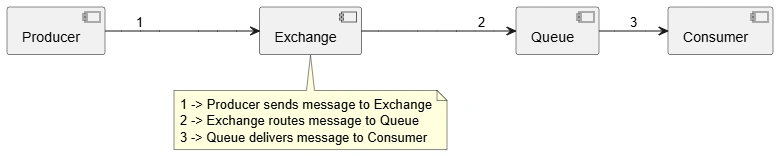
Exchange handles routing logic
Supports multiple exchange types (direct, topic, fanout)
Push-based message delivery
Messages removed after consumption (default)
Strong reliability with ACK and retries
Ideal for task queues and microservices
Kafka Architecture
In Kafka, producers send events to brokers, which store them in topics divided into partitions for scalability. Each message is assigned an offset, allowing consumers to track their reading position. Unlike RabbitMQ, Kafka does not push messages; consumers pull them at their own pace. Messages are retained for a configurable period, enabling replay and event sourcing. This design makes Kafka highly scalable and fault-tolerant. It is optimized for sequential disk writes and distributed processing. Kafka is best suited for streaming data pipelines and real-time analytics systems.
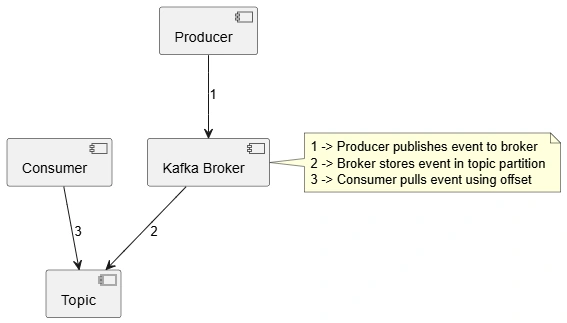
Distributed broker-based architecture
Topics split into partitions for scalability
Pull-based consumption model
Messages retained for replay
High throughput and fault tolerance
Ideal for event streaming and big data
Join the conversation! Your thoughts help the community grow.