

What is CTE?
CTE stands for Common Table Expressions.
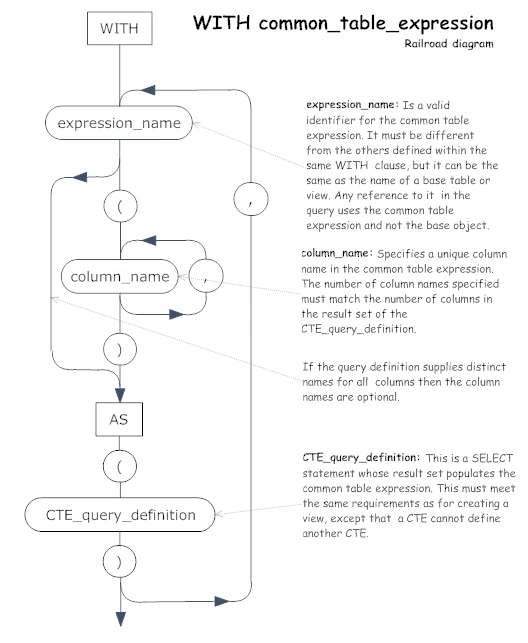
We define CTEs by adding a "WITH" clause directly before our SELECT, INSERT, UPDATE, DELETE, or MERGE statement. The WITH clause can include one or more CTEs, as shown in the following syntax.
- [WITH <common_table_expression> [,...]]
- <common_table_expression>::=
- cte_name [(column_name [,...])]
- AS (cte_query)
This can be represented like this…
So now, we have come to our main point, i.e., how to remove duplicated rows. Suppose, we have a table called CV_tbl which holds Chk_ID and Cv_ID. The table may contain records like this.
| Chk_Id | Cv_ID |
| 1 | 11 |
| 2 | 12 |
| 3 | 13 |
| 1 | 11 |
| 1 | 11 |
| 3 | 13 |
Now, we want to select only one distinct pair. Let's see how we can do that.
Take a look at the SQL code below.
- With DataCte as
- (select *, RANK( )
- over(partition By Chk_Id, Cv_Id order by Chk_Id) as rnk from CV_tbl )
- select * from DataCte
In the above SQL, DataCte is the CTE expression which acts as a temporary View. In the query definition, we are using RANK function and partitioning the table rows with Chk_ID and Cv_ID to assign an occurrence number to each pair. The query will return a result as below.
| Chk_Id | Cv_ID | rnk |
| 1 | 11 | 1 |
| 1 | 11 | 2 |
| 1 | 11 | 3 |
| 2 | 12 | 1 |
| 3 | 13 | 1 |
| 3 | 13 | 2 |
Now, instead of the final SELECT query, we can delete the rows from our temporary result set which has rnk > 1.
- With DataCte as
- (select *, RANK( )
- over(partition By Chk_Id, Cv_Id order by Chk_Id) as rnk from CV_tbl )
- select * from DataCte where rnk =1
Result of the above query.
| Chk_ID | Cv_ID | rnk |
| 1 | 11 | 1 |
| 2 | 12 | 1 |
| 3 | 13 | 1 |
This will just select only one occurrence of each Chk_ID and Cv_ID pair from the CV_tbl table.
Hadshana KamalanathanPosted Jul 15, 2018, 8:37 PM
Thank you for sharing
Manav PandyaPosted Dec 12, 2017, 8:02 AM
Nice one ....................
Rohan PatidarPosted Dec 11, 2017, 10:47 PM
Good for beginners ....