

Introduction
Before reading this article, I highly recommend reading the following previous parts:
- Introduction to JavaScript: Day 1
- Programming Basics in JavaScript: Day 2
- Comments and Objects in JavaScript: Day 3
Scope in JavaScript
The scope defines the accessibility of a variable, objects, and function. It is nothing but the boundary line. There are only two types of scope present in JavaScript as follows:
- Local Scope in JavaScript
- Global Scope in Script
Local Scope in JavaScript
- <!DOCTYPE html>
- <html>
- <title>Scope in JavaScript</title>
- <head></head>
- <body>
- <script language='javascript'>
- AuthorName();
- document.write("</br>Outside the function</br>");
- //can not access the author variable to outside
- document.write("</br>Author is " + typeof author);
- document.write();
- function AuthorName() {
- //local variable declaration means local scope
- var author = "Jeetendra";
- document.write("</br>Inside the function </br>Author is " + author + "</br>");
- }
- </script>
- </body>
- </html>
Output
Inside the function
Author is undefined
Author is Jeetendra
Outside the function
In the preceding, you observe that I used one keyword typeof. It returns the type of JavaScript variable. The following example clarifies the concept of typeof in JavaScript.
Example
- <!DOCTYPE html>
- <html>
- <title>typeof in JavaScript</title>
- <head></head>
- <body>
- <script language='javascript'>
- document.write("</br><b>typeof</b> in JavaScript</br>");
- document.write("</br>" + typeof "Jeetendra" + "<br>" +
- typeof 3.14 + "<br>" +
- typeof true + "<br>" +
- typeof [5,1,3,4] + "<br>");
- </script>
- </body>
- </html>
string
number
boolean
object
Global Scope in JavaScript
Example
- <!DOCTYPE html>
- <html>
- <title>Scope in JavaScript</title>
- <head></head>
- <body>
- <script language='javascript'>
- document.write("Global Scope in JavaScript</br>");
- //global variabe declaration
- var name = "krishna"; //it can be accessible to all within JavaScript code
- Name();
- function Name()
- {
- //access the test variable,
- //it can be accessible because it is global in scope
- document.write("My Name is " + name);
- }
- </script>
- </body>
- </html>
Output
Global Scope in JavaScript My Name is krishna
When you assign a value to a variable that is not declared, it automatically becomes global in scope. The following example clarifies the concept.
Example
Automatically Global in Scope
- <!DOCTYPE html>
- <html>
- <title>Automatically Global in Scope</title>
- <head></head>
- <body>
- <script language='javascript'>
- Name();
- //here you can access the name variable
- document.write("</br>Automatically Global in Scope " + name);
- function Name()
- {
- //automatically global in scope
- name = "Jeetendra";
- }
- </script>
- </body>
- </html>
Output
Automatically Global in Scope Jeetendra
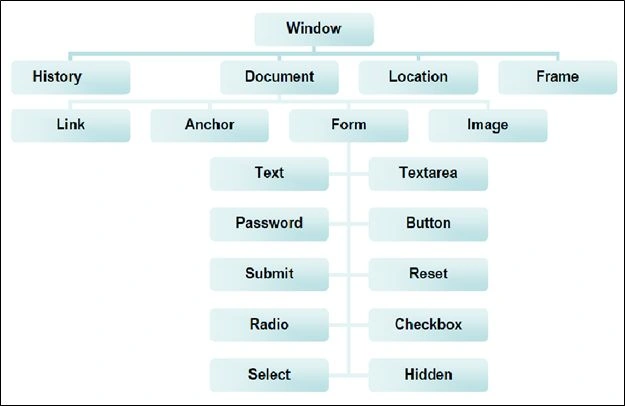
The following figure shows the object hierarchy in JavaScript. All objects have properties and methods, some objects also have "events". Every element on a web page has certain events that can trigger the invocation of event handlers. The "event handler" is a command that is used to specify actions in response to an event. Attributes are inserted into HTML tags to define events and event handlers.
Events in JavaScript
The following are examples of events:
- A mouse click.
- A web page or an image loading.
- Moussing over a hot spot on the web page.
- Selecting an input box in an HTML form.
- Submitting an HTML form.
- A keystroke.
The following are some of the most common events:
- onLoad – It occurs when a page loads in a browser.
- onUnload – It occurs just before the user exits a page.
- onMouseOver – It occurs when you point to an object.
- onMouseOut – It occurs when you point away from an object.
- onSubmit – It occurs when you submit a form.
- onClick – It occurs when an object is clicked.
- onAbort – An image failed to load.
- onBeforeUnload – The user is navigating away from a page.
- onBlur – A form field lost the focus (User moved to another field)
- onChange –The contents of a field has changed.
- onClick –User clicked on this item.
- onDblClick –User double-clicked on this item.
- onError –An error occurred while loading an image.
- onFocus –User just moved into this form element.
- onKeyDown –A key was pressed.
- onKeyPress –A key was pressed OR released.
- onKeyUp –A key was released.
- onMouseDown –A mouse button was pressed.
- onMouseMove –The mouse moved.
- onMouseUp –The mouse button was released.
- onReset –A form reset button was pressed.
- onResize –The window or frame was resized.
- onSelect –Text has been selected.
- onSubmit –A form's Submit button has been pressed.
- onUnload –The user is navigating away from a page.
The following is the object hierarchy in JavaScript:
 Example: OnClick event example.
- <!DOCTYPE html>
- <html>
- <head>Event Example</head>
- <body>
- <button onclick="clickme()">Click me</button>
- <script language='javascript'>
- function clickme() {
- alert("OnClick Event of Button");
- }
- </script>
- </body>
- </html>
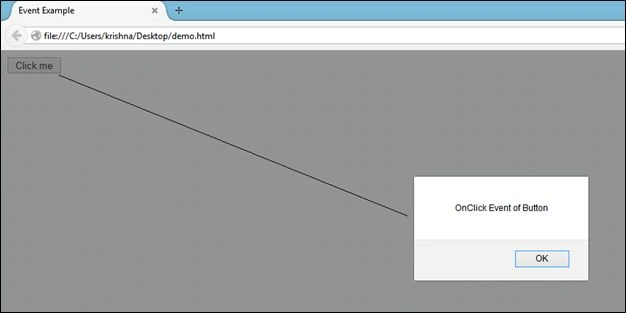
Run the preceding code, it will show you a button. When you click on that button it will pop up a message box as shown in the following output.
Output
 I hope you understand the basic concepts of JavaScript. If you have any suggestions regarding this article then please contact me.
Comments
Join the conversation! Your thoughts help the community grow.