
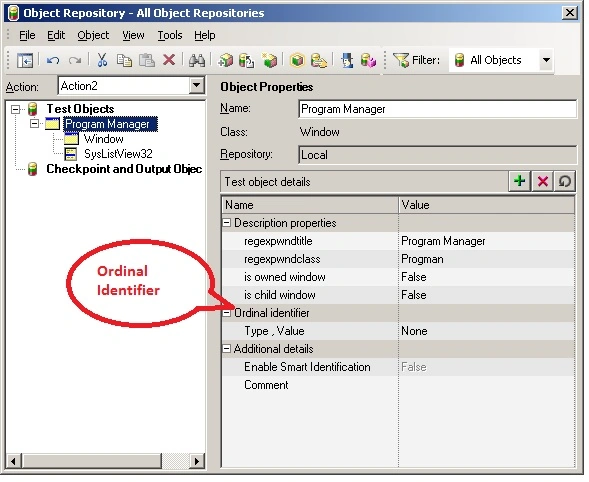
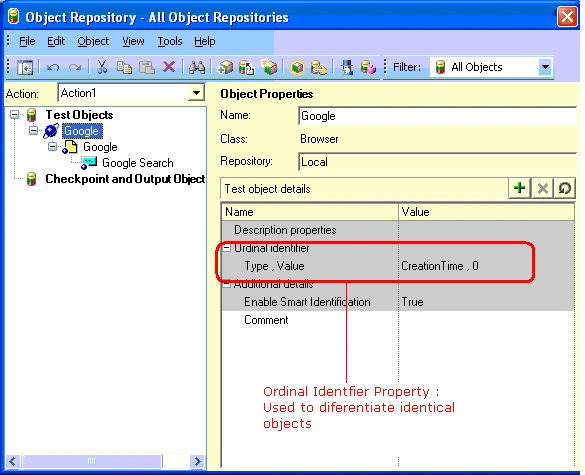
QuickTest uses the following Ordinal Identifiers to identify an object
- Creation Time: It indicates the order in which the browser was opened relative to other open browsers with an otherwise identical description.
- Index: It indicates the order in which the object appears in the application code relative to other objects with an otherwise identical description.
- Location: It indicates the order in which the object appears within the parent window, frame or dialog box relative to other objects with an otherwise identical description.
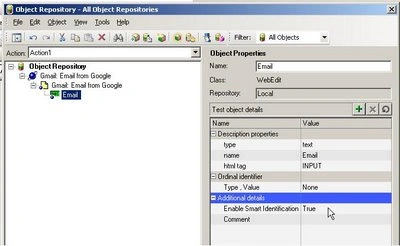
Configuring Smart Identification
This enables you to identify objects in your application, even if some of the properties in the object's learned description have changed.
If it finds more than one object that fits the description or QuickTest is not able to find the object that matches the learned object description, then QuickTest ignores the learned description and uses the Smart Identification mechanism to try to identify the object.
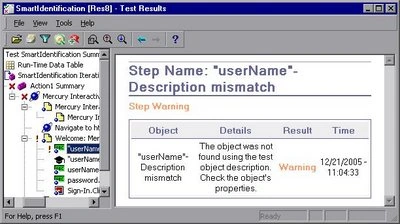
There are two types of Smart Identification Mechanism
- Base Filter Properties
These are the fundamental properties of a test object class whose values cannot be changed without changing the essence of the original object. - Optional Filter Properties
These are the properties that help in identifying objects of a particular class. These properties cannot be changed on a regular basis, but can be ignored if they are no longer applicable.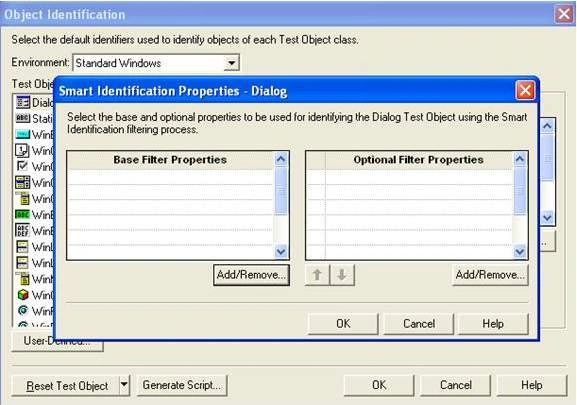
Varesh TuliPosted Jul 12, 2012, 4:51 AM
Very thankful for this article on QTP tool.Thanks for this post