

AI coding tools are becoming part of everyday software development. Developers now use tools like Claude Code, GitHub Copilot, Cursor, Gemini CLI, and Codex to generate code faster than ever before. But faster code generation also creates a new problem. When requirements are unclear, AI can produce inconsistent, messy, or incomplete software.
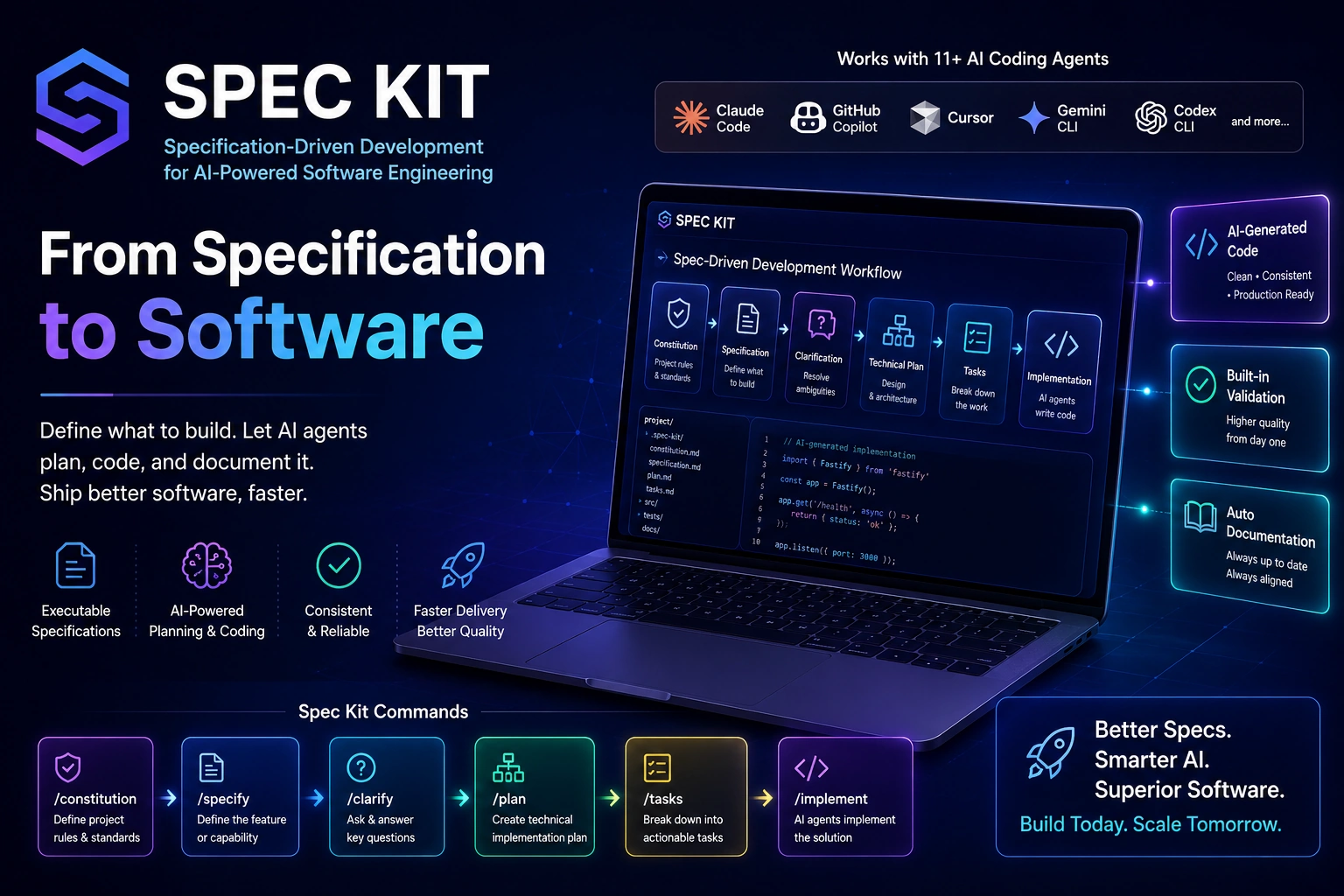
That is where Spec Kit comes in.
Spec Kit is an open-source framework built around Specification-Driven Development, often called SDD. Instead of jumping directly into coding, teams first define clear specifications. AI agents then use those specifications to generate plans, tasks, code, tests, and documentation in a more organized way.
The idea sounds simple, but it changes how software is built. Rather than treating specifications like temporary documents, Spec Kit turns them into living engineering assets that guide the entire development process.
This is one reason why many developers now see specification-driven workflows as the next major evolution in AI-assisted software engineering.
Organizations that want to modernize software delivery with AI-powered engineering practices can also work with https://www.c-sharpcorner.com/consulting/ to design scalable AI-first development systems and automation strategies.
Abstract / Overview
For years, software teams have struggled with the same issues. Requirements are often incomplete. Developers interpret features differently. Documentation gets outdated quickly. Testing happens late in the process. AI coding tools can speed things up, but they can also make these problems worse when prompts are vague.
Spec Kit was created to solve this challenge.
Instead of relying on random prompts like “build me an app,” Spec Kit introduces structure before implementation begins. Teams define specifications first. The framework then helps AI agents understand exactly what should be built, how it should behave, and what constraints must be followed.
This creates a workflow that is more reliable, easier to scale, and far easier to maintain over time.
According to the official Spec Kit platform, the framework supports more than 11 AI coding agents and has gained strong attention in the AI developer community because of its practical approach to structured AI engineering.
Spec Kit is not trying to replace developers. Instead, it helps developers spend less time repeating instructions and more time solving important engineering problems.
What Is Spec Kit?
Spec Kit is an open-source toolkit designed for AI-powered Specification-Driven Development. It provides a structured workflow that helps developers move from ideas to working software using clear specifications and AI-assisted implementation.
In traditional software development, teams usually move through disconnected phases. Product managers write requirements. Developers interpret them differently. Documentation changes over time. Engineers often spend hours clarifying missing details before real coding even begins.
Spec Kit changes that process by making specifications central to development.
Instead of starting with implementation, teams begin with intent. The specification becomes the source of truth for planning, coding, testing, and documentation. AI agents then use that structured context to generate outputs more accurately.
The official Spec Kit website describes this process as “making specifications executable.” That phrase captures the entire philosophy behind the framework.
Why Specification-Driven Development Matters
Many AI-generated coding problems come from weak instructions.
If a developer gives an AI tool a vague prompt, the AI has to guess. Those guesses often lead to:
inconsistent architecture
poor naming conventions
missing validation
security issues
incomplete testing
duplicated logic
Specification-Driven Development reduces these problems by forcing clarity early in the workflow.
Instead of saying:
“Build a dashboard app.”
A specification-driven workflow defines:
user behavior
validation rules
security expectations
APIs
business logic
architecture constraints
deployment expectations
The clearer the specification becomes, the better the AI output becomes.
This is one of the biggest reasons developers are moving from “prompt engineering” toward “specification engineering.”
How Spec Kit Works
Spec Kit follows a structured workflow designed specifically for AI-assisted development.

The process usually begins with a project constitution. This defines engineering rules and standards for the project. Teams can define coding practices, architecture constraints, security rules, and quality expectations.
After that comes the specification stage.
Here, developers describe what should be built. The focus is on the outcome rather than implementation details. Instead of writing code immediately, the team explains business intent in structured language.
A simple example may look like this:
/specify Build a task management platform with authentication and Kanban boards.The next phase is clarification. This is one of the most useful parts of the workflow because AI agents actively ask questions to reduce ambiguity.
For example, the AI may ask:
Should mobile devices be supported?
Which authentication system should be used?
Is offline access required?
Should the platform support multiple organizations?
This step helps catch missing details before development starts.
Once clarification is complete, Spec Kit creates a technical plan. This includes architecture decisions, frameworks, APIs, database structures, and deployment approaches.
Developers might define a stack like this:
/plan Use React, TypeScript, Node.js, and PostgreSQL.Spec Kit then breaks the implementation into structured engineering tasks. Instead of a giant coding request, AI receives smaller, manageable instructions with dependencies and sequencing.
Finally, the implementation stage generates working software artifacts such as:
APIs
frontend components
validation logic
tests
documentation
This creates a cleaner and more reliable development process.
Supported AI Coding Agents
One reason Spec Kit is gaining attention is its compatibility with multiple AI coding tools.
According to the official documentation, supported agents include:
Claude Code
GitHub Copilot
Cursor
Gemini CLI
Codex CLI
The framework also supports additional tools such as Windsurf, Roo Code, and Qwen Code.
This flexibility allows engineering teams to integrate Spec Kit into their existing AI workflows instead of rebuilding their development environment from scratch.
Why Developers Are Paying Attention to Spec Kit
Many developers are excited about Spec Kit because it introduces structure into AI-assisted engineering.
Without structure, AI-generated software can quickly become difficult to maintain. Teams often waste time rewriting prompts, debugging inconsistent outputs, and fixing architectural problems caused by unclear requirements.
Spec Kit helps reduce this chaos.
Because the workflow starts with specifications, the generated code is usually more consistent and aligned with project goals. Developers spend less time repeating instructions and more time refining business logic and architecture.
Another major advantage is traceability.
Every task, implementation decision, and generated artifact connects back to the specification. This makes systems easier to audit, debug, and maintain over time.
For enterprise engineering teams, this level of traceability is extremely valuable.
A Typical Spec Kit Development Flow

The most important thing to understand is that developers remain part of the process.
Spec Kit does not replace engineering judgment.
Human developers still handle:
architecture validation
security reviews
scalability decisions
performance optimization
business accuracy
AI accelerates the workflow, but developers guide the system.
Real-World Use Cases
Spec Kit works especially well for medium and large-scale software projects.
SaaS companies use it to generate structured APIs, dashboards, authentication systems, and internal platforms. Enterprise teams use it to standardize engineering practices across multiple departments.
Startups are also exploring Spec Kit because it can help small teams move faster without sacrificing engineering quality.
For AI-native products, specification-driven workflows are becoming even more important because AI agents perform better when context is structured and predictable.
Community Reactions
Developer discussions around Spec Kit have been mostly positive.
Many engineers say specification-driven workflows work especially well for:
large projects
multi-file systems
enterprise software
long-term products
Some developers feel the process may be too structured for quick prototypes or tiny projects. That criticism is understandable because writing good specifications takes time.
However, most developers agree that the approach improves clarity and reduces confusion when working with AI coding systems.
The broader industry trend also supports this direction. More engineering teams are realizing that AI works best when guided by strong context and structured intent.
Security and Governance Benefits
One interesting part of specification-driven engineering is its impact on software quality and security.
Recent research suggests structured specification workflows may reduce defects in AI-generated software because constraints and validation rules are defined earlier in the process.
This is especially important for industries like:
finance
healthcare
enterprise SaaS
government systems
In these environments, reliability matters more than raw coding speed.
Spec Kit helps create stronger alignment between requirements, implementation, testing, and governance.
Challenges and Limitations
Spec Kit is powerful, but it is not perfect.
Teams still need to learn how to write good specifications. That can be difficult at first because many organizations are used to informal requirement gathering.
There is also more upfront planning involved compared to simple AI prompting. Some developers may see this as slower initially.
However, many teams discover that the extra planning reduces expensive rework later.
Another limitation is that AI still makes mistakes. Even with strong specifications, developers must review generated code carefully for:
security issues
performance bottlenecks
logic problems
scalability concerns
AI remains an assistant, not a replacement for engineering expertise.
The Future of Specification-Driven Development
The software industry is moving toward AI-native development workflows.
Instead of treating AI like a chatbot that writes code occasionally, companies are beginning to build entire engineering systems around AI-assisted workflows.
Specification-driven engineering may become one of the foundations of this future.
We are already seeing early signs of:
autonomous task execution
AI-generated architecture planning
continuous validation systems
automated compliance checks
intelligent documentation generation
The role of developers is also changing.
Developers are increasingly becoming:
AI orchestrators
system designers
validation experts
architecture reviewers
product strategists
This shift does not reduce the importance of developers. In many ways, it increases it.
Future Enhancements for Spec Kit
As the ecosystem evolves, frameworks like Spec Kit may eventually support:
AI architecture optimization
automated security validation
self-healing specifications
intelligent technical debt analysis
real-time compliance monitoring
These capabilities could dramatically change how enterprise software is designed and maintained.
FAQs
1. What is Spec Kit?
Spec Kit is an open-source framework for AI-powered Specification-Driven Development that helps teams generate software from structured specifications.
2. What is Specification-Driven Development?
Specification-Driven Development is a software approach where specifications guide planning, coding, testing, and documentation.
3. Which AI tools work with Spec Kit?
Spec Kit supports tools like Claude Code, GitHub Copilot, Cursor, Gemini CLI, Codex CLI, and several others.
4. Is Spec Kit open source?
Yes. Spec Kit is open source and publicly available.
5. Does Spec Kit replace developers?
No. Developers still review architecture, security, business logic, and system quality.
6. Why are developers interested in specification-driven workflows?
Because structured specifications improve AI coding reliability, reduce confusion, and create more maintainable software systems.
7. Is Spec Kit suitable for startups?
Yes. Startups can use it to accelerate MVP development while keeping engineering workflows organized.
8. Can Spec Kit improve software quality?
Yes. Clear specifications reduce ambiguity and improve consistency across the development lifecycle.
Conclusion
Spec Kit represents a major shift in how modern software is built.
Instead of relying on disconnected prompts and fragmented workflows, it creates a structured system where specifications guide the entire engineering lifecycle.
This approach improves clarity, consistency, collaboration, and maintainability while helping AI tools generate better software outputs.
As AI-assisted development continues to evolve, specification-driven engineering may become the standard workflow for modern software teams.
The future of software development is not just AI-generated code. It is AI-guided engineering built on clear, structured specifications.
Organizations looking to adopt AI-native software delivery models can also explore enterprise AI engineering solutions from https://www.c-sharpcorner.com/consulting/.
References
Spec Kit Official Website — https://speckit.org/
GitHub Spec Kit Repository
Reddit Discussions on Specification-Driven Development
AI-Assisted Software Engineering Research Papers
GitHub Copilot Documentation
Claude Code Documentation
Cursor AI Documentation
Join the conversation! Your thoughts help the community grow.