

Introduction
Cloud computing and large-scale software systems have created two of the most in-demand engineering roles today:
DevOps Engineer and Site Reliability Engineer (SRE).
At first glance, they look similar. They use the same tools. They work with cloud infrastructure. They automate systems.
But their core purpose is very different.
For developers in India and across the global tech industry, understanding SRE vs DevOps is essential for choosing the right career path in modern software engineering.
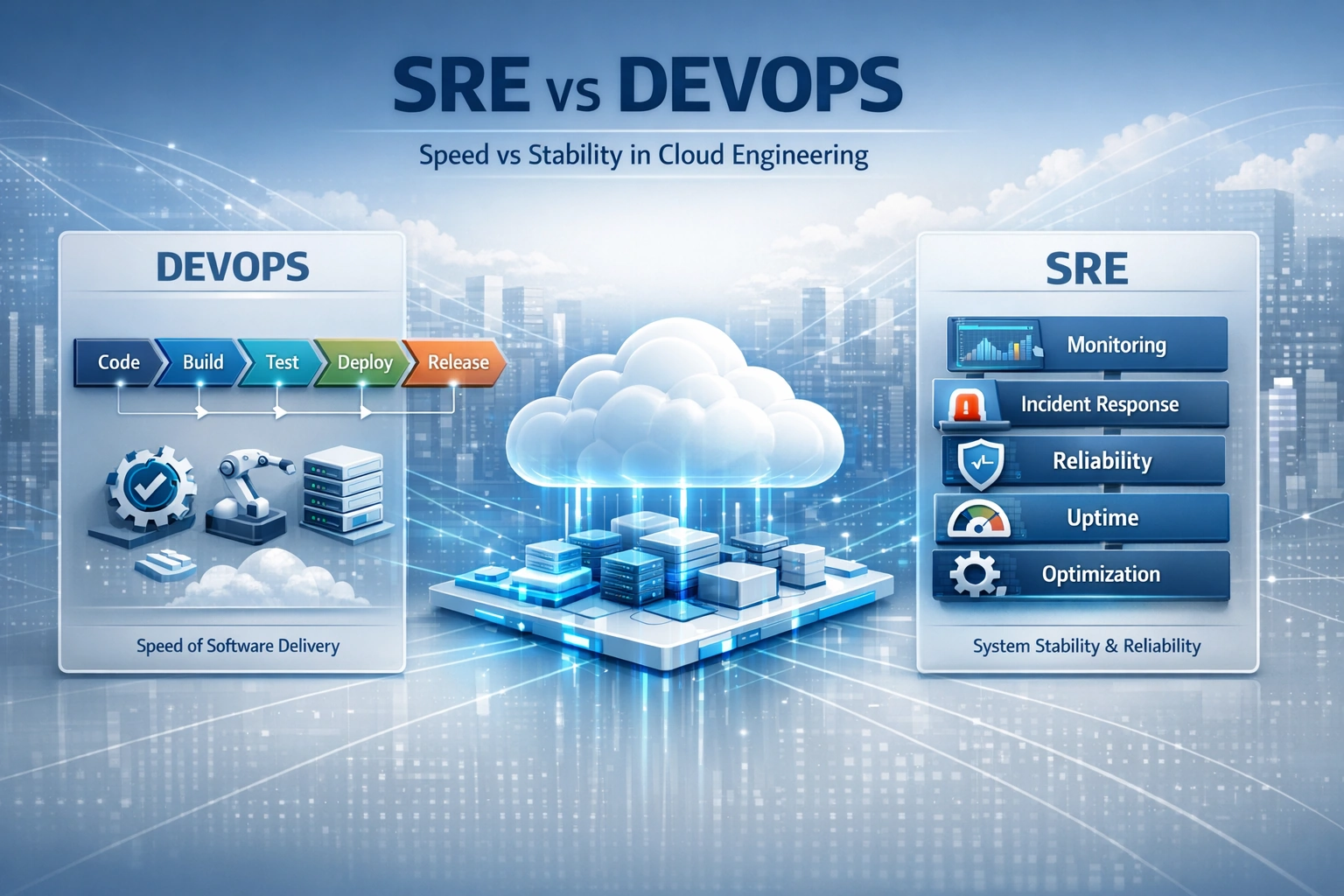
What is DevOps?
DevOps is a culture and engineering practice designed to speed up software delivery.
Its goal is to remove friction between:
Development teams
Operations teams
DevOps engineers focus on:
CI/CD pipelines
Automated testing
Infrastructure as Code
Deployment automation
Cloud provisioning
Primary Goal:
Deliver software faster, more frequently, and more efficiently.
In simple terms:
DevOps = Speed of Software Delivery
The Challenge That Appeared After DevOps
As companies adopted DevOps:
Deployments became faster
Releases became frequent
Experimentation increased
But a new problem appeared:
How do we ensure systems stay stable after rapid deployments?
Fast delivery introduced:
Downtime risks
Performance degradation
Alert fatigue
Incident overload
This challenge led to the rise of Site Reliability Engineering (SRE).
What is SRE (Site Reliability Engineering)?
SRE was originally developed by Google to solve large-scale system reliability challenges.
SRE applies software engineering principles to operations with focus on:
System uptime
Monitoring and observability
Incident response
Disaster recovery
Performance optimization
Service Level Objectives (SLOs)
Error budgets
Primary Goal:
Ensure software systems remain stable, reliable, and available at scale.
In simple terms:
SRE = System Stability & Reliability
SRE vs DevOps: The Core Difference
| Aspect | DevOps | SRE |
|---|---|---|
| Primary Focus | Fast software delivery | System reliability |
| Key Metric | Deployment frequency | Uptime & error budgets |
| Main Concern | Speed of release | Stability after release |
| Core Practice | Automation pipelines | Reliability engineering |
| Typical Question | “How do we deploy faster?” | “Will the system stay stable?” |
Tools Are Similar, Mindset is Different
Both DevOps and SRE use:
Docker & Kubernetes
Cloud platforms (AWS, Azure, GCP)
Monitoring tools
CI/CD pipelines
But their mindset differs:
DevOps mindset:
Build fast
Deploy often
Optimize delivery workflows
SRE mindset:
Measure reliability
Reduce failures
Design resilient systems
Career Impact: DevOps vs SRE
DevOps Engineer
High job demand
Broad role across companies
Strong automation focus
Excellent salary range
SRE Engineer
Fewer but premium positions
High responsibility roles
Deep reliability expertise
Higher average salary globally
Modern enterprises need both roles to run large-scale cloud systems successfully.
India and Global Demand
In India:
SaaS startups
Fintech platforms
Cloud-native enterprises
are rapidly hiring DevOps and SRE engineers.
Globally:
Tech giants
Cloud providers
AI infrastructure companies
require engineers who understand both delivery speed and system reliability.
Developers who master DevOps foundations and SRE principles gain:
Faster career growth
Global remote opportunities
Higher compensation potential
Which Role Should You Choose?
Choose DevOps if you enjoy:
Automation
CI/CD pipelines
Cloud infrastructure setup
Fast-moving product environments
Choose SRE if you enjoy:
System performance
Monitoring & observability
Incident handling
Designing resilient architectures
Future-ready engineers understand both.
Final Thoughts
DevOps transformed how software is delivered and SRE ensures software survives real-world scale.
The future of cloud engineering belongs to professionals who can:
Build fast. And keep systems stable.
For developers in India and globally, mastering DevOps and SRE concepts today is a direct path to high-impact, high-paying tech careers.
Join the conversation! Your thoughts help the community grow.