

Introduction
Manual stock analysis can be time-consuming, error-prone, and difficult to scale. Automating this process not only saves time but also ensures consistent, repeatable insights, enabling better decision-making.
In this article, we’ll explore how to analyse stocks effectively and set up an automated workflow to support daily analysis. You’ll learn the end-to-end process—from understanding the analysis approach to deploying a solution that delivers actionable insights every day.
Additionally, we’ll demonstrate how to train a simple prediction model. Specifically, we’ll use a linear regression model to forecast stock performance using historical data and technical indicators.
Note: This is a proof-of-concept setup intended for learning purposes only and should not be used for actual investment decisions.
High-Level Architecture
This automated stock analysis system is designed to fetch, process, and analyse stock data, generate predictions, and deliver daily insights—all without manual intervention. Below is a high-level overview of the architecture, its layers, purposes, responsibilities, and the tools used.
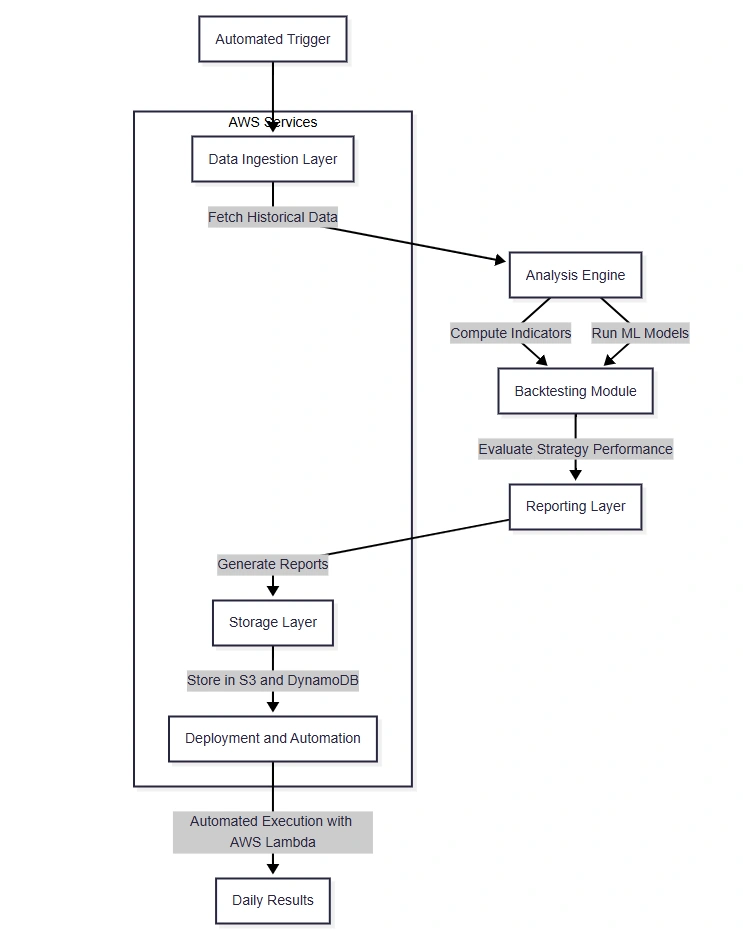
This tabular format provides a clear overview of the architecture layers, their purposes, and responsibilities.
| Layer | Purpose | Responsibilities | Tools/Tech |
|---|---|---|---|
| Automated Trigger | Initiates the workflow automatically | Schedule daily execution and ensure the workflow runs without manual intervention | AWS Lambda, CloudWatch |
| Data Ingestion Layer | Fetch and prepare stock data | Retrieve historical stock data from Yahoo Finance and store raw backups | Python, S3 |
| Analysis Engine | Process data and apply analysis logic | Compute technical indicators (RSI, EMA, MACD, ATR) and run machine learning models (Linear Regression) | Python, Pandas, scikit-learn(ML) |
| Backtesting Module | Evaluate strategy performance | Simulate the strategy on historical data and calculate metrics like CAGR, Sharpe ratio, and drawdown | Python, Backtrader |
| Reporting Layer | Present results in a user-friendly format | Generate structured tables, format data, and create CSV reports for storage and distribution | Python, Pandas |
| Storage Layer | Persist data for long-term access | Store processed results in DynamoDB and maintain historical reports in S3 | DynamoDB, S3 |
| Deployment & Automation | Ensure scalability, reliability, and monitoring | Execute workflows, monitor system health, and manage storage | AWS Lambda, CloudWatch, S3, DynamoDB |


Join the conversation! Your thoughts help the community grow.