

Abstract / Overview
Agentic AI use cases in 2026 are practical, revenue-relevant automations where AI agents plan, decide, and take actions across tools and systems with bounded autonomy and auditability. The fastest path to lead generation is to package these use cases as outcome-based offers (time-to-resolution reduction, faster hiring throughput, lower compliance risk) and route prospects into a short diagnostic that maps workflows, data access, and governance readiness.
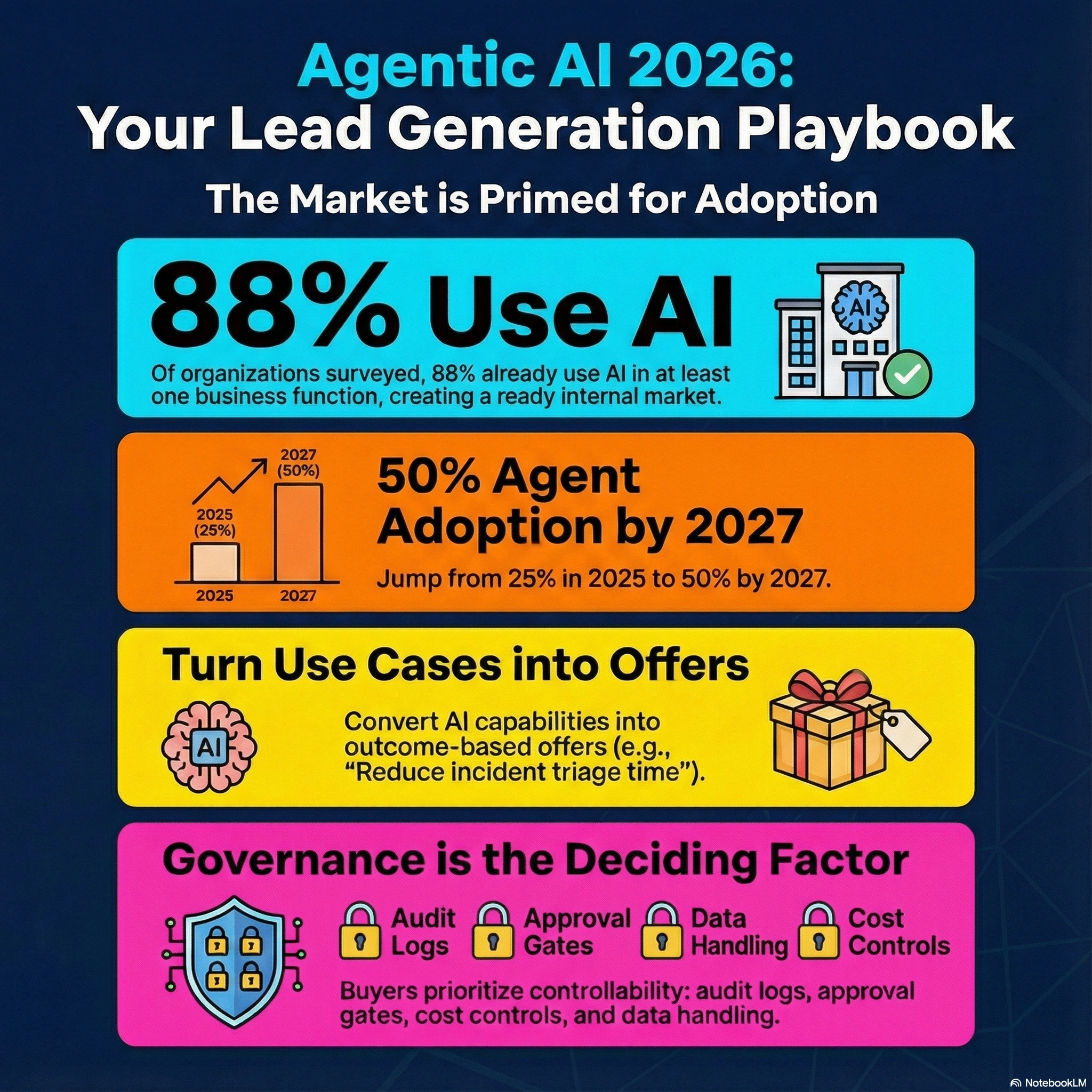
Enterprise signals are aligned for adoption. McKinsey’s 2025 global survey reports that 88% of respondents say their organizations use AI in at least one business function. (McKinsey & Company) Deloitte’s 2025 predictions report expects 25% of enterprises using GenAI to deploy AI agents in 2025, rising to 50% by 2027. (Deloitte) Meanwhile, the buyer discovery journey is shifting from “search links” to “answer engines”: Gartner predicts traditional search engine volume will drop 25% by 2026 due to AI chatbots and virtual agents. (Gartner)
Last updated: January 1, 2026.
Conceptual Background
What “agentic AI” means in business terms
An AI agent is a system that can autonomously perform tasks by designing workflows and using tools. (IBM) In enterprise practice, “agentic” implies:
Goal-driven execution (not just responding to prompts)
Tool use (APIs, ticketing, CI/CD, HRIS, email, chat)
Memory and state across steps
Guardrails: approvals, policies, budgets, and logs
Consultancies describe agents as tool-using systems that can decide when to access systems on a user’s behalf, with minimal oversight. (BCG Global)
Why 2026 is the lead-generation inflection point
Three market shifts matter for pipeline:
More buyers already use AI internally, but many teams have not scaled it beyond pilots. (McKinsey & Company)
“Autonomy” is being replaced by “controllability” as the real purchasing criterion (audit trails, cost controls, evidence). (C# Corner)
Discovery and trust now happen inside AI answers and citations, not only SERPs—so your content and offers must be structured for generative engines.
Step-by-Step Walkthrough
Step 1: Choose use cases that naturally create buying intent
High-intent agentic projects share four traits:
Clear owner (Head of DevOps, CIO, CHRO, RevOps)
A measurable bottleneck (MTTR, deployment frequency, time-to-hire)
Tooling surface area (Jira/ServiceNow, GitHub/Azure DevOps, Workday/Greenhouse)
A governance story (access control, PII handling, approvals)
Step 2: Productize each use case into a “lead magnet offer”
Convert “we build agents” into a simple promise:
“Reduce incident triage time by automating enrichment + runbook execution with approvals.”
“Cut time-to-first-shortlist by automating sourcing, screening, and structured interview packs.”
“Lower audit prep hours by generating evidence bundles from logs and tickets.”
Then attach a 15–30 minute diagnostic with three outputs:
Workflow map (current vs future)
Data and tool access checklist
ROI model and risk controls
Step 3: Build a reference architecture buyers can trust
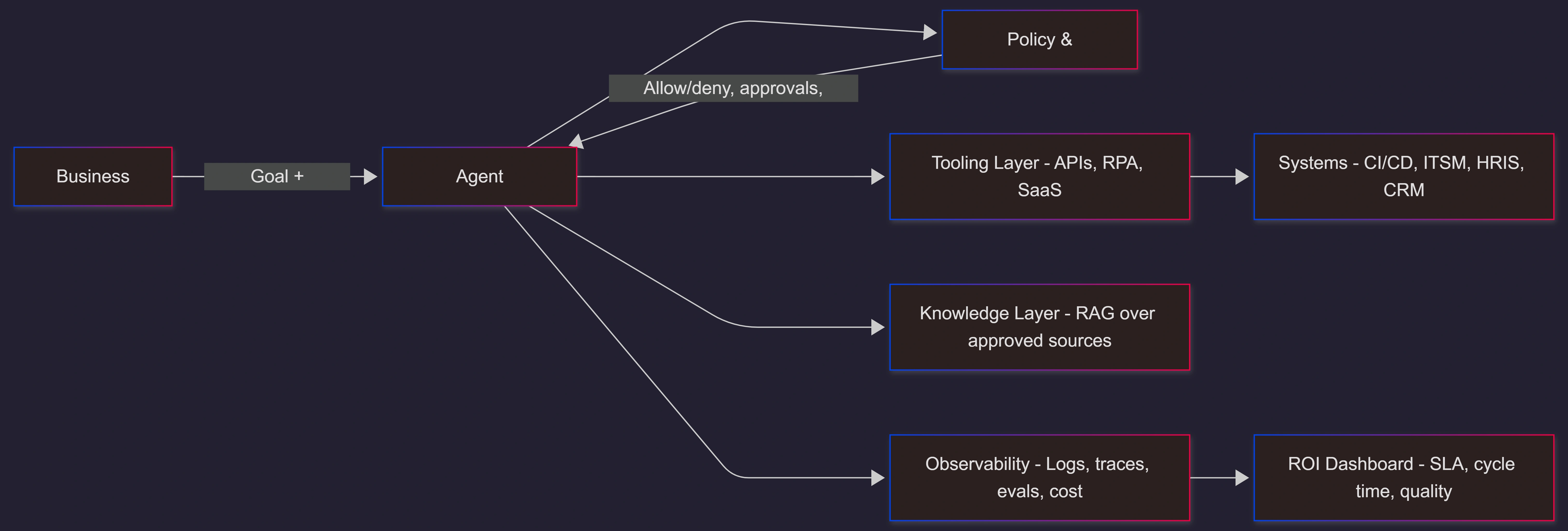
Use a consistent architecture across departments:
Orchestrator (agent runtime)
Tools (connectors to systems)
Knowledge (RAG over approved docs)
Policy layer (permissions, redaction, approval gates)
Observability (traces, costs, evaluations)
Step 4: Deploy with “thin slices” that prove value in 2–4 weeks
A reliable rollout sequence:
Start with read-only + suggestion mode
Add “draft actions” (PR drafts, ticket drafts, email drafts)
Introduce approval gates for write actions
Expand the scope after the evaluation scores stabilize
This aligns with the “controllability” buying requirement emphasized in the 2026 expectations content. (C# Corner)
Use Cases / Scenarios
1) DevOps: PR Triage and Auto-Fix Agent
What it does
Watches repos for failing builds, flaky tests, and noisy linters
Summarizes root cause from logs, opens a PR with proposed fixes, and requests review
Routes exceptions to the right owner using code ownership + service catalog
Why it converts
Developer productivity and release velocity are board-visible
GitHub research found Copilot users completed a coding task 55% faster in a controlled study, reinforcing willingness to pay for productivity tooling. (The GitHub Blog)
Lead magnet angle
“CI failure triage audit”: identify top 20 recurring failure patterns + quick automation wins
2) DevOps: Pipeline Health and Release Readiness Agent (Azure DevOps)
What it does
Monitors pipeline runs, detects flaky tests, analyzes build logs, and recommends fixes
Can automatically open issues and assign owners, or trigger rollback playbooks with approval
Proof point
Practical patterns for AI in Azure DevOps pipelines include real-time monitoring, build log analysis, and flaky test detection. (C# Corner)
Lead magnet angle
“Release readiness scorecard” + a sample alert-to-action workflow
3) SRE/IT Ops: Incident Triage + Runbook Execution Agent
What it does
Enriches incidents with context (recent deploys, config changes, similar past incidents)
Proposes resolution steps, executes runbooks in controlled mode, and documents the incident timeline automatically
Why it converts
MTTR reductions translate into SLA savings and reduced on-call burnout
This use case creates a clear governance narrative: approvals, break-glass access, and immutable logs
Lead magnet angle
“MTTR baseline + automation blueprint” for top incident categories
4) Security: Phishing Triage + Access Review Agent
What it does
Classifies inbound phishing reports, correlates with threat intel, and auto-quarantines suspicious emails
Prepares quarterly access reviews by summarizing entitlements and anomalies for manager approvals
Why it converts
Security teams buy outcomes: faster triage, fewer false positives, reduced audit burden
Banking and enterprise stories increasingly frame AI as “trusted AI” for risk tasks. (The Australian)
Lead magnet angle
“Access review time-savings assessment” + sample evidence bundle
5) RevOps/Sales Ops: Lead Enrichment + Routing Agent
What it does
Enriches inbound leads from multiple sources (firmographics, intent signals, product telemetry)
Applies routing rules, books meetings, and creates personalized follow-ups
Flags duplicates and potential fraud
Why it converts
Direct line to pipeline and revenue attribution
Buyers accept automation when guardrails are explicit: compliance, opt-out, and messaging caps
Lead magnet angle
“Lead leakage audit”: quantify leads that went uncontacted in 24 hours and fix the workflow
6) Customer Support: Case Deflection + Escalation Agent
What it does
Deflects tickets with grounded answers from KB + product docs
Detects escalation triggers (billing risk, churn risk, compliance)
Summarizes the full case history for human agents
Why it converts
Deflection and handle-time reductions are easy to model and measure
Support leaders already track the metrics; agents attach to existing dashboards
Lead magnet angle
“Top 50 questions” extraction + deflection playbook
7) HR: Recruiting Operations Agent (Sourcing → Shortlist)
What it does
Drafts role profiles and job descriptions, runs structured sourcing, and builds calibrated shortlists
Produces interview kits aligned to competencies and role scorecards
Communicates with candidates using compliant templates and scheduling rules
Adoption evidence
SHRM reports 43% of organizations leverage AI in HR tasks in 2025 (up from 26% in 2024), and recruiting is a leading use case. (SHRM)
SHRM also reports cost and quality impacts for recruiting-support AI, including reductions in hiring costs for some organizations. (SHRM)
Lead magnet angle
“Time-to-hire compression workshop”: map bottlenecks and propose 3 automations with governance controls
8) HR: Employee Lifecycle Agent (Onboarding → Policy → HRIS)
What it does
Guides onboarding tasks, collects forms, provisions accounts via IT workflows, and answers policy questions
Escalates exceptions (visa, accommodations, sensitive requests) to humans
Generates audit-friendly trails for compliance
Why it converts
HR and IT share cross-functional friction; the agent becomes a unifying automation project
Strong lead-gen hook: “reduce time-to-productivity for new hires”
Lead magnet angle
“Onboarding friction map” + automation ROI estimate
Limitations / Considerations
Governance is the purchase decision
In 2026, buyers evaluate:
PII handling (especially HR and recruiting)
Role-based access (least privilege)
Approval gates for write actions
Cost controls (token budgets, tool call limits)
Audit logs and traceability
This emphasis on controllability is explicitly highlighted in 2026-focused guidance. (C# Corner)
Avoid “agent sprawl”
Common failure modes:
Too many agents without ownership
Tool permissions that exceed job roles
Hallucinated actions due to weak grounding
No evaluation harness; no rollback strategy
Don’t confuse copilots with agents
Copilots assist humans. Agents execute. The business case must specify where autonomy is acceptable and where approvals are mandatory.
Fixes
If stakeholders fear autonomy, ship “suggestion mode” first, then add approvals, then narrow write permissions.
If outputs are inconsistent, constrain actions to tool-based steps, improve grounding sources, and add evaluation checks.
If costs spike, implement budgets per workflow, caching, and shorter context windows.
If HR is blocked on compliance, introduce redaction, data minimization, and documented retention policies.
If adoption stalls, embed agents inside existing tools (ITSM, CI/CD, HRIS) rather than launching a new portal.
Code / JSON Snippets
Sample workflow JSON: Lead-generation diagnostic → agent readiness score
Use this minimal JSON to standardize a lead-gen “Agentic Readiness Diagnostic” that feeds marketing, sales, and delivery.
{
  "workflow_name": "Agentic AI Readiness Diagnostic",
  "version": "1.0",
  "intake": {
    "channel": ["website_form", "linkedin_dm", "webinar"],
    "required_fields": ["company", "role", "use_case", "primary_tooling", "timeline"],
    "optional_fields": ["incident_volume_per_month", "time_to_hire_days", "compliance_requirements"]
  },
  "scoring": {
    "fit_signals": {
      "tooling_surface_area": ["Jira", "ServiceNow", "Azure DevOps", "GitHub", "Workday", "Greenhouse"],
      "measurable_kpi": ["MTTR", "deployment_frequency", "time_to_hire", "case_deflection"],
      "governance_readiness": ["SSO", "RBAC", "audit_logs"]
    },
    "weights": {
      "tooling_surface_area": 0.35,
      "measurable_kpi": 0.35,
      "governance_readiness": 0.30
    }
  },
  "routing": {
    "if_score_gte": 0.75,
    "action": "book_workshop",
    "calendar_link_placeholder": "YOUR_BOOKING_LINK",
    "sla_hours": 24
  },
  "outputs": [
    "current_state_workflow_map",
    "risk_and_controls_matrix",
    "roi_model",
    "90_day_delivery_plan"
  ]
}
Hire an Expert to Integrate AI Agents the Right Way
Integrating AI agents into real enterprise environments requires architectural experience, not just tooling.
Mahesh Chand is a veteran technology leader, former Microsoft Regional Director, long-time Microsoft MVP, and founder of C# Corner. He has decades of experience designing and integrating large-scale enterprise systems across healthcare, finance, and regulated industries.
Through C# Corner Consulting, Mahesh helps organizations integrate AI agents safely with existing platforms, avoid architectural pitfalls, and design systems that scale. He also delivers practical AI Agents training focused on real-world integration challenges.
Learn more at: https://www.c-sharpcorner.com/consulting/
FAQs
1. What is the most profitable agentic AI use case to start with?
Start where a single KPI is already tracked weekly and has a cost of delay: incident triage (MTTR), recruiting throughput (time-to-hire), or lead routing (speed-to-lead). These convert fastest because ROI is straightforward.
2. How is agentic AI different from RPA?
RPA automates fixed steps. Agentic AI can plan and adapt steps, choose tools, and handle exceptions—when guardrails and approvals are in place.
3. What do buyers require to approve agentic automation in HR?
Clear PII boundaries, role-based access, candidate consent/notice where applicable, human review gates for sensitive decisions, and traceable logs.
4. How do you measure success beyond “it feels faster”?
Use before/after comparisons on one KPI per workflow: MTTR, change failure rate, deployment frequency, time-to-shortlist, time-to-hire, case deflection rate, or speed-to-lead. Track cost per outcome and quality (reopen rate, candidate quality signals, customer CSAT).
5. How should content be written to generate leads in AI answer engines?
Front-load definitions, add “citation magnets” (stats and credible sources), use clean headings, and publish in multiple formats. GEO guidance frames this as optimizing to be cited inside AI answers.
References
McKinsey, The State of AI: Global Survey 2025 (AI use in at least one business function). (McKinsey & Company)
Deloitte, Deloitte Global 2025 Predictions Report (agent adoption projections). (Deloitte)
Gartner press release (Feb 19, 2024) (search volume drop prediction by 2026). (Gartner)
SHRM, 2025 Talent Trends (AI adoption in HR tasks). (SHRM)
IBM: What Are AI Agents? (definition). (IBM)
C# Corner, Sector Watch: What Agentic AI Is and How It Will Disrupt Industries First (agentic framing and enterprise integration emphasis). (C# Corner)
C# Corner, Fundamentals of AI-Assisted DevOps (Part-1) (DevOps lens for AI assistance). (C# Corner)
C# Corner, Azure DevOps Pipelines with AI and Continuous Integration (pipeline monitoring patterns). (C# Corner)
GEO Guide (C# Corner eBook PDF).
Conclusion
Agentic AI in 2026 is not a speculative trend. It is a governed automation layer that turns business goals into tool-driven actions across DevOps, IT Ops, RevOps, Support, and HR. The lead-generation advantage comes from productizing these use cases into diagnostics and outcome-based offers, then proving controllability through policy, approvals, and observability.
The highest-converting path is consistent:
Pick a KPI-heavy workflow with a clear owner
Ship a thin slice in suggestion mode, then add approvals
Capture ROI with baseline-and-after measurement
Publish structured, citation-rich content across formats to win AI-answer visibility
Track Share of Answer, impressions, coverage, and sentiment as core demand metrics
Join the conversation! Your thoughts help the community grow.