

Repeater Control
A Repeater control is a lightweight control and faster to display data compared to a grid view and data grid.
So, let's proceed with the following procedure:
- Repeater Control and Data Binding
- Twitter Bootstrap tables (table table-striped table-bordered) and MySQL Database
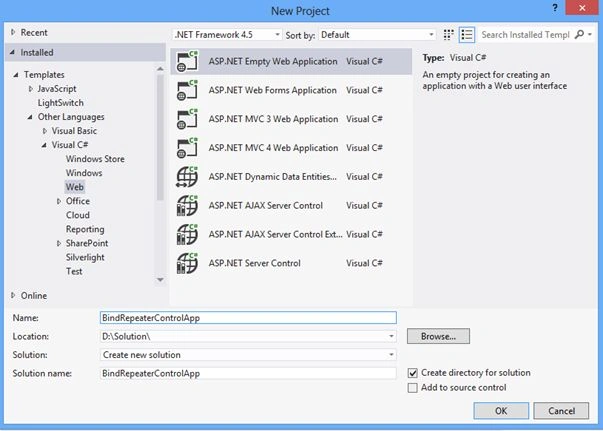
Open your instance of Visual Studio 2012 and create a new ASP.NET Web application. Name the project “BindRepeaterControlApp", as shown in the following figure:
In the Design Source (BindRepeaterControl.aspx) write the code as in the following.
Twitter Bootstrap tables CSS (table table-striped table-bordered)
BindRepeaterControl.aspx
- <%@ Page Title="" Language="C#" MasterPageFile="~/Site.Master" AutoEventWireup="true"
- CodeBehind="BindRepeaterControl.aspx.cs" Inherits="BindRepeaterControlApp.BindRepeaterControl" %>
- <asp:Content ID="Content1" ContentPlaceHolderID="titleContent"
- runat="server">Twitter Bootstrap and Repeater Control in ASP.NET
- </asp:Content>
- <asp:Content ID="Content2" ContentPlaceHolderID="head" runat="server">
- </asp:Content>
- <asp:Content ID="Content3" ContentPlaceHolderID="MainContent" runat="server">
- <div>
- <h3>Customer Data</h3>
- <p>
- <asp:Repeater ID="Repeater1" runat="server" >
- <HeaderTemplate>
- <table class="table table-striped table-bordered">
- <tr>
- <td><b>CustomerID</b></td>
- <td><b>Name</b></td>
- <td><b>Contact Name</b></td>
- <td><b>Contact Title</b></td>
- <td><b>Address</b></td>
- <td><b>City</b></td>
- <td><b>Phone</b></td>
- </tr>
- </HeaderTemplate>
- <ItemTemplate>
- <tr>
- <td>
- <%# DataBinder.Eval(Container.DataItem, "CustomerID") %>
- </td>
- <td>
- <%# DataBinder.Eval(Container.DataItem, "CompanyName") %>
- </td>
- <td>
- <%# DataBinder.Eval(Container.DataItem, "ContactName") %>
- </td>
- <td>
- <%# DataBinder.Eval(Container.DataItem, "ContactTitle") %>
- </td>
- <td>
- <%# DataBinder.Eval(Container.DataItem, "Address") %>
- </td>
- <td>
- <%# DataBinder.Eval(Container.DataItem, "City") %>
- </td>
- <td>
- <%# DataBinder.Eval(Container.DataItem, "Phone") %>
- </td>
- </tr>
- </ItemTemplate>
- <FooterTemplate>
- </table>
- </FooterTemplate>
- </asp:Repeater>
- </p>
- </div>
- </asp:Content>
Web.config
- <connectionStrings>
- <add name="ConnectionString" connectionString="Server=localhost;userid=root;password=;
- Database=Testdb" providerName="MySql.Data.MySqlClient"/>
- </connectionStrings>
BindRepeaterControl.aspx.cs
- using System;
- using System.Collections.Generic;
- using System.Linq;
- using System.Web;
- using System.Web.UI;
- using System.Web.UI.WebControls;
- using System.Data;
- using MySql.Data.MySqlClient;
- using System.Configuration;
- namespace BindRepeaterControlApp
- {
- public partial class BindRepeaterControl : System.Web.UI.Page
- {
- #region MySqlConnection Connection
- MySqlConnection conn = new MySqlConnection(ConfigurationManager.ConnectionStrings
- ["ConnectionString"].ConnectionString);
- #endregion
- #region show message
- /// <summary>
- /// This function is used for show message.
- /// </summary>
- /// <param name="msg"></param>
- void ShowMessage(string msg)
- {
- ClientScript.RegisterStartupScript(Page.GetType(), "validation", "<script
- language='javascript'>alert('" + msg + "');</script>");
- }
- #endregion
- #region Repeater Control
- /// <summary>
- /// Bind Data to Repeater Control
- /// </summary>
- /// <param name="sender"></param>
- /// <param name="e"></param>
- protected void Page_Load(object sender, EventArgs e)
- {
- //Query
- string query = @"SELECT CustomerID,CompanyName,ContactName,ContactTitle,
- Address,City,Phone,Email FROM customers";
- DataTable dt = new DataTable();
- try
- {
- MySqlDataAdapter da = new MySqlDataAdapter(query, conn);
- da.Fill(dt);
- }
- catch (MySqlException ex)
- {
- ShowMessage(ex.ToString());
- }
- //Populate Repeater control with data
- Repeater1.DataSource = dt;
- Repeater1.DataBind();
- }
- #endregion
- }
- }
I hope this article is useful. If you have any other questions then please provide your comments below.
PANKAJ KUMARPosted Sep 24, 2019, 12:14 PM
Where is bootstrap??
Prashant BariPosted Aug 17, 2015, 8:18 AM
ssfsdfs