

.NET MVC is a web application framework based on the MVC (Model-View-Controller) architectural pattern, built on top of the .NET platform developed by Microsoft, that helps developers build structured, scalable web applications. It’s commonly used to build dynamic websites, dashboards, admin panels, and data-driven web apps using C# and Razor syntax. Specifically, it usually means:
- ASP.NET MVC (for .NET Framework – Windows-only)
- ASP.NET Core MVC (for .NET Core / .NET 5+ – cross-platform)
MVC, or Model–View–Controller, is a software design pattern that organizes an application into three interconnected components, each with a distinct responsibility:
- Model: Manages the data and business logic. It’s like the brain of the application — storing, retrieving, and processing information.
- View: Handles the presentation layer. Think of it as the face — what users see and interact with.
- Controller: Acts as the coordinator. It receives user input, communicates with the model, and selects the appropriate view to display.
The Model-View-Controller (MVC) pattern is a core part of the .NET ecosystem. If you're learning about the .NET ecosystem, please read the full article at: Understanding the .NET Ecosystem
.NET MVC is a web development pattern and framework in .NET; it is not a language, but a structure used to build web apps efficiently.
ASP.NET Core MVC (part of .NET 8) is the current version of .NET MVC. It is used in all new development and supports modern features like Razor Pages, Minimal APIs, Blazor integration, dependency injection, and cloud/container readiness.
How does MVC work in a healthcare appointment portal?
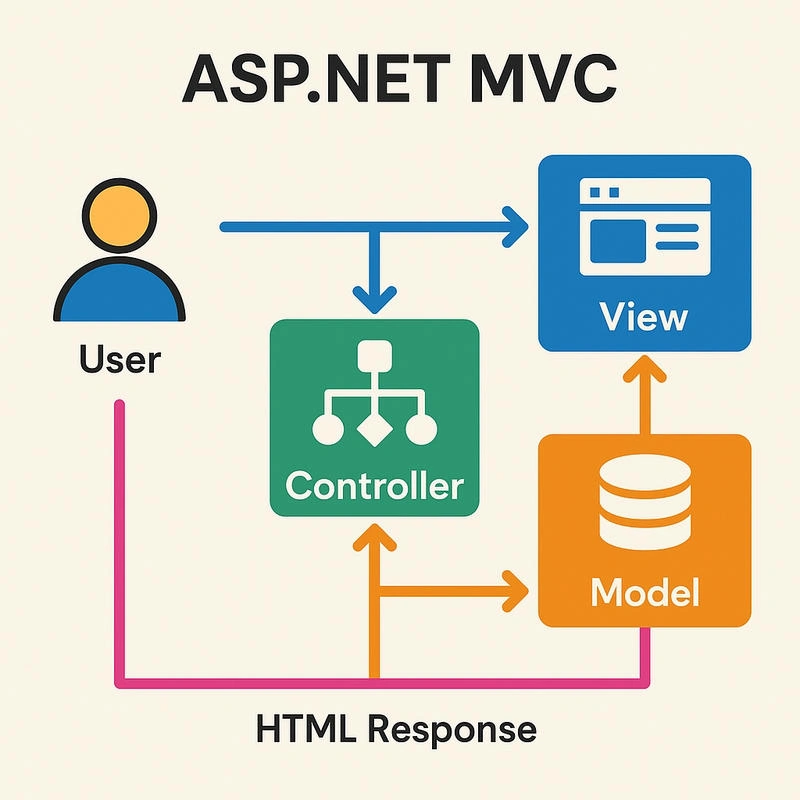
Imagine a clinic where patients can
- Register online
- View available doctors
- Book appointments
- Track their visit history
- Model: Represents entities like
Patient,Doctor,Appointment, andAttendance. These classes hold data such as names, contact info, appointment times, and medical notes. - View: Displays forms for registration, appointment booking, and reports. It shows dynamic content like available slots and doctor profiles.
- Controller: Handles user actions like submitting a booking form or requesting a report. It fetches data from the model and passes it to the view.
For example, when a patient books an appointment:
- The Controller receives the request and validates it.
- It uses the Model to store the appointment in the database.
- Then it returns a View showing confirmation and upcoming appointments.
This setup allows doctors to manage their schedules, patients to interact with the system seamlessly, and admins to generate reports all within a clean, maintainable architecture.
Features of .NET MVC
- Separation of Concerns: Keeps business logic (Model), UI (View), and input handling (Controller) separate, making code easier to manage and scale.
- Testability: You can write unit tests for your business logic and controllers without involving the UI.
- Clean URLs & SEO: Routing in MVC allows for readable, SEO-friendly URLs.
- Full Control Over HTML: Unlike Web Forms, MVC gives you direct control over markup, which is great for responsive design and accessibility.
- Extensibility: You can plug in custom filters, binders, and view engines to tailor the framework to your needs.
- Parallel Development: Frontend and backend teams can work independently on Views and Controllers.
Conclusion
.NET MVC is a structured and efficient way to build dynamic, testable, and maintainable web applications using the Model-View-Controller (MVC) pattern in the .NET ecosystem. It separates application logic, data handling, and the user interface, making development more organized and scalable. In my learning, I’ve found that whether you're using ASP.NET MVC (legacy) or ASP.NET Core MVC (modern and recommended), understanding the MVC workflow is essential for building clean, scalable, and high-performance web applications.
Join the conversation! Your thoughts help the community grow.