

Introduction
When you ask ChatGPT a question, it doesn’t simply look for matching words.
It looks for meaning.
This ability to understand meaning rather than exact keywords is what makes modern AI feel intelligent. And behind this capability lies a powerful but often hidden technology: Vector Databases.
They are the silent engine powering AI chatbots, recommendation systems, document search tools, and Retrieval-Augmented Generation (RAG) pipelines.
Let’s break down how they work — in simple but technically accurate terms.
The Limitation of Traditional Databases
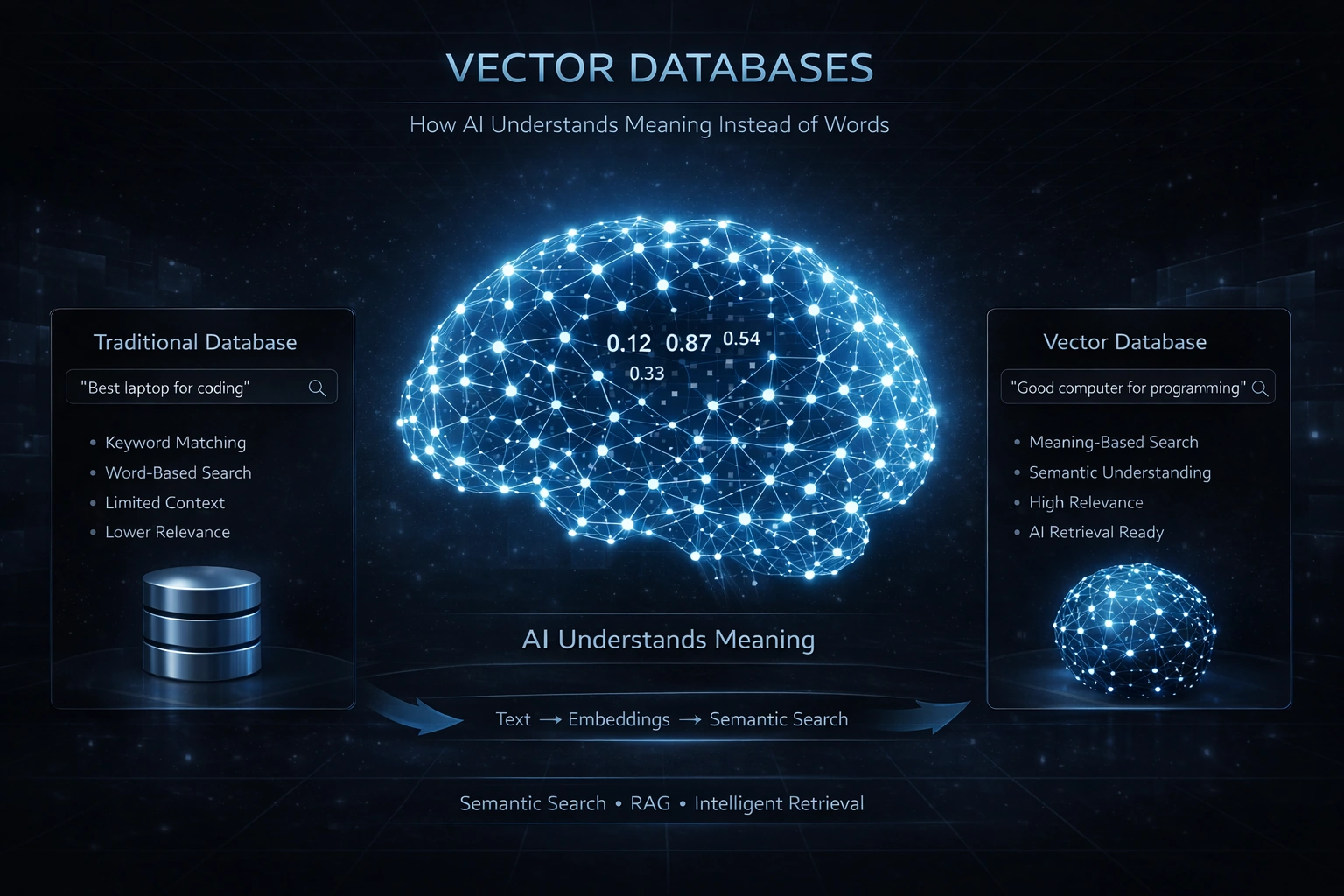
Traditional databases and search engines work on keyword matching.
If you search:
“Best laptop for coding”
The system looks for pages containing those exact words.
But if you search:
“Good computer for programming”
The words are different, even though the meaning is the same.
A keyword-based system may fail to recognize this similarity.
This is the fundamental limitation of traditional search:
It matches words, not meaning.
Modern AI needed a better solution.
How AI Represents Meaning
To understand meaning, AI converts text into numbers.
These numerical representations are called:
Vectors or Embeddings.
Every sentence, paragraph, or document becomes a point in a high-dimensional mathematical space.
Key idea:
• Similar meaning → vectors close together
• Different meaning → vectors far apart
This allows AI to compare concepts mathematically instead of relying on word matching.
What is a Vector Database?
A Vector Database is a specialized database designed to:
• Store vector embeddings
• Search for similar vectors efficiently
• Return meaning-based results
Instead of searching text directly, it searches vector similarity.
So rather than asking:
“Does this document contain the same words?”
It asks:
“Does this document have similar meaning?”
This is called: Semantic Search.
Why Vector Databases Are Essential for AI
Large Language Models like ChatGPT don’t store all knowledge internally.
They retrieve external information when needed.
This retrieval process works like this:
Your question is converted into a vector
The vector database finds closest matching vectors
Relevant documents are retrieved
The AI model generates the final answer
This architecture is known as:
Retrieval-Augmented Generation (RAG).
Without vector databases, RAG systems would not be possible.
Where Vector Databases Are Used Today
Vector databases now power many real-world AI systems:
• AI chatbots with knowledge bases
• RAG pipelines for enterprise AI
• Internal company document search
• Recommendation engines (movies, products, content)
• AI-powered research assistants
• Semantic enterprise search systems
They are a core building block of modern AI applications.
Popular Vector Database Technologies
Some widely used vector database solutions include:
• Pinecone
• Weaviate
• FAISS
• Chroma
• Qdrant
• Milvus
Each is optimized for high-speed similarity search at scale.
Why Developers Should Learn Vector Databases
As AI adoption grows, companies increasingly look for developers who understand:
• Embedding generation
• Vector storage systems
• Similarity search algorithms
• RAG pipeline architecture
• AI knowledge retrieval design
These skills are now part of modern AI system design.
The Future of AI Search
The future of information retrieval is:
• Meaning-based
• Context-aware
• Personalized
• AI-driven
Keyword search is the past.
Semantic vector search is the future.
Final Thoughts
Vector databases solve a critical problem in AI: They allow machines to search meaning, not words.
Every smart chatbot, AI assistant, or knowledge retrieval system relies on them.
As AI continues to evolve, vector databases will remain one of the most valuable technologies in the modern AI stack.
If you understand vector databases — you understand how intelligent AI actually thinks.
Join the conversation! Your thoughts help the community grow.