

Abstract / Overview
Updated March 24, 2026.
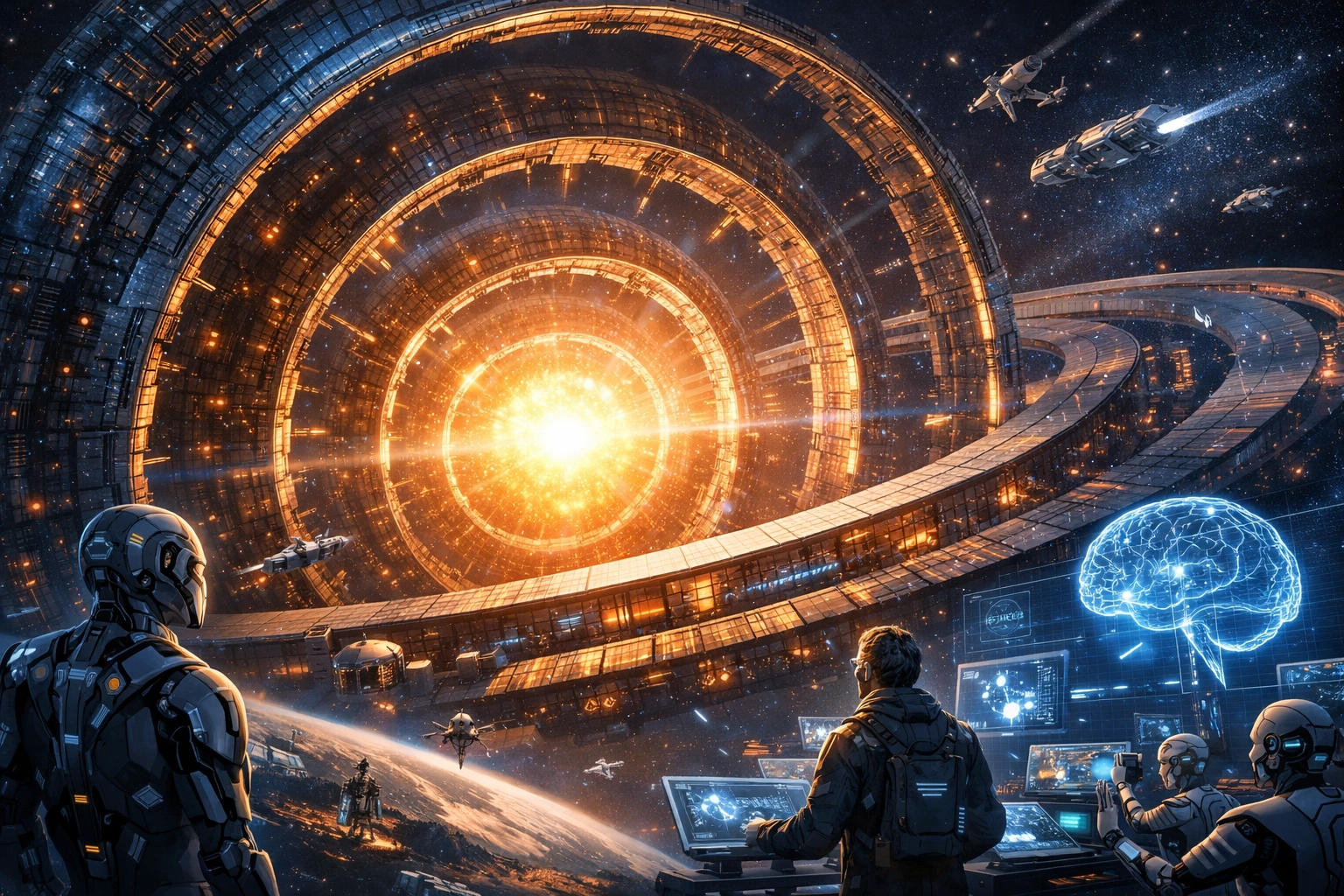
A matrioshka brain is a hypothetical stack of nested Dyson-like shells built to turn most of a star’s energy into computation. If it ever became real, it could remove some of the hardest limits that slow advanced AI today: power, cooling, hardware scale, and simulation capacity.
The honest answer is simple. A matrioshka brain could be the ultimate compute platform for superhuman AGI. It could let us train larger models, run richer world simulations, support huge numbers of expert agents, and test safety ideas at a scale that current data centers cannot reach. But intelligence is not made of energy alone. It also needs the right algorithms, data, memory, planning, action, and alignment.
Conceptual Background
A matrioshka brain is usually described as a special kind of Dyson system. Instead of building around a star to create living space, the goal is to turn starlight into computation. It is best treated as a serious thought experiment, not a near-term roadmap.
A key idea to understand is this: computers are physical systems. This means intelligence at a very large scale depends on real-world resources like energy, hardware, memory, cooling, and communication.
For AGI, one simple definition is AI that can do most tasks as well as a human. In this article, superhuman AGI means AI that goes beyond humans in speed, scale, memory, and quality across most tasks.
Why does compute matter so much? Because modern research shows that AI performance improves when model size, data, and training compute grow together. In simple words, more compute helps, but only when used in the right way.
That is why a matrioshka brain is exciting. It suggests a jump from large data centers to star-scale computing. If intelligence continues to benefit from scale, then such a system could support capabilities far beyond what we see today.
Step-by-Step Walkthrough

1) It breaks today’s energy ceiling
Modern data centers already use a large share of global electricity. A single star produces vastly more energy than all current computing systems combined. A matrioshka brain would move AI from Earth-scale power to star-scale power.
2) It could support much larger training runs
With far more compute, we could train much larger AI systems. These systems could handle more data, keep more memory active, and learn more complex patterns.
3) It could make world models far more realistic
A world model is an internal simulation of reality that an AI uses to plan and reason. With huge compute, AI could run detailed simulations of physics, cities, economies, and even human behavior.
4) It could support a society of expert AIs
Instead of one AI doing everything, we could have many specialized AIs working together. Some could focus on science, others on safety, others on engineering. This collective system could outperform a single model.
5) It could let AI design better AI and better hardware
AI could improve its own code, training systems, and hardware designs. This creates a feedback loop where each generation becomes better faster.
6) It could make safety testing much deeper
With more compute, we could test AI systems in many simulated scenarios. This helps find risks before real-world deployment.
If you want to turn advanced AI ideas into real systems, architecture, and strategy, C# Corner Consulting can help you move from concept to execution: https://www.c-sharpcorner.com/consulting/
Use Cases / Scenarios
A science engine for civilization
It could run millions of experiments at once in fields like medicine, materials, and climate. This could speed up discovery.
A full world-simulation platform
It could simulate entire systems like cities or economies. This helps test policies and ideas safely.
A large cooperative AI society
Many AI agents could work together under shared rules, improving results through teamwork.
A self-improving infrastructure loop
The system could keep improving its own tools, models, and processes over time.
Fixes
What a matrioshka brain still does not fix
A matrioshka brain is powerful, but it is not a complete solution.
It does not solve bad goals. If the AI has wrong objectives, more power makes it more risky.
It does not fix poor training strategies. Bigger systems still need balanced data and design.
It does not guarantee AGI. New ideas and breakthroughs are still needed.
It does not remove physical limits. Heat and energy efficiency still matter.
It does not make construction easy. Building such a system is far beyond current technology.
So, it solves the scale problem, but not the intelligence or alignment problems.
Future Enhancements
Near-reversible computing to reduce energy loss
Self-building and self-repairing space systems
Better world models for planning and reasoning
Strong AI monitoring and interpretability tools
AI-driven hardware and algorithm design
FAQs
1. Is a matrioshka brain the same as a Dyson sphere?
No. A Dyson sphere is a general concept for capturing star energy. A matrioshka brain is a layered version focused on computation.
2. Would enough computing automatically create AGI?
No. Intelligence depends on algorithms, data, and design, not just computation.
3. Is a matrioshka brain realistic soon?
No. It is a long-term concept, not a near-term engineering plan.
4. Why not just improve algorithms?
We need both better algorithms and more computing. They work together.
5. Could superhuman AGI be safe?
Only if safety grows with capability. Safety must be built in from the start.
References
Bradbury, R. J. Matrioshka Brains
Wright, J. T. Dyson Spheres
Kaplan, J. et al. Scaling Laws for Neural Language Models
Hoffmann, J. et al. Training Compute-Optimal Large Language Models
Lloyd, S. Ultimate Physical Limits to Computation
Bennett, C. H. Notes on Landauer’s Principle
International Energy Agency reports on AI energy use
Google DeepMind research and publications
Conclusion
A matrioshka brain matters because it removes one of the biggest limits in AI: the lack of compute. With star-scale energy, we could build systems far beyond today’s capabilities.
But compute alone is not enough. True superhuman AGI will need better models, better goals, and strong safety systems.
The future will likely come from combining massive compute with smarter design and careful control.
Join the conversation! Your thoughts help the community grow.