

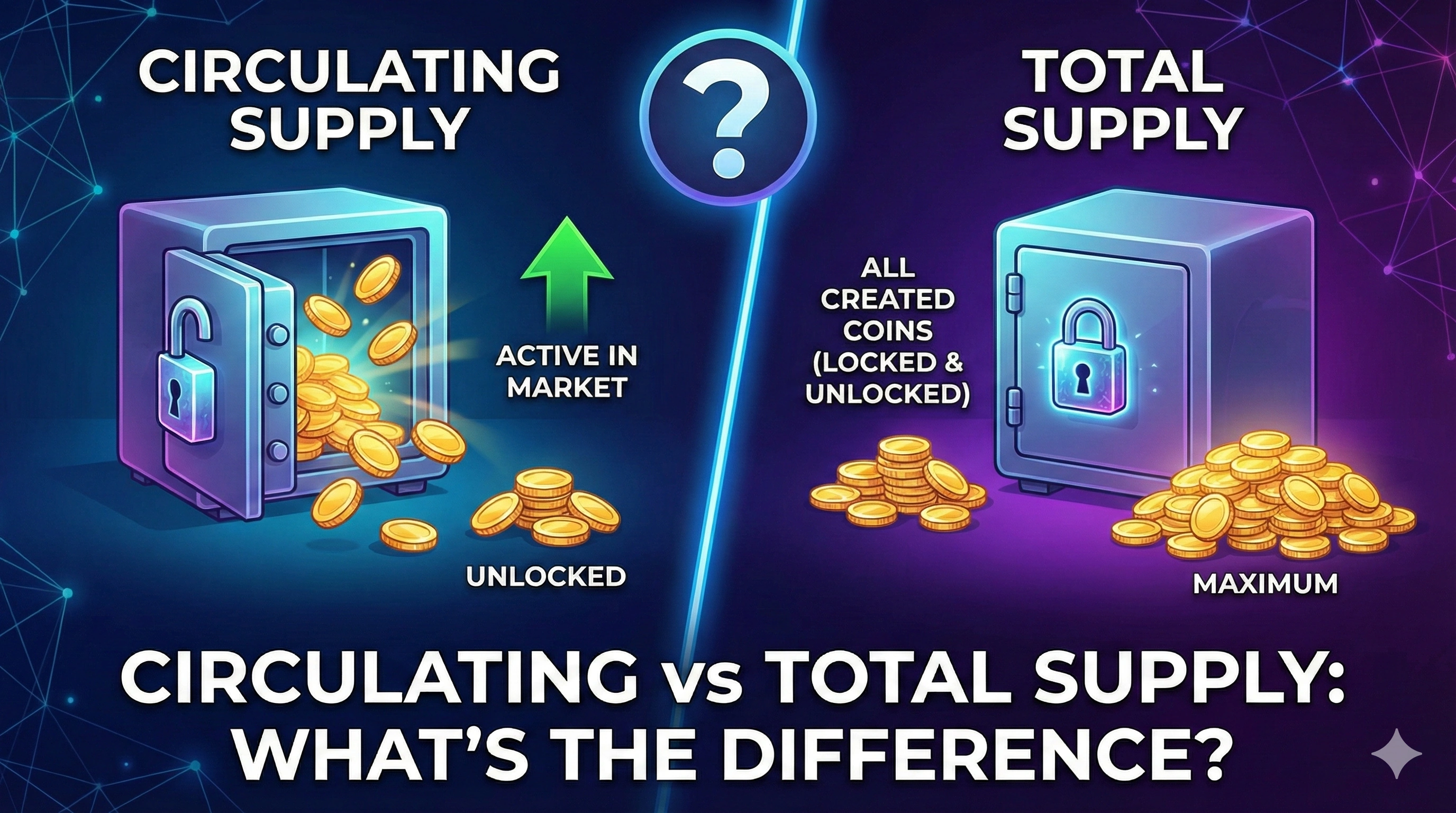
If you want to understand token price, market cap, FDV, liquidity needs, or investor behavior, you must understand one thing first.
Supply controls everything.
The crypto market misprices tokens every day because people confuse circulating supply with total supply. The difference between these two numbers decides how a token behaves after launch, how fast price moves, and how risky the investment really is.
Here is the simple but critical breakdown.
What Is Circulating Supply
Circulating supply is the number of tokens currently available and actively moving in the market. These tokens can be bought, sold, staked, traded, held in wallets, or used in the ecosystem.
Circulating supply includes
tokens listed on exchanges
tokens in public wallets
tokens distributed to users, investors, and partners
tokens earned through rewards that are unlocked
Circulating supply does not include locked, vested, or restricted tokens.
Circulating supply is what drives real price action because it reflects the number of tokens traders can buy or sell today.
What Is Total Supply
Total supply is the full number of tokens that exist, minus any tokens that have been burned. It represents the entire token supply whether it is unlocked, locked, vested, or in treasury.
Total supply includes
team tokens locked for years
investor tokens still vesting
community allocations not released
ecosystem reserves
treasury holdings
Total supply helps investors understand the full economic size of the token even if much of it is not circulating yet.
Why The Difference Between The Two Matters
Circulating supply affects current price. Total supply reveals future price pressure.
If circulating supply is small and total supply is huge, early price can look artificially high because only a tiny percentage of the tokens are trading. This often leads to the classic post launch crash when unlocked tokens start entering the market.
If circulating supply is healthy and unlock schedules are controlled, price is more stable and predictable.
How Supply Affects Market Cap and FDV
These two numbers completely change how investors view a token.
Market Cap
Price multiplied by circulating supply. Market cap reflects the token’s real value today.
Fully Diluted Value FDV
Price multiplied by total supply. FDV reflects the token’s potential value if all tokens were unlocked.
Example
If a token is priced at 1
Circulating supply is 10 million
Total supply is 1 billion
Market cap is 10 million
FDV is 1 billion
This means the token appears small today but has enormous future dilution risk.
Why Tokens With Low Circulating Supply Pump Hard
Low float means fewer tokens available for buyers. Small supply shocks create huge price swings. A few buyers can move the chart dramatically because liquidity is thin.
Low float pumps look exciting, but they usually collapse when vesting releases begin.
Why Tokens With High Circulating Supply Are More Stable
When most tokens are already circulating
sell pressure is visible
unlock surprises are minimal
market makers can stabilize liquidity
The price becomes more predictable and easier for institutional investors to evaluate.
How Founders Should Design Healthy Supply Models
Strong projects engineer supply intentionally.
The best practices include
slow vesting schedules
balanced emissions
transparent unlock calendars
healthy initial circulating supply
ecosystem utility that absorbs tokens
burn mechanics tied to platform activity
Projects like Sharp Economy implement practical models where circulating supply grows gradually, while utility driven activity reduces supply through burns and redemptions.
This avoids artificial pumps and prevents post launch crashes.
How Supply Impacts Liquidity Requirements
Liquidity must match circulating supply, not total supply.
Too little liquidity creates volatility.
Too much liquidity early makes the token capital inefficient.
Correct liquidity sizing requires circulating supply forecasting, market maker strategy, and treasury planning.
This is why many teams work with experts like Mahesh Chand and C# Corner Consulting to architect supply, vesting, and liquidity models before launch.
Conclusion
Founders must treat supply modeling as a core part of economic design. And teams designing new tokens should work with seasoned advisors to avoid long term structural problems.
For expert tokenomics and supply architecture, teams can connect with C# Corner Consulting
https://www.c-sharpcorner.com/consulting/
Join the conversation! Your thoughts help the community grow.