

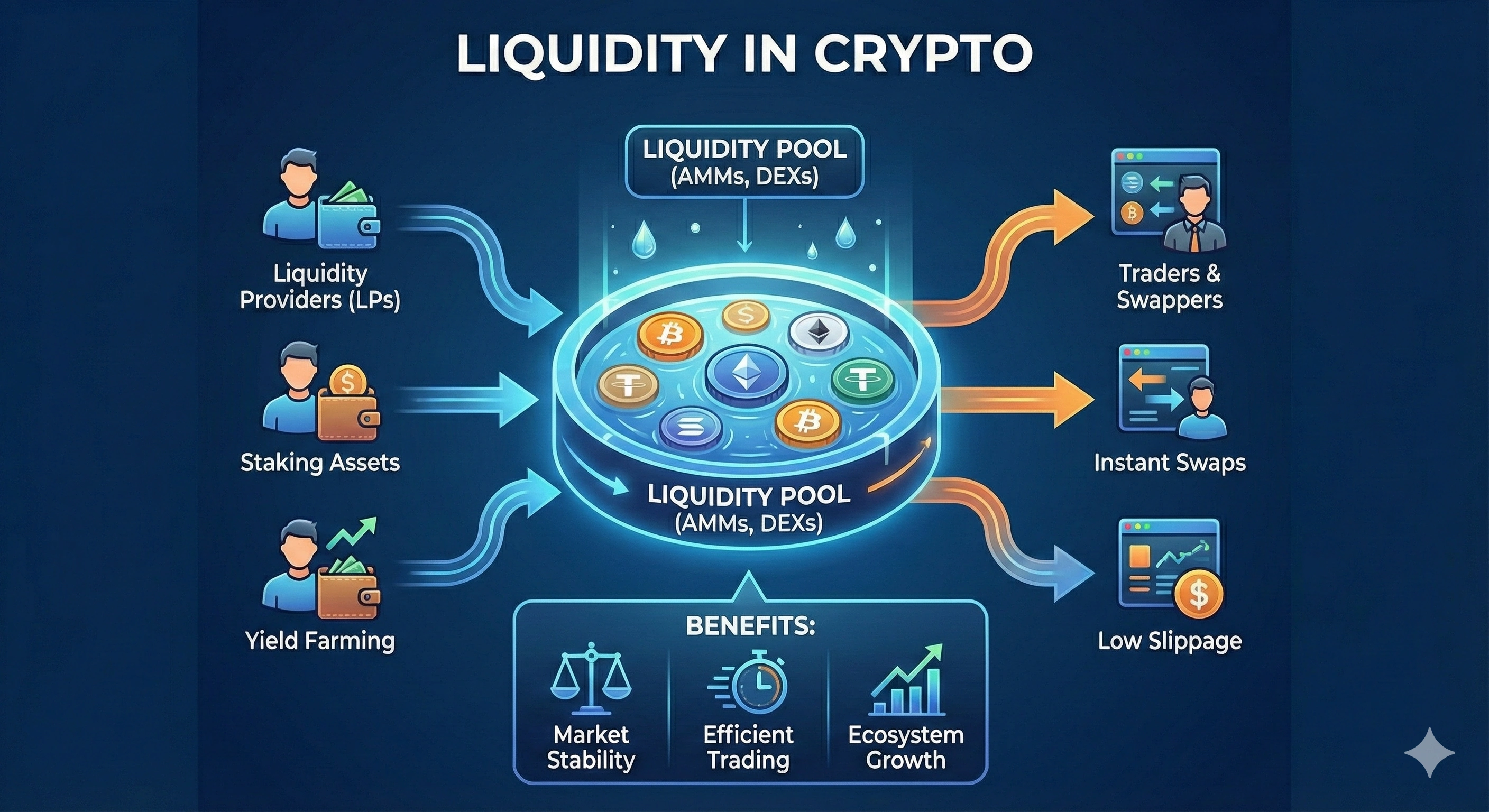
Liquidity is one of the most important concepts in crypto and also one of the most misunderstood. Many people focus on price, charts, or market cap, but liquidity is what determines whether those numbers are meaningful or fragile.
In simple terms, liquidity describes how easily a crypto asset can be bought or sold without significantly affecting its price. High liquidity means trades happen smoothly. Low liquidity means even small trades can move the market sharply.
Liquidity is not hype. It is structure.
Why Liquidity Matters More Than Price
Price tells you what the last trade happened at. Liquidity tells you whether that price can survive real trading activity.
A token can show a strong price but still be extremely weak if liquidity is thin. In that case, price is easily manipulated, slippage is high, and investors struggle to enter or exit positions safely.
How Liquidity Works In Crypto Markets
Liquidity exists wherever buyers and sellers meet.
On centralized exchanges, liquidity comes from order books. Buyers place bids, sellers place asks, and liquidity is measured by how much volume exists near the current price.
On decentralized exchanges, liquidity comes from liquidity pools. Users deposit pairs of assets into smart contracts, and trades happen against those pools using automated market maker formulas.
In both cases, liquidity determines how much capital the market can absorb without breaking.
Liquidity Pools Explained
A liquidity pool is a smart contract that holds two or more assets and allows users to trade between them. For example, a token paired with USDT forms a pool where trades are executed automatically.
The larger the pool, the smaller the price impact of each trade. The smaller the pool, the more volatile the price becomes.
Liquidity pool size directly affects slippage, which is the difference between expected price and executed price.
What Is Slippage And Why It Matters
Slippage happens when there is not enough liquidity to fill a trade at the expected price. The trade pushes the price up or down as it executes.
High slippage discourages serious investors. It favors bots and arbitrage traders. Healthy tokens aim to keep slippage low for normal trade sizes.
Liquidity is the only real solution to slippage.
Liquidity And Market Makers
Market makers play a critical role in crypto liquidity. They continuously place buy and sell orders or rebalance liquidity pools to keep markets active and spreads tight.
Market makers do not create demand, but they stabilize trading. When liquidity is deep and market making is professional, price behavior becomes smoother and more predictable.
Without market makers, most tokens experience chaotic price action.
Liquidity Vs Market Cap
Market cap is price multiplied by circulating supply. Liquidity is the capital actually available for trading.
A token can have a large market cap but poor liquidity. This usually means price can drop quickly under selling pressure.
Liquidity is a better indicator of market health than market cap alone.
Why Liquidity Is Critical At Token Launch
Token launches are the most fragile phase of a project. Circulating supply is low, emotions are high, and liquidity is often shallow.
Without sufficient liquidity, early trading becomes unstable. Price pumps and crashes scare long term investors and attract short term speculators.
Successful projects plan liquidity before they plan marketing.
Liquidity In DeFi Vs Centralized Exchanges
Decentralized exchanges rely on liquidity pools and incentives to attract capital. Liquidity grows through LP rewards, fees, and confidence in the protocol.
Centralized exchanges rely on order books and market makers. Liquidity quality depends on capital depth and professional market making.
Serious tokens plan for both environments and coordinate liquidity across them.
How Founders Should Think About Liquidity
Founders must treat liquidity as infrastructure, not as a launch checkbox. Liquidity must scale as circulating supply grows and as usage increases.
Ignoring liquidity planning leads to volatility, loss of trust, and long term price weakness even if the product succeeds.
Liquidity decisions should be rule based, transparent, and long term.
How Investors Should Evaluate Liquidity
Investors should look beyond price and ask simple questions. How much capital is available near the current price. How much slippage occurs on a normal trade. How stable is liquidity during market stress.
If liquidity disappears during volatility, risk is high.
Common Liquidity Mistakes In Crypto
Many projects launch with too little liquidity, spread liquidity across too many pools, over incentivize short term LPs, or ignore liquidity growth as supply unlocks.
These mistakes compound and are difficult to fix later.
Liquidity As A Competitive Advantage
Tokens with deep, stable liquidity attract more investors, larger trades, and exchange listings. Liquidity reduces manipulation and creates trust.
Over time, strong liquidity becomes a moat.
Why Expert Guidance Matters For Liquidity Strategy
Liquidity design touches tokenomics, incentives, treasury management, market making, and exchange relationships. Small mistakes can have large consequences.
This is why founders and teams work with Mahesh Chand to design liquidity strategies, structure LP programs, coordinate market makers, and plan long term market depth.
If you are launching a token or struggling with volatility, expert guidance can prevent years of damage.
You can contact Mahesh Chand through C# Corner Consulting here
https://www.c-sharpcorner.com/consulting/
Join the conversation! Your thoughts help the community grow.