

Introduction
Android has been very popular among developers and users for a long time now. Approximately 80 percent of mobile users are using Android-based smartphones worldwide.
Android is a very powerful, durable, and easy to operate OS. Moreover, it is changing very rapidly from touchscreens to foldable phones and from Android watches to Android auto. Since version 1.0 of Android when smartphones were just an idea, the Android OS has improved a lot and now smartphones are an integral part of our lives. They help us to stay in touch with others, organize our day, find restaurants and other desired places in the city and other such day-to-day tasks.
The latest version of Android is Android Q that is not yet fully released but is in talks because of many cool features. Let us discuss some of the newly introduced features of Android Q in this article.
Location Permission Changes
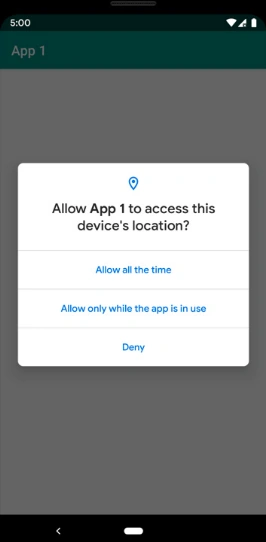
We can see there is a new option "Allow only while the app is in use". Previously, there were only two options - Allow and Deny. To support the new option, there is new permission called ACCESS_BACKGROUND_LOCATION. To enable this option, a developer needs to declare the permission in manifest like below.
To protect user privacy, the manual configuration of the list of Wi-Fi networks is now restricted to system apps and device policy controllers (DPCs). A given DPC can either be the device owner or the profile owner.
The app must have the ACCESS_FINE_LOCATION permission. If permission is denied, then your app cannot use several methods within the Wi-Fi, Wi-Fi Aware, or Bluetooth APIs when running on Android Q. The following list shows the affected methods according to Google.
- <manifest>
- <uses-permission android:name="android.permission.ACCESS_COARSE_LOCATION" />
- <uses-permission android:name="android.permission.ACCESS_BACKGROUND_LOCATION" />
- </manifest>
If your app runs on Android Q but targets Android 9 (API level 28) or lower, the following behavior applies.
- If your app declares a <uses-permission> element for either ACCESS_FINE_LOCATION or ACCESS_COARSE_LOCATION, the system automatically adds a <uses-permission> element for ACCESS_BACKGROUND_LOCATION during installation.
- If your app requests either ACCESS_FINE_LOCATION or ACCESS_COARSE_LOCATION, the system automatically adds ACCESS_BACKGROUND_LOCATION to the request.
Restriction on enabling and disabling Wi-Fi
- An app running on Android Q now cannot enable or disable the WiFi. The WifiManager.setWifiEnabled() method always returns false.
- If needed, we need to use the Settings panel to prompt users to enable and disable Wi-Fi.
Pravesh DubeyPosted May 24, 2019, 1:27 AM
Is this OS version has support for foldable phones ?