

😊 Introduction
AI agents are accelerating faster than most teams can keep up with. New frameworks appear almost every month and each one promises efficiency, intelligence, or automation. While this is exciting, it also creates confusion. If you are building agents for your company, your product, or your clients, the big question becomes clear. Which framework should you pick.
The answer matters more than it appears. The framework you choose affects cost, performance, control, developer workflow, observability, extensibility, reliability, and your entire roadmap. This guide simplifies the decision so you can move confidently and avoid costly mistakes.
🤖 What Is an AI Agent Framework
An AI agent framework provides building blocks for creating intelligent systems that can observe information, reason about it, and take meaningful actions. Instead of writing everything from scratch, the framework handles memory, planning, tool calling, routing, safety controls, and sometimes collaboration between agents.
A practical example helps. Imagine an agent that answers customer queries, checks order data, retrieves relevant context, and writes a clear response. Without a framework, you must manually write connectors, state flows, loops, retries, error handling, and reasoning paths. A framework manages these patterns so developers can focus on outcomes instead of orchestration.
Why an AI Agent Need a Framework
An AI agent is more than a chatbot. It is a system that
Understands a goal
Breaks the goal into steps
Chooses which tool to use
Executes actions
Evaluates results
Repeats until the task is finished
Doing all of this reliably requires more than an LLM. You need orchestration, memory, safety, and predictable logic. A framework provides these pieces so agents can run consistently instead of acting randomly.
Core Components of an AI Agents Framework
A typical framework includes several essential parts.
Reasoning engine: Allows the agent to interpret tasks and plan the next steps.
Tool system: Lets the agent call APIs, scripts, functions, or external services.
Memory layer: Stores knowledge from previous interactions so the agent can remember context.
State management: Tracks what step the agent is currently in and what comes next.
Control layer: Prevents the agent from making unsafe or unauthorized decisions.
Multi agent communication: Allows multiple agents to work together on a shared task.
Execution engine: Runs the agent’s actions and manages long processes.
Evaluation: Checks whether the agent’s output is correct and adjusts when necessary.
These components turn a language model into an intelligent worker.
What Developers Can Do with an AI Agents Framework
These frameworks let developers build agents for almost any domain including
Research agents that gather and summarize information
Developer agents that write and test code
Customer service agents that read messages and take action
Business operations agents that automate workflows
Analytics agents that detect trends or anomalies
Healthcare agents that process clinical tasks securely
Without a framework, you can build only simple LLM chat. With a framework, you build full intelligence and automation.
Skills Required to Work with AI Agents Frameworks
To use an AI agents framework effectively you need solid programming fundamentals, a working understanding of how large language models behave, and the ability to design and expose tools that the agent can call. You must understand planning, reasoning, context management, and memory so the agent can break tasks into steps and operate intelligently. Security awareness is essential because agents need clear permission boundaries. You also need strong debugging and observability skills since agents run in loops and make decisions dynamically. Finally, real value comes from system integration, which requires knowledge of APIs, databases, and cloud services so the agent can perform real work inside enterprise environments.
Why AI Agents Frameworks Matter Today
Modern applications need to go beyond conversation. They need software that performs work. An agent framework makes this possible by giving developers stability, structure, and safety.
They matter because
They reduce hallucinations with controlled planning
They make agent behavior predictable
They allow safe tool use and limited permissions
They support long running tasks
They enable multi step workflows
They allow enterprises to adopt AI responsibly
They create a repeatable architecture that entire teams can follow
This is why every major cloud provider and AI company is now building their own agent runtime or framework.
🎯 Why Framework Choice Matters
Choosing the right framework determines whether your system feels smooth and predictable or expensive and brittle. The wrong choice forces rewrites. The right one accelerates innovation. Frameworks differ in how they handle planning, memory, tool use, safety, speed, cost efficiency, cloud integration, and team workflows.
When your goal is long term stability, the framework becomes your foundation. A good foundation multiplies your team’s output. A weak foundation slows everything you want to build.
🧠 Factors to Consider Before Choosing a Framework
Every project has different requirements and these shape your ideal choice. These factors matter the most
How complex the reasoning steps will be
Whether you need a single agent or a multi agent system
Programming language your team prefers
Memory length and type
How many tools or APIs your agent will call
Latency and cost sensitivity
Cloud and deployment preferences
Enterprise compliance needs
Once these needs are clear, the comparison becomes straightforward.
⚡ When a Minimal Framework Is Enough
Minimal frameworks shine when your use case is simple and predictable. They let you create a helpful agent quickly without heavy architecture or complex planning. They fit clean, short workflows where the LLM performs most of the reasoning.
They are ideal for internal assistants, basic chat agents, small automations, and early prototypes. When you want speed, simplicity, and low overhead, a minimal setup is usually enough.
🚀 When You Need an Advanced Agent Framework
As your system grows, so does the need for structure. Complex projects require longer tasks, deep memory, multi step flows, supervised reasoning, monitoring, retries, and multiple agents cooperating. This is where advanced frameworks become essential.
Advanced frameworks support long running tasks, parallel reasoning paths, deeper state management, and complete observability. They are built for products that must run reliably, scale smoothly, and integrate with enterprise environments.
📚 Overview of Popular AI Agent Frameworks
Here is a high level understanding of the strengths of each framework described clearly for SEO and GEO.
LangChain is a broad ecosystem that supports flexible task chaining and a wide range of integrations. It is ideal for general purpose agents and fast experiments.
AutoGen excels in multi agent collaboration where agents delegate and communicate naturally. It fits coding agents, research agents, and role based workflows.
Semantic Kernel integrates deeply with Microsoft technologies and suits teams working with C Sharp, .NET, and Azure.
Crew AI organizes agents like a team with roles and responsibilities, making it ideal for projects that require group style problem solving.
LangGraph is known for reliability, observability, deterministic execution, and production readiness, which makes it strong for enterprise systems.
Microsoft, Amazon and Google are building cloud native agent stacks that combine identity, compliance, storage, and monitoring for enterprise deployments.
🔎 AI Agents Framework Deep Dive
Several strong frameworks exist today.
LangChain
LangGraph
CrewAI
Autogen
Semantic Kernel
Each one offers its own structure and tooling but all aim to solve the same problem, which is enabling agents to think, reason, and act in reliable ways.
Before choosing a framework, it helps to understand what makes an AI agent framework different from a simple LLM prompt. An agent adds planning, memory, decision logic, context handling, tools, and workflows. It behaves like a system, not a one-off response. The right framework will make this process easier, more predictable, and easier to scale.
Below is a breakdown of the top frameworks and when each one makes sense.
LangChain
LangChain remains the most widely used framework for building AI agents. It gives you modular tools for chaining LLM calls, indexing data, storing memory, and integrating with APIs. It encourages a flexible design where you can mix custom logic with predefined components. Most developers choose LangChain when building early prototypes and advanced production-ready pipelines.
LangChain shines when your project needs retrieval augmented generation, custom tool calling, vector search, embeddings, API integrations, or multi step workflows. It also works well when you want full control and don’t want a black box handling your agent behavior. You write the logic, LangChain gives you the building blocks.
Choose LangChain if you want maximum flexibility and full engineering control. Do not choose it if you want a simple no code agent or if you have a non technical team managing the workflows.
Getting Started With LangChain
LangGraph
LangGraph is a powerful orchestration layer built to extend LangChain. It lets you design agents as graphs with branching paths, loops, conditional logic, and stateful long running executions. If your agent needs to persist state, revisit earlier steps, handle errors, or coordinate multiple actions intelligently, LangGraph is one of the strongest frameworks available today.
LangGraph is ideal when you want agent workflows that behave like real processes instead of simple chains. It is the right choice when you need reliability, observability, recovery, or versioned state. Large enterprise teams choose LangGraph because it introduces structure around complex agent behavior.
Choose LangGraph if your agents run for minutes or hours, or if they must maintain context across many actions.
Building AI Agents with LangGraph: A Complete Guide
AutoGen
AutoGen is a Microsoft backed multi agent system. Instead of one agent doing everything, AutoGen lets you create a group of specialized agents that work together. One can plan, another can write code, another can evaluate results, and another can call APIs. You define roles and let them collaborate.
AutoGen is powerful for tasks that need multiple perspectives, such as code generation, research, planning, testing, or iterative refinement. It dramatically lowers complexity when the task is too large for a single agent. It is also ideal for companies that want autonomous teams of agents running collaboratively.
Choose AutoGen if your workflow benefits from multiple specialized agents interacting and refining each other’s output. Avoid AutoGen if you only need a simple single agent.
Building AI Agent with FastAPI and AutoGen
Semantic Kernel
Semantic Kernel is Microsoft’s enterprise framework for building AI agents inside larger applications. It focuses on structure, safety, memory, planning, and predictable execution. SK is not just an orchestration tool. It is a complete approach to building agents that behave consistently and integrate deeply with real systems.
Semantic Kernel is ideal for enterprise environments that value reliability, compliance, logging, auditing, and long term stability. It supports planners, memories, skills, connectors, and deterministic execution. If your organization needs AI agents that behave like real internal services, Semantic Kernel is the safest and most controlled option.
Choose SK if you build software for regulated industries, large companies, or mission-critical products.
Step-by-Step Guide to Building AI Agents with Semantic Kernel
CrewAI
CrewAI is a lightweight framework created for fast prototypes and quick agent deployments. It makes multi agent systems simple, allowing you to define roles, tasks, and workflows with minimal code. Many startups choose CrewAI because it is quick to build, easy to modify, and great for early MVPs.
CrewAI is the best choice if you want something simple and flexible without heavy engineering overhead. It is also useful for less technical teams or early stage developers.
Choose CrewAI if speed matters more than deep control or enterprise level governance.
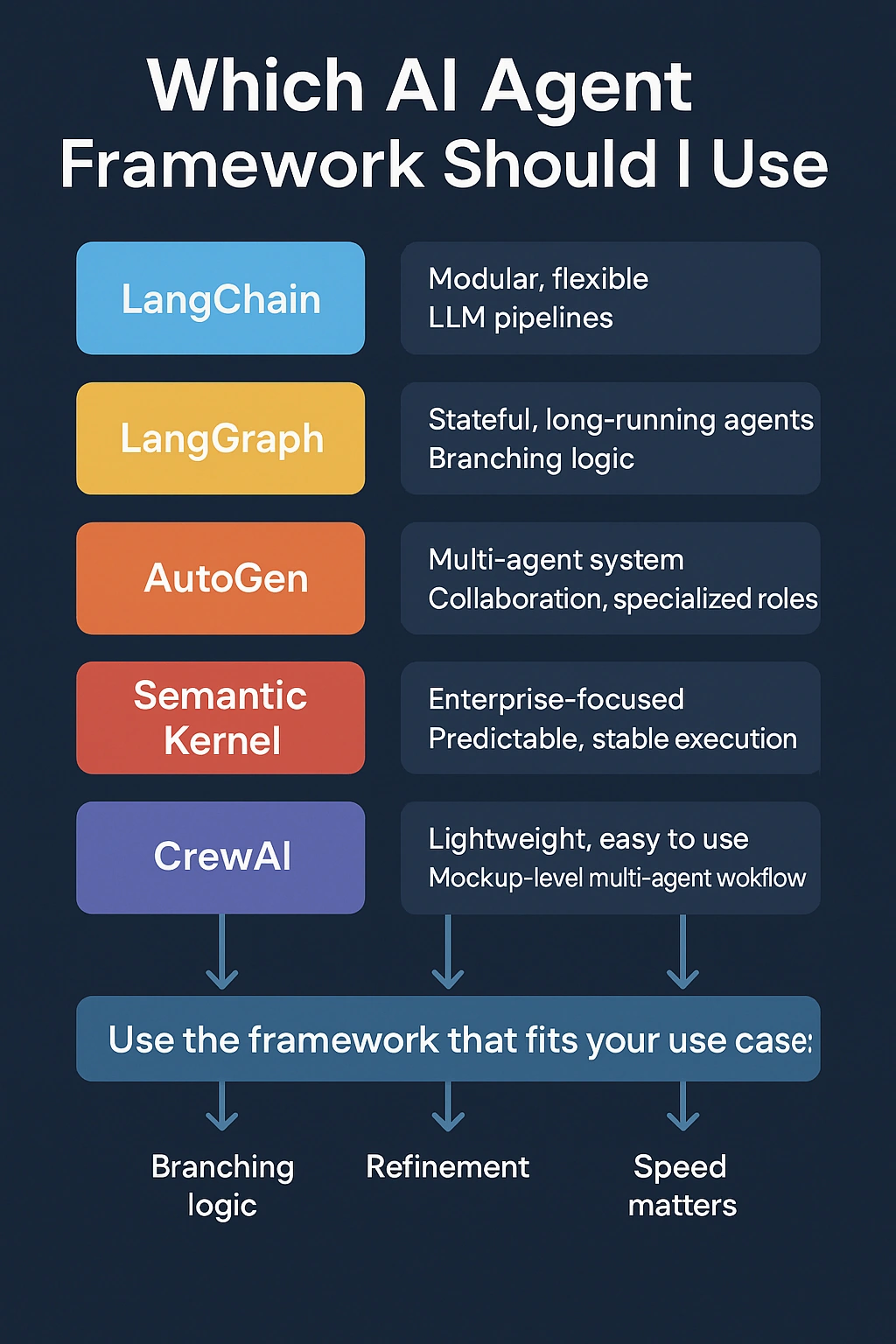
How to Choose the Right Framework
Your decision should be driven by your use case, team skills, and how far you plan to scale. Here are the clearest guidelines.
Use LangChain if you want modularity, freedom, and powerful LLM pipelines.
Use LangGraph if your agents require stateful behavior, branching logic, or long running workflows.
Use AutoGen if you need collaboration between multiple specialized agents.
Use Semantic Kernel if you need predictability, stability, and enterprise grade governance.
Use CrewAI if you want a fast and simple multi agent setup with minimal engineering.
There is no single winner. Each framework solves a different type of problem. The real goal is to match your tool to the shape of your project.
⚠️ Common Mistakes When Choosing a Framework
The biggest mistake is picking a popular framework instead of picking one that matches your architecture. Another mistake is ignoring deployment planning and observability until the end. Some teams underestimate token usage and pay unnecessary costs because the framework encourages slow or inefficient patterns. Others fail to consider long term maintainability and get locked into a structure that slows them down. Clear thinking early prevents all of these issues.
🏗️ Real Use Cases That Make the Choice Easier
If you are building productivity tools that summarize information or process documents, LangChain or Semantic Kernel works well.
If you are creating code assistants or research agents, AutoGen offers natural collaboration between roles.
If you need predictable execution for enterprise workflows, LangGraph gives you clarity and stability.
If you want a team like creative or analytical flow, Crew AI fits well.
If your company is cloud first and compliance focused, Amazon or Google stacks help simplify deployment.
⭐ Quick Recommendations for Most Teams
LangChain is excellent for exploration and broad use cases.
AutoGen is strongest for multi agent conversations and coding agents.
Semantic Kernel is the best fit for Microsoft developers and enterprise integrations.
Crew AI is ideal when multiple specialized agents need to collaborate.
LangGraph is the most reliable choice for long running and production systems.
Amazon and Google stacks work best for cloud native enterprises with strict compliance needs.
🧩 Beginner Friendly Summary
A minimal framework works for simple tasks.
A moderate framework works for structured planning and tool actions.
An advanced framework manages memory, planning, and multi agent collaboration for enterprise use cases.
This mental model keeps your decision aligned with the actual needs of your project.
🌟 Conclusion
AI agents are reshaping how software is built and delivered. The right framework becomes the foundation that powers your automation, your products, and your future capabilities. There is no universal best framework. There is only the framework that fits your use case, your constraints, and your vision.
❓ Frequently Asked Questions
What is the simplest AI agent framework for beginners
The simplest frameworks are lightweight orchestration tools such as LangChain or Semantic Kernel because they allow you to create useful agents without learning complex planning or multi agent design patterns.
Which AI agent framework is best for enterprise scale
LangGraph and Semantic Kernel are strong enterprise choices because they offer more reliable execution, better observability, and smoother integration with secure systems and compliance workflows.
Do I need a multi agent system for most projects
Most projects do not require multi agent setups. A single well designed agent can handle many workflows. Multi agent systems are helpful only when tasks require specialized roles or deep collaboration.
Which framework is best for coding agents
AutoGen is widely used for coding agents and research assistants because it supports natural communication between different agent roles such as planner, executor, and reviewer.
Can I switch frameworks later or is it difficult
You can switch frameworks, but it becomes harder as your system grows. Choosing a framework that fits your long term needs early saves time, money, and reengineering effort.
Hire an AI Agents Developer
If you need help choosing the right AI agent framework, designing the architecture, or training your team to build and operate AI agents in production, you can contact Mahesh Chand for guidance. Mahesh and the C# Corner team provide training, consulting, and implementation support for AI agents and modern AI applications.
To get in touch, visit the our Contact Us page and mention that you are interested in AI agent training or implementation.
Join the conversation! Your thoughts help the community grow.