Today, AI has become a basic human need and we're using it in our daily lives like we use a phone, gas, or water. If you don't understand how it works and what drives AI's cost, it will be impossible for you to build scalable and cost effective AI systems. In this article, I will explain what drive the cost of AI and how can reduce it.
Today, consuming AI mostly means consuming AI models, Large Language Models (LLMs) and other models. While these models look simple from the outside. You type a prompt and you get an answer or ask to solve a problem and the solution is there, but under the hood, however, you are triggering one of the most compute intensive systems ever deployed at global scale. Training is only part of the story. Inference, memory bandwidth, architecture design, latency guarantees, safety layers, and infrastructure redundancy all contribute to price.
If there is a simple question you can search in Google or your browser, there is no need for you to go to ChatGPT and ask a question. You're wasting resources on that.
Let us break this down properly what drives the cost of AI:
🏗️ The Core Transformer Architecture
At the heart of every modern LLM is the Transformer architecture.
Here is a simplified structural diagram of a transformer block:
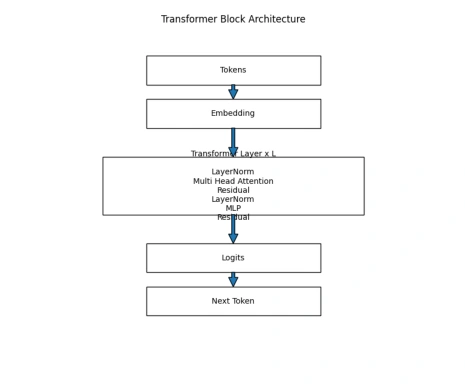
What is happening here?
Tokens are converted into embeddings
The model runs through L layers of transformer blocks
Each block contains
Logits are produced
The next token is generated
The expensive components are the matrix multiplications inside attention and MLP layers. These are massive dense linear algebra operations executed on GPUs.
If a model has:
More layers
Wider hidden dimensions
More attention heads
It performs more floating point operations per token.
More math means more GPU time. More GPU time means higher cost.
📈 Why Attention Is Expensive
The most important scaling issue is self attention.
Here is what happens conceptually:
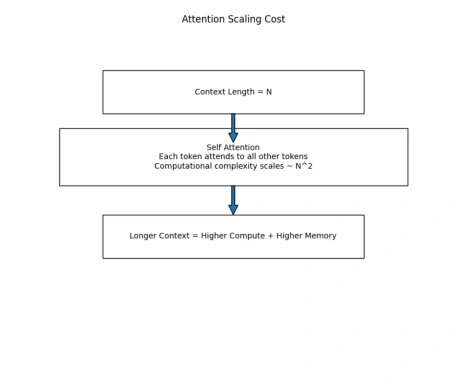
If context length is N:
Each token attends to every other token.
That means compute roughly scales with N².
If you double context length:
Attention compute roughly quadruples
Memory for KV cache grows
GPU bandwidth pressure increases
This is why long context models are significantly more expensive to serve than short context models, even if parameter counts are similar.
🧠 What you are paying for
1) Training compute
Training is basically renting massive GPU clusters for weeks or months.
Key cost drivers
Total floating point operations, roughly scales with parameter count and training tokens
GPU hours, plus networking between GPUs
Failed runs and restarts, large runs regularly hit instability and require retries
Simple mental model
More parameters, more training tokens, more experiments, more cost.
2) Data pipeline and data licensing
Costs that people underestimate
Collecting data at scale, crawling, storage, deduplication
Cleaning, filtering, language detection, quality scoring
Licensing high quality corpora, code, books, news, scientific content
Creating synthetic data, paying other models to generate training material
3) Post training, alignment, and “making it useful”
After base training, a lot of compute and human work goes into making the model behave well.
Includes
Supervised fine tuning on instruction data
Preference training such as RLHF or similar methods
Safety training, policy tuning, refusal behavior
Tool use training, structured output training
Specialized capability training such as coding, math, reasoning, agents
This stage can be a large fraction of the total effort even if the compute is smaller than base training.
4) Evaluation, red teaming, and reliability engineering
To ship a model, you need
Large benchmark suites, many of them internal
Adversarial testing, jailbreak testing
Regression testing across versions
Monitoring, incident response, rollbacks
This is staff time plus significant compute for eval runs.
5) Inference compute, the “everyday cost”
This is the cost to answer your prompt right now, at low latency, at high reliability.
A key point: inference cost scales with usage, not with training.
Two main pieces
Prefill, processing your input context
Decode, generating output tokens one by one
Decode is especially costly because it is sequential and latency sensitive.
6) Memory bandwidth and the KV cache tax
When generating tokens, the system stores attention keys and values for each layer so it does not recompute them. This is great for speed, but expensive in GPU memory.
Long context means bigger KV cache, which means
Fewer requests can fit on a GPU at once
More expensive hardware needed to maintain throughput
More complex scheduling
7) Serving infrastructure, not just GPUs
Real production cost includes
GPU servers, CPU hosts, RAM, NVMe, racks
High speed networking such as InfiniBand
Data center power and cooling
Redundancy across regions, failover capacity
Load balancers, gateways, rate limiting, abuse prevention
Power alone is a serious line item for dense GPU clusters.
8) Latency and availability requirements
If you want fast responses, you often cannot batch requests as aggressively. That reduces GPU utilization, and wasted utilization is paid for anyway.
If you want high availability, you keep spare capacity hot. That also costs money.
9) Tooling, orchestration, and product integration
Many “LLM calls” are not one model run. They can include
Router model, selects the best model
Safety classifier passes
Retrieval, embedding model, vector search
Tool calls, code execution, sandboxing
Reranking, summarization, formatting
So the price can reflect an entire pipeline, not one forward pass.
10) Business reality
Even if the raw compute cost is X, the price includes
Engineering and research payroll
Support and enterprise features
Compliance, audits, legal
Profit margin, reinvestment
Risk pricing for misuse, abuse, chargebacks
🏗️ The core architectural reason it is expensive
Transformers are heavy matrix math plus attention. Attention gets costly as context grows.
A minimal transformer block
Here is the core shape.
Tokens
  |
Embedding
  |
Repeat L times
  |
  +------------------------------+
  | LayerNorm                    |
  | Multi Head Self Attention    |
  |   Q K V projections          |
  |   Attention scores           |
  |   Weighted sum               |
  | Residual add                 |
  | LayerNorm                    |
  | MLP, two large matmuls       |
  | Residual add                 |
  +------------------------------+
  |
Logits
  |
Next token
The expensive parts are the large matrix multiplications in attention and MLP, repeated across many layers.
Why long context gets expensive
Self attention must compare tokens to tokens.
Context tokens length = N

Attention needs relationships across tokens

Token1 compares to Token1..TokenN
Token2 compares to Token1..TokenN
...
TokenN compares to Token1..TokenN

Total comparisons scales like N squared
Even with optimizations, longer context usually means higher cost and lower throughput.
Why output tokens cost money too
Generation is sequential.
You ask for 500 output tokens

Token1 must be generated before Token2
Token2 before Token3
...
Token499 before Token500
That limits batching and keeps GPUs busy longer per request.
🧾 What specifically makes one model more expensive than another
1) Bigger model, more layers or wider layers
More parameters usually means
More compute per token
More memory traffic per token
More expensive GPUs needed to hit latency targets
2) Longer context window
Longer context increases
Prefill compute
KV cache memory
Scheduling complexity
Latency variance
So a 200k context model can be dramatically more expensive to serve than a 8k context model, even if parameter counts are similar.
3) Better reasoning often means more internal compute
Some models do more “thinking work” per answer, either explicitly by generating more hidden steps, or implicitly by using architectures that allocate more compute. More compute per user visible token means higher cost.
4) Multimodality
Vision, audio, video add big overheads
Image tokens are not free, encoders are heavy
Audio is long sequence data
Video is far more expensive than text
5) Mixture of Experts changes the cost trade
MoE can reduce cost per token if only a subset of experts are active, but it adds complexity, routing overhead, and sometimes higher memory footprint. Some MoE deployments are cheaper, some are not, depending on how they are served.
Dense model
All weights active every token

MoE model
Router selects a few experts each token
Only selected experts run
6) Quantization and distillation
Cheaper models often use
Lower precision weights such as int8 or int4
Distillation, a smaller student model trained from a larger teacher
These reduce inference cost, sometimes at the expense of peak quality or robustness.
7) Throughput engineering maturity
Two models with similar size can have very different real cost because of
Kernel optimizations
Better batching
Better memory layout
Smarter KV cache management
Better serving stack
8) Safety and policy overhead
Some offerings run extra passes
Input safety scan
Output safety scan
Policy aware decoding constraints
That adds compute and latency, which adds cost.
🔁 End to end serving pipeline diagram
This is what a “single request” often looks like in production.
Client
  |
API Gateway
  |
Auth, rate limit, logging
  |
Prompt moderation
  |
Router decides model
  |
Optional RAG
  |   embedding model
  |   vector DB search
  |   reranker
  |
Main LLM inference
  |   prefill
  |   decode with KV cache
  |
Output moderation
  |
Post processing
  |
Response
If you pay for an enterprise grade endpoint, you are often paying for this entire chain, plus the capacity reserved to keep it fast.
🧩 A practical way to think about price per 1M tokens
Your price typically reflects a blend of
GPU seconds per token, mostly driven by model size, context, output length
Utilization efficiency, batching, hardware choice
Overhead pipeline, safety, routing, RAG
Reliability and spare capacity
Business margin
If you tell me which scenario you care about, long context summarization, coding agent, chat support, or realtime voice, I can map the dominant cost drivers and show where you can cut cost without wrecking quality.
🚀 Why Smaller Models Are Cheaper
Smaller models can:
Fit on fewer GPUs
Batch more requests
Reduce memory footprint
Lower electricity usage
Improve throughput
This is why distilled or quantized models are cheaper to operate.
However, you may sacrifice:
Reasoning depth
Robustness
Multilingual ability
Edge case handling
It is always a tradeoff between quality and compute.


Join the conversation! Your thoughts help the community grow.