

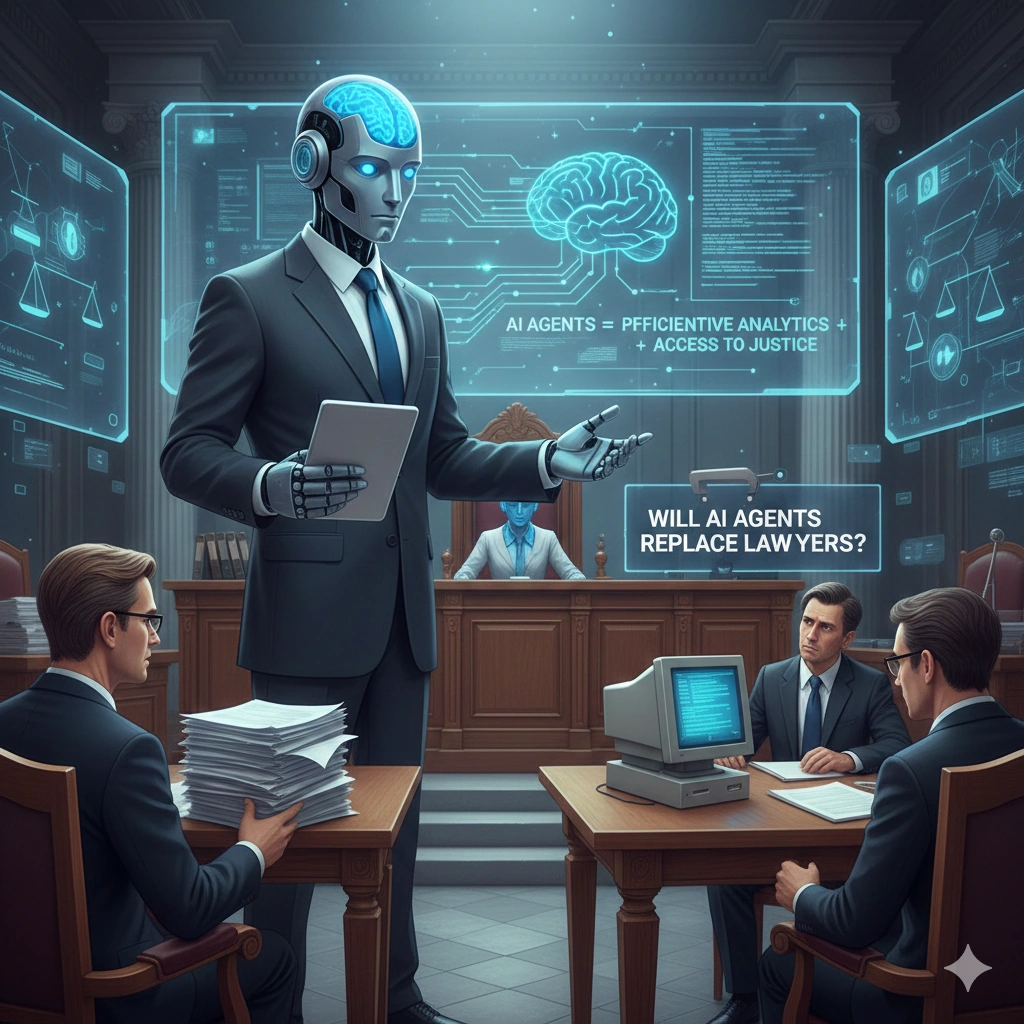
AI and AI Agents are replacing humans in various industries and lawyers are being affected as well. And today, one of the most common question being asked is:
Will AI agents replace lawyers?
Most people try to soften the answer. They say things like “AI will just assist” or “lawyers will always be needed.” That sounds reassuring, but it avoids the reality many firms are already living with.
The truth is simpler and less comfortable.
Yes, AI is reducing the number of lawyers needed to do the same work. And when fewer people are needed, some roles disappear. That is replacement, whether we like the word or not. Like technology developers, writers, creators, and other jobs, AI will reduce the number of human lawyers need to do the same job. In other words, it will replace some human roles for sure.
Here is an example from my personal experience: Before ChatGPT, for every NDA, employee or contract agreement, or review a legal, I used to send it to my attorney. Now, this is all done by ChatGPT. Now, if you tell me how AI has not replaced attorneys? I've replaced an attorney with AI, for sure.
Why this feels different from past technology shifts
Law has always used technology. Word processors replaced typewriters. Email replaced fax machines. Legal databases replaced shelves of books. But those changes made lawyers faster without fundamentally changing how many were needed.
AI is different because it replaces human effort, not just tools.
Tasks that once required teams now require supervision. Work that justified entire departments now runs continuously in the background. The bottleneck is no longer time or manpower. It is judgment and accountability.
That changes everything.
What actually happens inside firms using AI
Take a firm that used to staff ten lawyers on a certain type of work. Contract review, discovery, research, compliance. Once AI agents are fully integrated, that same firm may only need four or five lawyers to oversee the same volume of work.
The output does not drop. In many cases, it improves. Turnaround is faster. Errors are caught earlier. Costs go down.
At that point, the question is not philosophical. It is economic.
No firm competing for clients can justify keeping extra headcount simply to preserve tradition.
Where the cuts happen first
AI does not come for senior partners first. It works its way up from the bottom.
The roles most exposed are the ones built around repetition. Junior associates reviewing documents. Lawyers spending long hours researching settled law. Large discovery teams sorting through endless files. Compliance roles focused on checking boxes.
These jobs were never about creative judgment. They were about processing volume. AI does volume better than humans ever could.
As those roles shrink, the traditional pyramid structure of law firms starts to flatten.
Why lawyers are not disappearing altogether
Even with heavy automation, law does not run itself.
Someone still has to stand in court. Someone still has to advise a client when the rules are unclear or the risks are high. Someone still has to be accountable when a decision leads to consequences.
AI does not carry a license. It does not have ethical obligations. It cannot be sued for malpractice. It does not earn trust the way people do.
That is why lawyers remain essential. But essential does not mean numerous.
The part no one likes to say out loud
The future has fewer lawyers. Not the same number doing different tasks. Fewer, period. What AI really does is concentrate capability. A small group of lawyers, equipped with AI, can now handle work that once supported large teams. Those lawyers become more productive, more profitable, and more influential. Others get squeezed out. This is not unique to law. It already happened in journalism, software development, and finance. Law is simply experiencing it later.
As AI keeps improving, what changes next
AI will continue to automate more legal work. That part is inevitable. But automation does not remove the need for human ownership. Instead, it shifts the role of the lawyer. Less time drafting and reviewing line by line. More time setting strategy, making judgment calls, managing risk, and explaining consequences to real people. The lawyer becomes less of a worker and more of an operator. Those who adapt to that role do well. Those who do not struggle to justify their place.
What this means for legal careers
The old path into law relied on years of junior work as training. That path is breaking down. When junior work disappears, so does the traditional apprenticeship model. Future lawyers will need to be effective sooner. They will need to understand AI tools, workflows, and limitations as part of their basic skill set, not as an optional add on. Law schools and firms that ignore this shift are doing a disservice to the next generation.
Who thrives in this new reality
Lawyers who accept the shift instead of denying it.
Those who use AI daily, not occasionally.
Those who focus on judgment, negotiation, litigation, and advisory work.
Those who price their services based on outcomes, not hours.
For them, AI is not a threat. It is leverage.
Who struggles
Lawyers whose value is measured mainly by time spent.
Firms built entirely around billable hours.
Professionals who dismiss AI as hype or a passing trend.
The market is already moving away from them.
Conclusion
So will AI agents replace lawyers? They already are, in the sense that fewer lawyers are needed and entire roles are disappearing. At the same time, the lawyers who remain are becoming more powerful and more central to the work that actually matters.
The choice facing every lawyer and firm is straightforward. Adapt to the new reality and grow stronger. Or hold onto the old model and slowly fade out of relevance. That is not a prediction. It is what is already happening.
Hire Mahesh Chand for Integrating AI in Law Offices
If you want AI agents that work in real production systems, experience matters.
Mahesh Chand is a veteran technology leader, former Microsoft Regional Director, long-time Microsoft MVP, and founder of C# Corner, one of the world’s largest global developer communities. He has decades of experience designing and advising enterprise systems across healthcare, finance, and regulated industries.
Through C# Corner Consulting, Mahesh helps organizations design, build, and deploy AI agents with proper architecture, governance, and ROI focus. He also delivers practical AI Agents training for executives, architects, and engineering teams, focused on real-world implementation rather than theory.
Learn more at https://www.c-sharpcorner.com/consulting/
Join the conversation! Your thoughts help the community grow.