

If you look up the definition of a perfect number in Wikipedia it states - "A Perfect number is defined as a positive integer which is the sum of its proper positive divisors (not including the number itself)". For example, 6 is a perfect number because its divisors are 1,2, and 3. 1+2+3 = 6. In this C# Corner BLOG, we show you how to use LINQ to search for all perfect numbers up to 10000.
Euclid proved that
2n-1(2n - 1)
gives an even perfect number whenever 2n-1 is prime.
Here are some other cool facts about perfect numbers:
1) if you sum the reciprocal of the divisors, they always equal 2:
e.g. 1/1 + 1/2 + 1/3 + 1/6 = 2
2) The only even perfect number of the form x^3 + 1 is 28
3) The first 39 even perfect numbers are 2n-1(2n - 1) for
- n = 2, 3, 5, 7, 13, 17, 19, 31, 61, 89, 107, 127, 521, 607, 1279, 2203, 2281, 3217, 4253, 4423, 9689, 9941, 11213, 19937, 21701, 23209, 44497, 86243, 110503, 132049, 216091, 756839, 859433, 1257787, 1398269, 2976221, 3021377, 6972593, 13466917
(The numbers start getting quite large after 7)
Anyway here is the linq code that finds the numbers with n = 2,3,5,7. It loops through all numbers from 1-10000, gets each numbers divisors with LINQ and sums the divisors with LINQ. If the sum of the divisors equals the number itself, we found a perfect number.
private static void WriteOutPerfectNumbers(){
List<int> allNumbers = new List<int>(); // list of range of numbers to check List<int> perfectNumbers = new List<int>(); int numbersToSearchTo = 10000; // look for perfect numbers up to 10000 // get a list of all numbers from, 2 - 10000 (1 is not considered perfect) var allNumbersVar = System.Query.Sequence.Range(2, numbersToSearchTo - 1); allNumbers = allNumbersVar.ToList<int>();// loop through all numbers and see if each one is perfect
for (int nextNumber = 1; nextNumber < allNumbers.Count; nextNumber++)
{
// first get all the unique divisors of the number
List<int> divisors = new List<int>(); var allPossibleFactors = System.Query.Sequence.Range(2, nextNumber); var divisorsVar = from num in allPossibleFactors where nextNumber % num == 0 && (int) nextNumber > num select num; divisors = divisorsVar.ToList<int>(); divisors.Insert(0, 1); // insert 1, because it counts as a divisor // if the number is not prime, check it for 'perfection'if (divisors.Count() > 1)
{ // get the sum of the divisors
int sumVal = divisors.Sum(); // if the sum of the divisors equals the number itself
// we found a perfect number!! if (sumVal == nextNumber)
{
perfectNumbers.Add(nextNumber);
}
}
}
// write out all the perfect numbers we foundforeach (var num in perfectNumbers)
{
Console.Write("{0}, ", num);
}
Console.WriteLine();
Console.ReadLine(); // wait for enter key to exit
}
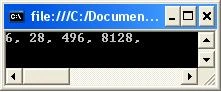
If your run this method in .NET 3.0, you should get the following output
Glenn WestmorePosted Jun 4, 2016, 4:53 AM
Unique beauty of numbers can be seen in patterns they form. If you are interested in number theory and recreational mathematics, and wish to practice your programming skills further, indulge yourself with these number curiosities: http://www.glennwestmore.com.au/category/advanced-number-curiosities/ or http://www.glennwestmore.com.au/category/number-curiosities/