

Basically a WCF Contract is an agreement between the two parties, in other words a Service and a Client. In Windows Communication Foundation, contracts can be categorized as behavioral or structural.
Behavioral Contracts
- The ServiceContract attribute marks a type as a Service Contract that contains operations.
- OperationContract attribute marks the operations that will be exposed.
- FaultContract defines what errors are raised by the service being exposed.
Structural Contracts
- The DataContract attribute defines the types that will be moved between the parties.
- The MessageContract attribute defines the structure of the SOAP message.
In this WCF Tutorial, we will discuss and implement contracts in Windows Communication Foundation using a step-by-step approach with practical examples.
Service Contract and Operation Contract
A Service Contract basically describes the operations a service exposes to another party (in other words a client). We can map a WCF Service Contract to a Web Service Description Language (WSDL).
It's recommended to apply the ServiceContract attribute to an interface, although it can be applied to a class as well. Applying it to an interface provides us a clear separation of contract and its implementation.
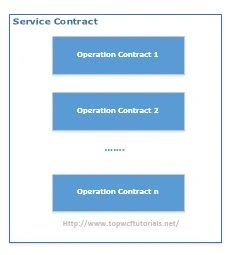
It describes:
- What operations are exposed by the service
- Platform independent description of the interface as well as methods of our service
- A Message Exchange Pattern (MEP) between the parties, in other words Request/Response, One-Way or Duplex. Please follow here for a detailed description of MEPs.
To define a Service Contract, we will apply the ServiceContract attribute to a .NET Interface and OperationContract attribute to methods as follows:
- [ServiceContract]
- interface ISimpleService
- {
- [OperationContract]
- string SimpleOperation();
- }
- class SimpleService : ISimpleService
- {
- public string SimpleOperation()
- {
- return "Simple Operation Result";
- }
- }
In the code above, we used the ServiceContract attribute to mark ISimpleService (an interface) as a Service Contract and the OperationContract attribute to the method "SimpleOperation". Also provided an implementation class "SimpleService".
Note: The ServiceContract attribute is not inherited, in other words if we are defining another interface/class as a Service Contract inheriting from ISimpleContract, we still need to explicitly mark it with the ServiceContract attribute.
In the preceding example, we use a ServiceContract attribute without any parameter but we can pass parameters also like Name, Namespace, ConfigurationName, ProtectionLevel, SessionMode and so on as follows:
- [ServiceContract(Name = "MySimpleService")]
- interface ISimpleService
- {
- [OperationContract]
- string SimpleOperation();
- }
Join the conversation! Your thoughts help the community grow.