

This is the Day 10 article. If you have not read
the previous articles then please go through the following articles:
- Day 1 - WCF Introduction and Contracts
- Day 2 - WCF Fault Contracts
- Day 3 - WCF Message Exchange Patterns
- Day 4 - WCF DataContract
- Day 5 - WCF Difference between service application and service library
- Day 6 - WCF Serialization Part 1
- Day 7 - WCF Serialization Part 2
- Day 8 - WCF Opt-In VS Opt-Out
- Day 9 - WCF Message Contract
Introduction
In this article, we will discuss endpoints which consists of Address, Binding and
Contract.
In previous articles, we have seen about ServiceContract, OperationContract, and
implementation of these in the service class. In this implementation, we write
business logic. Services expose endpoints to the world. There may be multiple
endpoints in a service. Endpoints define communication options.

Endpoint
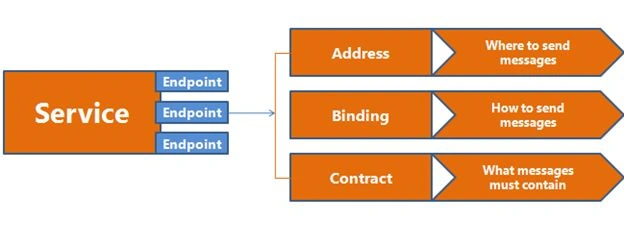
An Endpoint is a piece of information that tells WCF how to build the runtime
communication channels to send and receive messages. An endpoint consists of the
three things address, binding and contract.
Address
Address - Where - Where to send messages
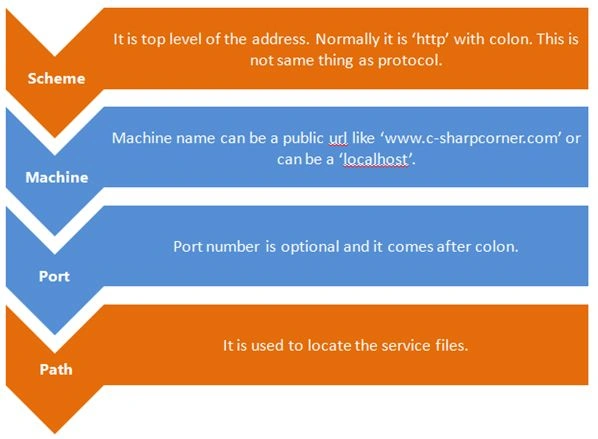
An Address is a unique Uniform Resource Locator (URI) that identifies the
location of the service. It defines the network address for sending and
receiving the messages. It is divided into four parts:
Binding
Binding - How - How to send messages
A Binding specifies which transport protocol to use, what message format and
which any of the ws* protocols we want to use to a particular endpoint.
BasicHttpBinding
- Replacement for earlier Web Service based on ASMX (Active Server Methods)
- Supports:
- HTTP - Hypertext Transfer Protocol
- HTTPS - Hypertext Transfer Protocol over SSL
- MTOM - Message Transmission Optimization Mechanism encoding methods.
wsHttpBinding
- Uses SOAP over HTTP and supports reliability, transactions and security over the internet.
- Supports:
- HTTP - Hypertext Transfer Protocol
- HTTPS - Hypertext Transfer Protocol over SSL
- MTOM - Message Transmission Optimization Mechanism encoding methods.
wsDualHttpBinding
- Used for duplex service contract because it supports bidirectional communication.
webHttpBinding
- Sends information directly over HTTP or HTTPS without creating a SOAP envelope
- It is a good choice when SOAP is not required by the client
NetTcpBinding
- Used to send binary-encoded SOAP messages from one computer to another
- Uses TCP (Transmission Control Protocol) and includes support for reliability, transactions and security
NetPeerTcpBinding
- Used for peer-to-peer communication over TCP
- Communication should occur between two or more computers
netNamedPipeBinding
- Binary encoded SOAP messages are sent over named pipes
- Used on a single WCF computer
netMSMQBinding
- Queued binding is used to send binary-encoded SOAP messages over MSMQ
- Communication should occur between two computers
Contract
A Contract provides the additional detail about the structuring contents of the
various messages that will be used by the various operations exposed to the
particular endpoints. For example we create a service "TopupService", the
interface used to define the service is "ITopupService" and the project name is
"Utility". The contract for this service would be Utility.ITopupService.
Pratibha BhadauriaPosted Mar 6, 2017, 6:05 AM
How can we use sapBinding in web.config of wcf application?
Lalit RaghavPosted Jun 19, 2015, 1:20 PM
nice article
Santosh YadavPosted Feb 26, 2013, 11:27 AM
very nice and useful. Thanks..
Maunika PanchaleditedPosted Oct 25, 2012, 9:55 AMEdited Oct 25, 2012, 9:56 AM
Nice.. very Usefule article
Tina GargPosted Oct 22, 2012, 12:22 AM
Very nice article sir.....