

The REST APIs are designed to work with Web i.e. a network of different connected domain that works together by sharing resources. But in today’s world we have all modern browsers which are highly supporting the CORS. Those who don’t know about CORS can learn about it here.
In a simple language, CORS is simply allowing other domain to request for a resource hosted in a another domain. So, for example, if an image is hosted on SiteA.com and SiteB.com wants to access this image to display in one of his page, then SiteA.com has to allow it. The browser which is accessing SiteB.com will know by reading the response header which are coming after making a request to SiteA.com. So if it has CORS header information then the request can be fetched otherwise browser will simply reject the response without displaying any specific error.
Sample Response headers of CORS from SiteA.com:
- Access-Control-Allow-Origin: http://SiteB.example
- Access-Control-Allow-Methods: POST, GET, OPTIONS
- Access-Control-Allow-Headers: X-PINGOTHER
- Access-Control-Max-Age: 1728000
You visualize the above situation something like below though it’s not a complete coverage of whole CORS concept but it will get you going.
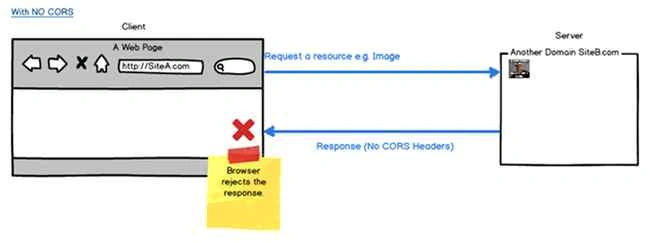
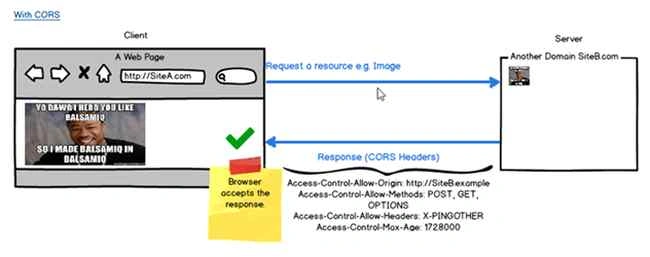
Know more about the Server side CORS and Client CORS. The same scenario applies when a cross domain REST API request is made. So your WCF REST API service should serve the response with CORS headers. The feature is not supported out of box but WCF provides a lot of extensibility points. So you can extend/create a new behavior and plug it in to have your WCF REST API CORS enabled.
Here’s how the custom message inspector would look like the following:
- using System;
- using System.Collections.Generic;
- using System.Linq;
- using System.ServiceModel.Channels;
- using System.ServiceModel.Dispatcher;
- using System.Text;
- using System.Threading.Tasks;
- namespace WebHttpBehaviorExtensions.Cors
- {
- public class CustomHeaderMessageInspector : IDispatchMessageInspector
- {
- Dictionary<string, string> requiredHeaders;
- public CustomHeaderMessageInspector(Dictionary<string, string> headers)
- {
- requiredHeaders = headers ?? new Dictionary<string, string>();
- }
- public object AfterReceiveRequest(ref System.ServiceModel.Channels.Message request, System.ServiceModel.IClientChannel channel, System.ServiceModel.InstanceContext instanceContext)
- {
- return null;
- }
- public void BeforeSendReply(ref System.ServiceModel.Channels.Message reply, object correlationState)
- {
- var httpHeader = reply.Properties["httpResponse"] as HttpResponseMessageProperty;
- foreach (var item in requiredHeaders)
- {
- httpHeader.Headers.Add(item.Key, item.Value);
- }
- }
- }
- }
- using System;
- using System.Collections.Generic;
- using System.ServiceModel.Configuration;
- using System.ServiceModel.Description;
- namespace WebHttpBehaviorExtensions.Cors
- {
- class EnableCorsBehavior : BehaviorExtensionElement, IEndpointBehavior
- {
- public void AddBindingParameters(ServiceEndpoint endpoint, System.ServiceModel.Channels.BindingParameterCollection bindingParameters)
- { }
- public void ApplyClientBehavior(ServiceEndpoint endpoint, System.ServiceModel.Dispatcher.ClientRuntime clientRuntime)
- { }
- public void ApplyDispatchBehavior(ServiceEndpoint endpoint, System.ServiceModel.Dispatcher.EndpointDispatcher endpointDispatcher)
- {
- var requiredHeaders = new Dictionary<string, string>();
- requiredHeaders.Add("Access-Control-Allow-Origin", "*");
- requiredHeaders.Add("Access-Control-Request-Method", "POST,GET,PUT,DELETE,OPTIONS");
- requiredHeaders.Add("Access-Control-Allow-Headers", "X-Requested-With,Content-Type");
- endpointDispatcher.DispatchRuntime.MessageInspectors.Add(new CustomHeaderMessageInspector(requiredHeaders));
- }
- public void Validate(ServiceEndpoint endpoint) { }
- public override Type BehaviorType
- {
- get { return typeof(EnableCorsBehavior); }
- }
- protected override object CreateBehavior()
- {
- return new EnableCorsBehavior();
- }
- }
- }
Define the Extension behavior first:
- <extensions>
- <behaviorExtensions>
- <add name="corsBehavior" type="WebHttpBehaviorExtensions.Cors.EnableCorsBehavior, WebHttpBehaviorExtensions, Version=1.0.0.0, Culture=neutral" />
- </behaviorExtensions>
- </extensions>
- <behaviors>
- <endpointBehaviors>
- <behavior name="webHttpServiceBehavior">
- <corsBehavior />
- <webHttp/>
- </behavior>
- </endpointBehaviors>
- </behaviors>
- <services>
- <service name="WcfWebHttpIISHostingSample.TestService" behaviorConfiguration="ServiceBehavior">
- <endpoint binding="webHttpBinding" contract="WcfWebHttpIISHostingSample.ITestService" behaviorConfiguration="webHttpServiceBehavior" />
- </service>
- </services>
This blog post is part of an Extension behavior library that I’m currently working on to provide a set of Regularly required feature which aren’t available out of the box. To download the Library via Nuget from here:

If you like to contribute or want to look at the source code, the complete source code is open source and hosted on Github.

Former memberPosted Nov 11, 2015, 2:39 AM
Nice one
Mukesh KumarPosted Oct 21, 2015, 12:37 AM
Thanks to share with us
Amit ChoudharyPosted Oct 20, 2015, 8:48 PM
Thanks guys!!
venkadesan perumalPosted Oct 20, 2015, 8:24 AM
nice once
Priyaranjan K SPosted Oct 20, 2015, 5:55 AM
Good One ..
Harshad PansuriyaPosted Oct 20, 2015, 3:20 AM
Nice one
Sibeesh VenuPosted Oct 20, 2015, 3:06 AM
Nice Share
Nilesh JadavPosted Oct 20, 2015, 1:13 AM
NIce Share sir !!