

For Agile at home, read J.D. Meiers book here: https://kindle.amazon.com/work/getting-results-agile-way-personal-ebook/B005X2IR4G/B005X0MFD2
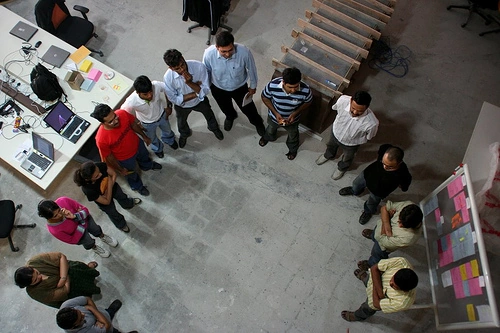
Anyone that has used and/or are using Scrum will (hopefully) be running Daily Standups and might encounter these "smells" that I will later document, but first I will explain what a Daily Stand-up is.
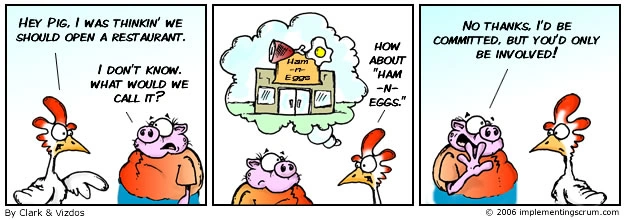
The meeting can also be known as the Daily Meeting, Daily Scrum, Standup. In an ideal world, your Scrum teams will be located within the same building and the same time each day (usually morning before you start work or the afternoon before the shift finishes), the following will happen:
- The Scrum Master will facilitate the meeting but this isn't necessary. Other team members (not Chickens) can run the meeting.
- The team will stand up together, usually around a physical Task Board, containing an artifact of a Sprint Burn-down chart.
- A good stand-up is timed to a maximum duration of 15 minutes.
- Pigs: Ask answer the three questions:
- What I did yesterday
- What I plan to do today
- Any Impediments stopping you from completing the work. At this point, another Pig could pop up offering help to remove the impediment, this is good Scrum practice (and teamwork).
- The Pig throws a ball to the next Pig that wants to speak.
- Chickens: Don't say anything. AOB's should be done after the stand-up.
- The Team re-plans where necessary due to impediments or if the member needs more time to complete a story. Because the Product Owner should attend each standup, prioritization should be easy.
Now we do not live in an ideal world and there are some things that can upset the Apple cart when running the daily scrum, these are usually called smells. Please look out for these and try to correct them collectively as a team, be aware that even a well-oiled scrum team can fall into a rut.
Robotic Status Updates
When the 3 questions becomes just a status update, that even when an impediment is raised, no one notices or reacts. This shows that people are only interested in their own work and stopped buying into the process of being a self-organizing team. Need to coach the team that the stand-up is about re-planning and focusing on the top priorities of the Sprint and not about just the status report.
Chickens talking during the stand-up
Let's face it, when we talk about Chickens we mean Project Managers. PMs are not part of a Scrum Team and shouldn't be. Yes, they have their place, but not within a Scrum Team. They have biased and often selfish opinions about getting their own project work done but not for the good of our Scrum Team. Chickens should adhere to the rules of a stand-up and talk to the team once the stand-up has finished. Remember, stand-ups are focused on the 3 questions with a 15 minute time box. I wouldn't even have an AOB at the end of the meeting, coach the guys and gals to take the long winded stuff off the stand-up, otherwise people get bored.
Some things no one notices
No one notices the burn-down when the actual effort line is constantly over the line. A good, well-run stand-up has a visible copy of the burn-down chart for all the team to see. If we are over the line, then there is an issue/impediment somewhere. If the team is not reacting to this then again this is probably due to a lack acceptance of the process. When that line goes over, the team together (being self organizing) works together with the Product Owners to bring that back down (hint: removing work from the Sprint). Remember, this is a re-planning exercise and not a status report.
Re-prioritizing and assigning re-planned work
The Scrum master might re-prioritize and assigne re-planned work. Can you guess why this is wrong? That's right, we are self-organizing and that means a developer, tester and so on signs up to a piece of the work, it should be given to someone. Also, it is the Product Owner's role to assign priorities, not the Scrum Master. Also, if your Product Owners are not attending the stand-ups, there could also be an issue that if that role is filled part time (say from a business representive) , then there is a lack of faith or acceptance there. Talk to the Product Owners to determine their concerns, because Product Owners are an important part of a Scrum team.
Absence of self-organizing
"You say self-organizing, but there is no self-organizing where I come from." This is a common and requires disciplined teams, who want to be using Scrum and who have a company who wants to use Scrum. There is nothing worse than trying to work in an Agile way, but your company's internal processes, management and business stakeholders are not. This will cause your team to loose faith in something that probably is working and not the best fit for your organization at that time. Agile can be a big cultural change, but if done right, can benefit everyone.
Environmental Smells
There are some things that are out of your control, but which may cause your stand-ups to fail, as in the following:
- Geo Located Teams (Multi site): There is no getting away from it, stand ups together, in the same room are more effective. But if you cannot all be in the same room, then my one bit of advice would be to Video teleconference. A phone is not good enough, people will switch you off. Also, lock the call (and advertise that) so anyone who is late won't interrupt the flow. People should be on time.
- Tools-over-process: If people get bogged down on tooling over actually using the Scrum Process itself, for example "This tool says you are 10 hours over due" Then yes tooling is good, our burn-downs should be built from the data, but we should use the stand-ups to re-plan and then update the tool, not use the tool to update the plan.
- Scrum fall: if you are running a mixture of Scrum and Waterfall, where there are multiple projects with multiple priorities, from multiple sources all screaming that their work is number 1 in the list, then re-evaluate if Scrum is the best approach for you. Scrum should be fun and not a hindrance.
So a daily scrum is a vital part of the Scrum process and should be taken seriously as a process but have fun with it. You can even get virtual ball apps for those geo-located teams! But remember REPLAN REPLAN REPLAN!
References
More Information on Pigs and Chickens: https://www.implementingscrum.com/2006/09/11/the-classic-story-of-the-pig-and-chicken/
More information on the Scrum Master Role: https://www.mountaingoatsoftware.com/agile/scrum/scrummaster
Vaikesh K PPosted Aug 22, 2015, 8:31 AM
Great share :)
Nitesh KejriwalPosted Jul 11, 2015, 8:39 AM
Nice read
Sibeesh VenuPosted Jul 11, 2015, 8:21 AM
Nice share.
Santhakumar MunuswamyPosted Jul 11, 2015, 2:52 AM
Good one
Krishnanand SivarajPosted Jul 11, 2015, 1:25 AM
Makes me think about my daily update scrum meetings.. I will consider your points.. Thanks for sharing..
Nilesh JadavPosted Jul 11, 2015, 1:17 AM
Good
Chiheb ChebbiPosted Jul 10, 2015, 6:57 PM
nice
Narasimha Reddy ChennupalliPosted Jul 10, 2015, 1:14 PM
Funny and Good one...