

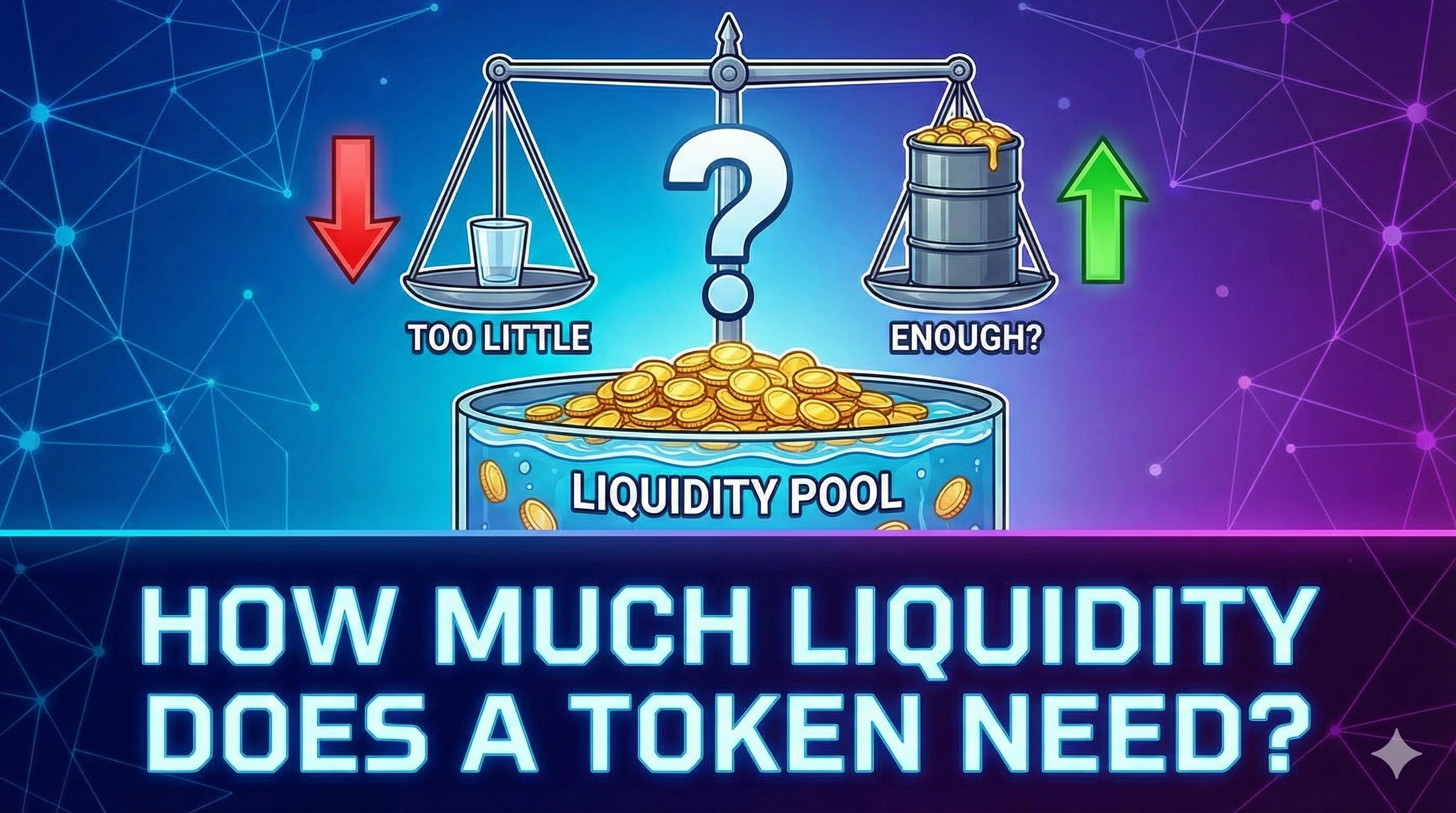
Why Liquidity Matters More Than Most Founders Realize 💡
Liquidity is not about making your token look valuable on launch day. Liquidity is about whether your token can survive real trading behavior.
Liquidity decides
Whether buyers can enter without pumping the price
Whether sellers can exit without crashing the chart
Whether your token looks legitimate or manipulated
Whether exchanges and investors take you seriously
What Liquidity Means in Simple Terms 🔄
Liquidity is the amount of capital available for trading your token without causing extreme price movement
In practical terms liquidity answers
Can someone buy without massive slippage
Can someone sell without destroying the price
Can daily trading volume grow naturally
Liquidity exists as
Liquidity pools on decentralized exchanges
Order books supported by market makers on centralized exchanges
For early stage tokens DEX liquidity is usually the most critical
There Is No One Size Fits All Number ⚖️
Any fixed number applied to all tokens is misleading
Liquidity requirements depend on
Token price
Circulating supply
Expected trading volume
Community size
Utility and demand drivers
DEX only or DEX plus CEX strategy
However there are proven ranges that work consistently
A Practical Rule of Thumb That Works 📐
A healthy token typically needs liquidity equal to
Healthy Equity: 5% to 15% of circulating market cap
Example
Circulating market cap of ten million dollars
Minimum acceptable liquidity five hundred thousand dollars
Strong liquidity one to one point five million dollars
Less than 5% causes violent volatility. More than 15% is great but often capital inefficient early on.
Liquidity and Trading Volume Relationship 📊
Liquidity without volume is wasted capital. Volume without liquidity creates chaos.
A healthy ratio looks like
Daily trading volume equals ten percent to thirty percent of total liquidity
Examples
One million dollars liquidity with ten thousand dollars daily volume means low interest
One million dollars liquidity with five hundred thousand dollars daily volume means under liquidity and high manipulation risk
Balance is critical.
DEX Liquidity Requirements Explained 🧩
For Uniswap PancakeSwap and similar DEX launches
Typical ranges
• Early utility or experimental token
• Two hundred thousand to five hundred thousand dollars
• Mid tier serious launch
• One million to three million dollars
• Large ecosystem or enterprise backed token
• Five million dollars or more
Anything below one hundred thousand dollars is not taken seriously by the market.
CEX Liquidity Is a Different Game 🏦
Centralized exchanges use order books not pools.
CEX liquidity requires
Dedicated market making capital
Bid and ask spread management
Inventory balancing
Continuous monitoring
Typical monthly costs per exchange $20,000 to $100,000 depending on tier.
Listing without proper liquidity support leads to broken charts and fast loss of confidence.
What Happens When Liquidity Is Too Low ☠️
Low liquidity causes
Extreme price swings
Easy whale manipulation
Fake pump and dump behavior
Rug pull accusations even for honest teams
Loss of retail and institutional trust
Why Too Much Liquidity Can Also Hurt ⚠️
Over allocating liquidity early can
Lock up too much treasury capital
Reduce flexibility for operations and growth
Cap upside price movement
Attract short term traders instead of real users
Liquidity should scale with adoption not lead it
Smart Liquidity Beats Big Liquidity 🧠
The best projects design liquidity instead of blindly adding it
Smart liquidity strategies include
Gradual liquidity increases
Liquidity added after usage milestones
Revenue backed liquidity growth
Buyback and add liquidity programs
Incentives tied to real usage not speculation
This is where most founders need experienced guidance
Liquidity and Price Stability 🔒
Price stability does not mean no movement
It means controlled predictable movement
Good liquidity creates
Lower slippage
Smoother price charts
Higher trader confidence
Reduced manipulation
When You Should Increase Liquidity 📈
Increase liquidity when
Daily volume consistently grows
User adoption increases
New utilities launch
New exchanges are added
Treasury revenue allows sustainable expansion
Liquidity Is Infrastructure Not Marketing 🚫
Liquidity is not promotion
Liquidity is not hype
Liquidity is not optional
Treat liquidity like backend engineering. Not like advertising spend. Marketing without liquidity destroys credibility fast.
The Hard Truth Most Founders Learn Too Late 🔑
Liquidity is foundational
Liquidity planning must happen before launch
Liquidity mistakes are expensive and public
If liquidity fails everything else becomes irrelevant
Need Expert Help Designing Token Liquidity 🤝
Liquidity design requires deep understanding of
Market psychology
Token economics
Treasury management
DEX and CEX mechanics
If you are launching a token or fixing an existing one and want it done right, work with Mahesh Chand, a technology leader and advisor with real world experience designing sustainable token economies and liquidity strategies.
👉 Contact Mahesh Chand for consulting and advisory services
https://www.c-sharpcorner.com/consulting/
Join the conversation! Your thoughts help the community grow.