
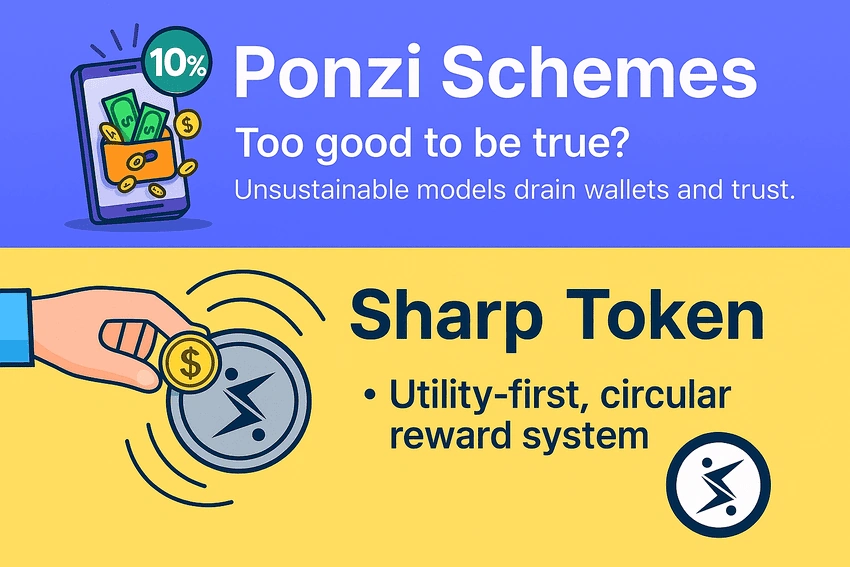
If you’ve been in crypto for more than a minute, you’ve likely come across promises like "guaranteed 10% returns every week" or "earn forever with no risk." Sounds too good to be true? That’s because it usually is.
Ponzi-like reward models have plagued the crypto space, draining wallets and damaging trust. But not all projects operate this way. One standout example of a more sustainable, trust-centered approach is Sharp Token.
In this article, we’ll break down how to identify Ponzi-like structures and highlight how Sharp Token avoids these traps through a utility-first, circular reward system.
What Is a Ponzi-Like Reward Model in Crypto?
A Ponzi-like model is one where new investor money is used to pay earlier investors, rather than relying on a sustainable product or service. These models often collapse when new participants stop joining.
Red Flags to Watch For
- No actual product or service — just "staking" or "yield promises"
- Returns are paid from new user deposits, not real utility or usage
- Heavy focus on recruitment and "invite more to earn more"
- No transparency in tokenomics or revenue generation
- Unsustainable APYs that rely on constant growth
If your only way to profit is by getting others to join or buy in, that’s a red flag.
How Sharp Token Avoids Ponzi Pitfalls
Sharp Token is built around real value creation, not just speculative growth. Here’s how
1. Circular Utility Model
- Users earn Sharp by learning, contributing, or participating in community tasks.
- They can redeem those tokens for buying products on the Sharp Rewards App.
- This cycle repeats, keeping tokens within the ecosystem and generating continuous value.
2. Transparent Tokenomics
- All reward mechanisms are publicly documented.
- Sharp does not rely on new buyers to fund old rewards.
- Token distribution is tracked on-chain, with regular audits and community reports.
3. Product-First, Not Hype-First
-
Sharp offers real, usable tools like:
- learning platform
- Quizzes and certification modules
- Community contribution rewards
-
Users come for the value, not just the potential price pump.
4. No Fake APYs or Empty Promises
- Sharp doesn’t offer "guaranteed" yield.
- All rewards are based on proof-of-effort or value (like contributing content).
Sharp Token’s Circular Economy in Action
Here’s how Sharp’s model works step-by-step
| Step | Action | Result |
|---|---|---|
| 1 | Learn, contribute, or refer others | Earn SHARP tokens |
| 3 | Community grows and quality content increases | Organic demand increases |
| 4 | More users join for actual utility, not speculation | Ecosystem remains healthy |
This keeps value circulating, instead of draining from new entrants to pay old ones.
Why This Matters in 2025
- As Web3 matures, users are demanding real utility, real transparency, and real rewards. Projects built on hype and short-term gains are being replaced by ecosystems that prioritize community and sustainability.
- Sharp Token isn’t about "get-rich-quick" — it’s about grow-as-you-contribute.
- Whether you’re a learner, educator, builder, or simply curious, you can be part of an economy that respects time, trust, and transparency.
Final Thoughts
Avoiding Ponzi-like schemes in crypto comes down to asking one question
"Where does the value come from?"
If the answer is hype, recruitment, or high-yield promises, run. But if it’s education, participation, and community-driven rewards, then you’re in the right place.
Sharp Token is setting a new standard for Web3 incentives by focusing on what really matters: value through contribution, not speculation.
Join the conversation! Your thoughts help the community grow.