

Introduction
Before reading this article, I highly recommend reading the following previous parts of the series:
Topics covered
- Devices that make the IoT
- IoT Technologies
DEVICES THAT MAKE IoT
When it comes to devices of the IoT, most of us wonder, are smartphones and tablets IoT devices? Well:
- Smart phones and tablets have sensors, accelerometers, gyroscopes and so on
- Are embedded devices with displays and keypad
- Can be connected to the internet
- Has an IP address
Therefore they fit every requirement of IoT devices!
So, can we call smartphones or tablets IoT devices?
This doubt was clarified at a keynote event during Sept 2011’s Mobile World Congress in Barcelona by Qualcomm Chairman and CEO Dr. Paul Jacobs.
Paul Jacobs talked about how mobile technology could be used to connect non-phone and non-tablet devices called IoT devices and objects to the internet. In the future where everything will be connected on the web and mobile phones will serve as the hub, or the remote control, for the Internet of Things.
So IoT is internet connectivity of smart objects and embedded systems other than mobile phones that can be connected to external hardware. Mobiles, Tablets, Laptops, and PCs are a remote control/access center of IoT.
Let’s have a look.
Today, smartphones or tablets are equipped with sensors of data from anything from location to the device orientation to light conditions. Altogether, these sensors produce a huge amount of data, both in an unstructured form (picture or videos) as well as structured, such as GPS or acceleration data. With the rise of the wearables, smartphones increasingly have an additional role. This new role can be considered as the "brain" of your Body Area Network (BAN), given the storage and communication capabilities of the smart phone. Last but not least with technologies such as Near Field Communications (NFC)?, smart phones can function not only as sensors but also as actuators. That is, trigger actions (such as payments) or control other things, including home, parking slots, cars and many more.
Smart Devices
With IoT, we also get to hear a lot about Smart Devices. What are these Smart Devices? Let's look into the definition.
“A Smart Object is an object that can describe its own possible interactions.”
OR
According to Wikipedia, "A smart device is an electronic device, generally connected to other devices or networks via various wireless protocols such as Bluetooth, NFC, WiFi, 3G and so on that can operate to some extent interactively and autonomously.".
Any device that not only has a state but also has certain data associated with that state and can also determine the nature of connectivity, duration of connectivity and connectivity protocol are called smart objects. Some of the smart devices are smartphones, tablets, smartwatches, smart bands, and smart key chains. The term smart device can also refer to a ubiquitous computing device, a device that exhibits some properties of ubiquitous computing.
Characteristics of smart devices
- A set of system hardware and software Information and Communication Technology (ICT) resources. This set is usually statically fixed at design time.
- Dynamic component-oriented resource extensions and plug-ins (Plug and Play) of some hardware resources.
- Remote external service access and execution.
- Local, internal autonomous service execution.
- Access to specific external environments: human interaction, physical world interaction and distributed ICT / virtual computing interaction.
- Ubiquitous computing properties.
Ubiquitous Computing Properties
- Devices need to be networked, distributed and transparently accessible.
- Human-computer interaction with devices is hidden to a degree from its users.
- Devices exhibit Context-awareness of an environment to optimize their operation in that environment.
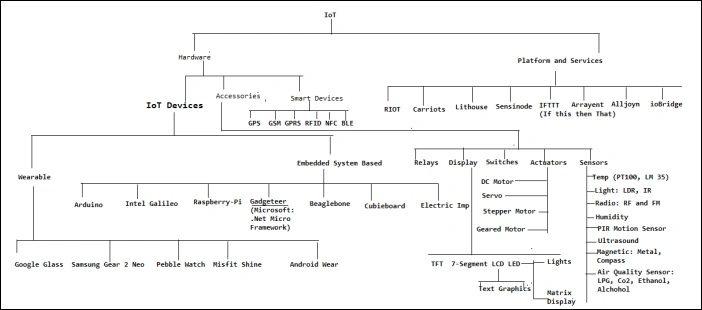 Figure 1: IoT devices and technology, classified
IoT TECHNOLOGIES
Now, let's have an understanding of various Technologies of IoT.
- Radio Frequency Identification (RFID)
- An RFID chip holds information about the "thing"
- An RFID chip is attached and transfers data to the reader.
- The antenna on the RFID module is used to receive energy that is used to operate the RFID device and transmit information back to the reader.
- RFID enables efficient management, tracking and monitoring processes and logistics and supply chain applications.
Wireless Sensor Networks (WSN)
- Efficient, low-cost, low-power devices for use in remote sensing applications.
- Low-power integrated circuits and wireless communications.
- A large number of intelligent sensors collect raw data, and create valuable services by processing, analyzing, and spreading data.
- Challenges are related to limited processing capability and storage, and sensor data sharing for multiple device/system cooperation.
IoT Cloud Computing Support
- For Advanced IoT services, IoT networks may need to collect, analyze and process segments of raw data and turn it in into operational control information.
- Advanced IoT services will need support for cloud computing.
- Numerous IoT connections will be made to various devices and sensors.
- Many IoT devices will not have a PC or smartphone level of sufficient data processing capability or interoperability functionality.
Cloud Computing
- IoT applications will need support from a reliable, fast, and agile computing platform.
- IoT devices can overcome a lack of software, firmware, memory storage, hardware and data processing capability using cloud computing.
- The following are cloud service models:
- Software as a Service (SaaS)
- Platform as a Service (PaaS)
- Infrastructure as a Service (IaaS)
That’s all for this article. I hope you enjoyed reading!
References:
- https://www.coursera.org/learn/iot-augmented-reality-technologies/lecture/Cebzu/iot-technologies
- http://readwrite.com/2011/02/16/mobile-phones-will-serve-as-hubs-to-internet-of-things
- https://www.mapr.com/blog/smart-phones-and-internet-things#.VakT2LV7b9p
- https://en.wikipedia.org/wiki/Smart_device
Delpin Susai RajPosted Aug 29, 2016, 2:31 AM
Good one
Sr KarthigaPosted Jan 23, 2016, 5:39 AM
Good one
Humayun Kabir MamunPosted Oct 2, 2015, 12:55 AM
Nice...
Sukanya MandalPosted Aug 22, 2015, 2:39 PM
Thanks a lot everyone for appreciating and encouraging me :)
RakeshPosted Aug 22, 2015, 1:32 PM
Good work
Gopi ChandPosted Aug 22, 2015, 1:27 PM
Great work
Sandeep KumarPosted Aug 22, 2015, 1:13 PM
really nice article,a new tech to learn :)
Sumit JoshiPosted Aug 22, 2015, 10:25 AM
thanks for sharing
Santhakumar MunuswamyPosted Aug 22, 2015, 6:27 AM
Good Article. Thanks for sharing
Karthikeyan KPosted Aug 22, 2015, 4:45 AM
Good one...Thanks for share
Sukanya MandalPosted Aug 22, 2015, 4:26 AM
Thanks a lot everyone, for keeping me motivated with your valuable feedback!
Mohammed IbrahimPosted Aug 22, 2015, 2:56 AM
nice information
Yashwanth MuthineniPosted Aug 22, 2015, 2:50 AM
Nice info.
Vaikesh K PPosted Aug 22, 2015, 2:47 AM
Good
Chervine BhiwooPosted Aug 22, 2015, 1:49 AM
Nice! Thanks for sharing!
Rajeesh MenothPosted Aug 22, 2015, 1:41 AM
Good One
Gowtham KPosted Aug 22, 2015, 12:58 AM
Good one
Nilesh JadavPosted Aug 22, 2015, 12:02 AM
Nice start mam :0
Sam HobbsPosted Aug 21, 2015, 11:43 PM
The Wikipedia can be a very useful resource but unfortunately it is possible for it to be wrong. The definition of a smart device in terms of communication capability is wrong. I have posted a relevant comment in the Talk page. I hope to be able to fix the Wikipedia article with a reliable source for the definition. Note that the current definition (that defines a smart device in terms of communication) does not have a reference.