

Introduction
MVC stands for Model View Controller which is not a programming language but it is a design pattern which use to develop the application. The application which has developed using MVC design pattern will get divided in 3 Components. Which Model will contain all the data which will get retrieve on the request of user. View will contain UI code and Controller will contain Business logic code. For better understanding of MVC we will see graphical example of MVC

Figure. Graphical Example of MVC
The Properties of MVC is.
- Loose Coupling
- Lightweight code
- Effective look
- Testing is Very Easy
- Rapid application integrated development.
MVC Architecture
The architecture of MVC can be seen in the following figure.
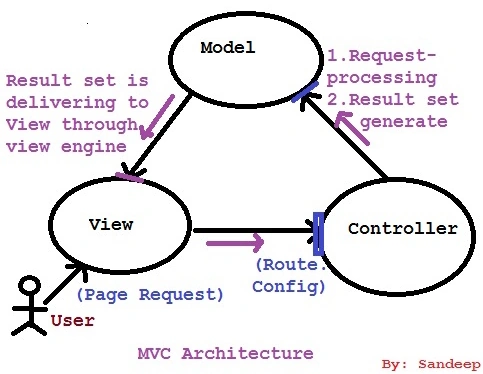
Figure. MVC Architecture
Explanation
User will make request for the page which user would like to retrieve. Requested page will go to controller and on controller Route.Config will be checked. Requested page will get transfer to Model from Controller.
On Model there will be 2 steps.
- Page initialization will get started.
- Then result set will be generated.
After these operation result set will get unload to View through view engine.
Responsibility of view engine
- View Engine get the request from Controller
- The requested page will get executed
- The result got by the execution process will get deliver to View.
Life cycle of MVC
Life Cycle of MVC is in the following figure.

Figure. Life Cycle of MVC
Explanation of MVC Life Cycle
Step 1. User will make request for page
Step 2. Route.Config will get check on Controller
Step 3. After Route.Config validation request will get transfer from Controller to Model
Step 4. Page request will go to Model & on Model the following operation will perform.
- Page initialization will start after the initialization of the page.
- One result set will get generated.
Step 5. Generated result set will be delivered to the Controller from the Model.
On Model Page validation operation will perform.
Step 6. After page validation on controller, Page will deliver to View through View engine.
Step 7. Now user can see requested page as response page.
Life Cycle of MVC can be seen as in the following figure.
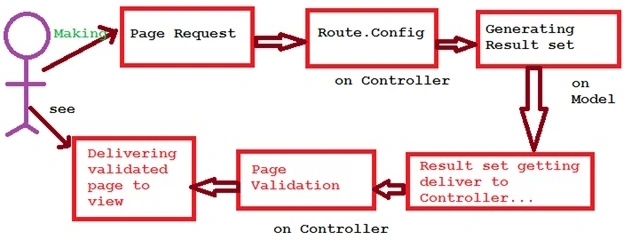
Figure. Life Cycle of MVC
Explanation
- User will make page request.
- Route.Config of requested page will get checked on Controller.
- Page initialization will be performing on Model and after page initialization one result set will get generated.
- Generated Result set will be getting delivered to the Controller from Model.
- Result set will get validated (Page Validation) and after page validation Result set will get delivred to View through view engine.
Recap
MVC Stands for Model View Controller, which is a design pattern. MVC based developed application will get divided in 3 components. Each and every component will contain their own code only.
Sudhakar ChavaliPosted Sep 26, 2019, 6:25 AM
Just want to let you know that MVC is a architectural pattern but not a design pattern
Ankur MistryPosted Sep 19, 2019, 12:37 AM
Nice example Sandeep Kumar
kritika pundirPosted Sep 18, 2019, 9:24 AM
Awesome article
Santhakumar MunuswamyPosted Jan 19, 2016, 3:15 PM
Thanks for sharing
Anil KumarPosted Jan 19, 2016, 12:11 PM
I strongly disagree with your first image. This image is making complete cock-up of the beautiful post.
Saillesh PawarPosted Jan 19, 2016, 10:13 AM
I don't think models will be called as storage as you have mentioned in top diagram. As we will have data access layer for retrieval and insertion to db, that is assumed to always there. Models here are business classes. Any how appreciate your efforts
KaustubhPosted Jan 19, 2016, 1:14 AM
nice article
Jaipal ReddyPosted Jan 19, 2016, 1:09 AM
Nice explanation. .
Jaco ZwartsPosted Jan 19, 2016, 1:01 AM
I have read many MVC tutorials and this one is really good, well done
Ankur MistryPosted Jan 18, 2016, 11:58 PM
good example
Humayun Kabir MamunPosted Jan 18, 2016, 10:46 PM
Nice...
sreenivasa kPosted Jan 18, 2016, 6:59 PM
good
Ehsan SajjadPosted Jan 18, 2016, 12:59 PM
Nice explanation with diagrams