

Introduction
This article will help us understand Outgoing Webhook in MS Teams, and is a step by step guid for creating outgoing webhook using yeoman teams generator.
Outgoing Webhook in MS Teams acts like a bot which can be triggered from channel using @mention, web hook can receive messages posted along with the @mention and can send reply based on the incoming message.
In this article we will focus on creating Outgoing web hook using yeoman generator and use it in MS Teams.
Note
Outgoing webhooks are scoped at the team level.
Setup Environment for Yeoman Teams Generator
- Install Latest version of Nodejs or we can use nvm if we require multiple versions of node js. To check the complete installation guide check my blog here.
- Install yeoman and gulp cli
npm install yo gulp-cli --global
- Install Microsoft teams app generator
npm install generator-teams --global
Create Outgoing Webhook using yeoman Teams generator
To create the solution we need to use the below command and provide below parameters which will help in creating the solution
-
mkdir webhookwithYeoman
-
cd webhookwithYeoman
-
yo teams
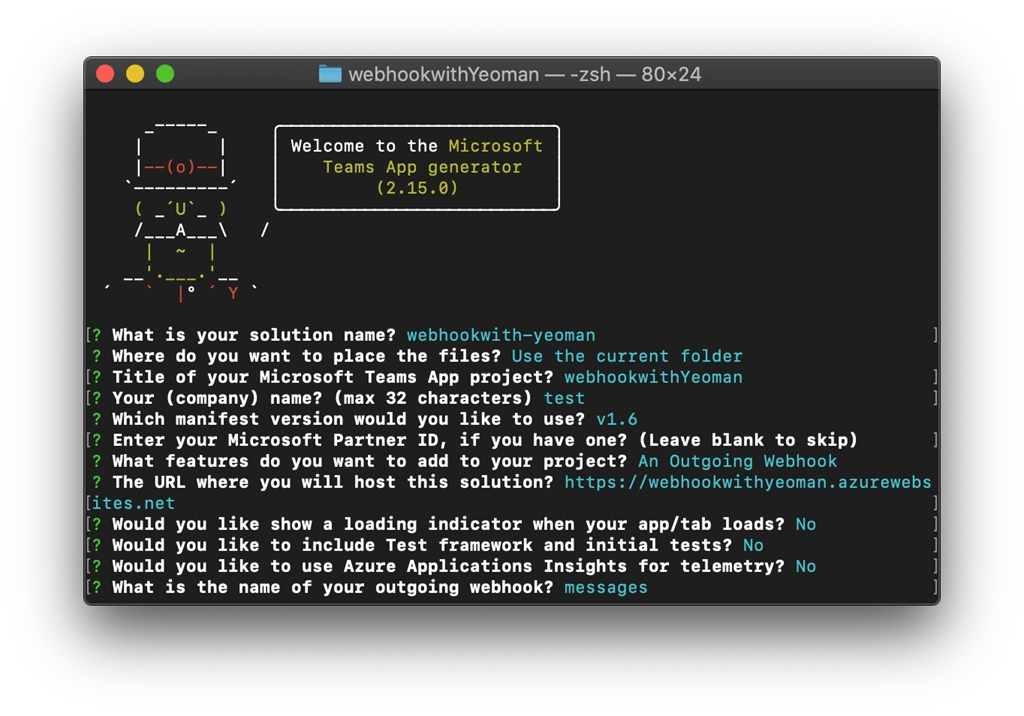
Now let us open the code and check the project structure.
The main folder which we need to concentrate is src folder; inside src we have two folders app and manifest.
The app folder contains the code and manifest folder contains all the necessary files required for deployment in MS Teams
Our code for outgoing web hook will be present inside the folder messagesOutgoingWebhook with the file named message.ts. This will depend on the name of the web hook which you have provided.
If we check the code we can understand it is a simple echo bot which would send the same message which is received in the request
- import * as builder from "botbuilder";
- import * as express from "express";
- import * as crypto from "crypto";
- import { OutgoingWebhookDeclaration, IOutgoingWebhook } from "express-msteams-host";
- /**
- * Implementation for messages
- */
- @OutgoingWebhookDeclaration("/api/webhook")
- export class Messages implements IOutgoingWebhook {
- /**
- * The constructor
- */
- public constructor() {
- }
- /**
- * Implement your outgoing webhook logic here
- * @param req the Request
- * @param res the Response
- * @param next
- */
- public requestHandler(req: express.Request, res: express.Response, next: express.NextFunction) {
- // parse the incoming message
- const incoming = req.body as builder.Activity;
- // create the response, any Teams compatible responses can be used
- const message: Partial<builder.Activity> = {
- type: builder.ActivityTypes.Message
- };
- const securityToken = process.env.SECURITY_TOKEN;
- if (securityToken && securityToken.length > 0) {
- // There is a configured security token
- const auth = req.headers.authorization;
- const msgBuf = Buffer.from((req as any).rawBody, "utf8");
- const msgHash = "HMAC " + crypto.
- createHmac("sha256", Buffer.from(securityToken as string, "base64")).
- update(msgBuf).
- digest("base64");
- if (msgHash === auth) {
- // Message was ok and verified
- message.text = `Echo ${incoming.text}`;
- } else {
- // Message could not be verified
- message.text = `Error: message sender cannot be verified`;
- }
- } else {
- // There is no configured security token
- message.text = `Error: outgoing webhook is not configured with a security token`;
- }
- // send the message
- res.send(JSON.stringify(message));
- }
- }
sajid kaziPosted Feb 12, 2021, 6:19 AM
I am getting the error "Sorry, there was a problem encountered with your request"