

Introduction
SQL stands for Structured Query Language. SQL is a language that helps us to work with databases. The database does not understand English or any other language. Just as to create software, we use Java or C#, and in a similar way to work with databases, we use SQL. SQL is the standard language of a Database and is also pronounced as a Sequel by many people.
In my previous article "Introduction To DBMS", I mentioned that DBMS allows us to create databases, maintain databases, retrieve data, analyze data, etc. But, how exactly DBMS allows us to achieve all this functionality? The answer is SQL.
SQL is a language that allows you to define, manipulate and retrieve data from relational databases. Relational Databases are databases that store data in the form of objects (like tables) that may be related to each other.
The diagram below displays a relation (table) and its components.
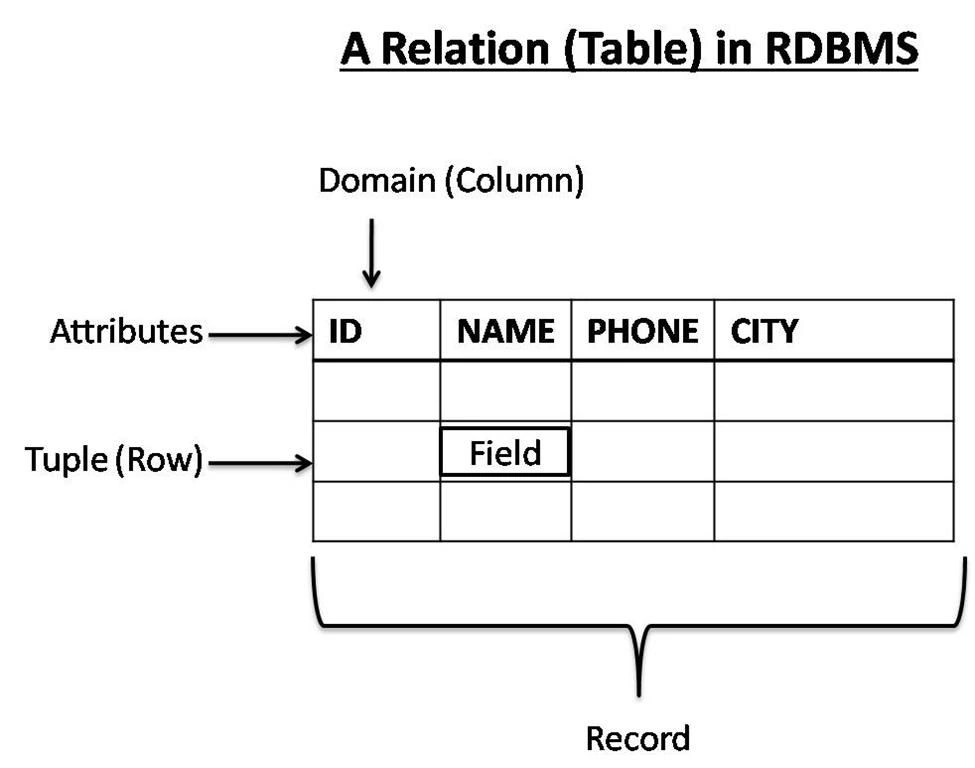
Table in RDBMS
SQL allows us to create such tables, insert data, delete data, view data from such tables, and much more. The table is made up of rows (tuples) and columns (domains). Column headings are also called Attributes. A field is a basic building block of the table. A record is a horizontal row of data.
SQL COMMANDS
SQL Language is made up of various types of SQL Commands. The SQL language commands are divided into four main sections.
-
DML (Data Manipulation Language) Commands
DML commands are used to insert, update and delete data in the database. As the name suggests, they are used to manipulate the data in the database. The DML commands are INSERT, UPDATE and DELETE. Find more about DML Commands here- DML Commands in SQL
-
DDL (Data Definition Language) Commands
DDL commands are used to manipulate the database itself. They deal with the creation of a database, altering its structure, and deleting the database. The DDL Commands are CREATE, ALTER, and DROP. Find more about DDL Commands here- DDL Commands in SQL
-
DCL (Data Control Language) Commands
DCL commands are used to control access to the database. They are used to give privileges to the users and take away privileges from the users. The DCL Commands are GRANT and REVOKE. Find more about DCL Commands here- DCL Commands in SQL
-
DQL (Data Query Language) Command
Data is accessed from the database by firing queries. DQL command allows us to fire queries to the database and get the data from the database. The DQL command is SELECT.
Conclusion
We will learn about each of these commands in detail in the upcoming series of articles. Stay tuned. Happy Learning!
Reference
ran.hima himaPosted Sep 10, 2018, 3:20 PM
I would just like to thank you so much for such an incredible information.
Shivani GoyalPosted Jan 8, 2018, 1:10 PM
Very easy language
SubashPosted Jul 25, 2016, 5:07 AM
Excellent
Shobana JPosted Jul 13, 2016, 5:09 AM
Good explanation
venkatesh duddukuriPosted Feb 17, 2016, 6:01 AM
Simple and useful
Ehsan SajjadPosted Jan 13, 2016, 10:34 AM
Good One
Santhakumar MunuswamyPosted Jan 5, 2016, 11:25 PM
Thanks for nice share
Arul RPosted Jan 5, 2016, 2:39 AM
Nice share!
Yashwant VishwakarmaPosted Jan 5, 2016, 12:13 AM
Thanks for sharing Jainish Shah :)
Karthikeyan KPosted Jan 4, 2016, 1:29 PM
Good one bro..Thanks for sharing
DmitriyPosted Jan 4, 2016, 11:48 AM
Thank You for this explain. I hope it's only start and wait for Your next posts :)
Pankaj Kumar ChoudharyPosted Jan 4, 2016, 11:40 AM
Nice Explain ...........
Mahesh ChandPosted Jan 4, 2016, 11:35 AM
Welcome to C# Corner, Jainish. I like your write of style, simple for beginners. I also like you linked other related article. Look forward to read the next articles of the series. I advice you to link your previous article in the series so people can go back. Cheers!