

Imagine you have a large database that stores customer orders, and you need to keep another system, like a reporting dashboard, updated in real-time. Instead of repeatedly scanning the entire database for changes, which is inefficient, you can use Change Data Capture (CDC).
CDC is a technique that tracks changes made to a database and ensures they are captured and passed on to other systems efficiently. It helps keep data in sync without causing a heavy load on the database.
Why Does CDC Matter?
- Reduces System Load: Instead of checking all records, CDC tracks only what has changed.
- Ensures Data Synchronization: Keeps different databases or applications in sync with real-time updates.
- Enhances Performance: Speeds up data processing and reduces unnecessary computations.
- Supports Real-Time Analytics: Enables event-driven architectures and live dashboards.
Different Types of Change Data Capture
There are multiple ways to implement CDC, and the right approach depends on your system’s needs. Let’s look at the common types:
1. Trigger-Based CDC
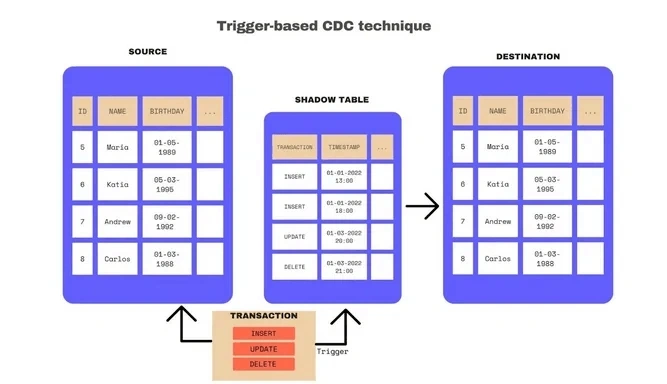
This method uses database triggers, which are special rules that get executed when data changes. Whenever a row is inserted, updated, or deleted, the trigger captures this change and logs it in an audit table.
When to Use
- If your database does not support log-based CDC.
- When you need to maintain a detailed history of changes
Pros
- Works even if your database doesn’t have built-in CDC features.
- Provides a complete history of data changes.
Cons
- Can slow down database operations since triggers add extra processing.
- Increases database complexity with additional tables and logic.
2. Log-Based CDC
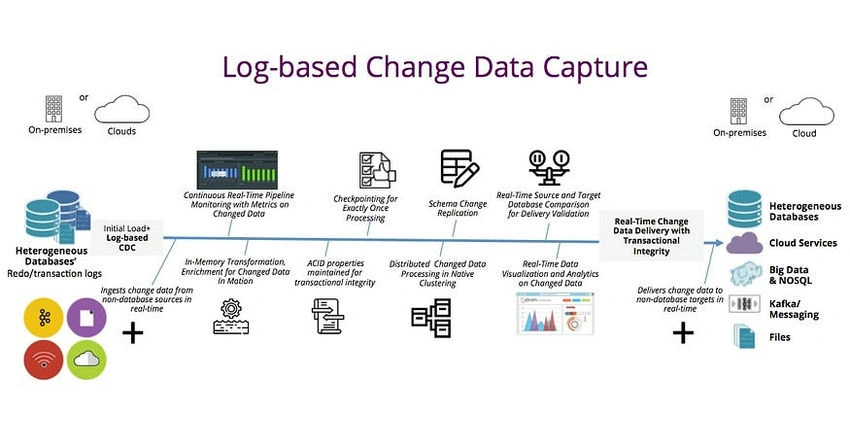
This approach reads the database transaction logs — the records of every change made to the database. Instead of modifying the database structure, it monitors changes at the system level.
When to Use
- When you need real-time CDC with minimal performance impact.
- When dealing with high-volume transactional databases.
Pros
- Has the least impact on database performance.
- Efficient for handling large data volumes.
Cons
- Requires access to database transaction logs, which not all databases allow.
- More complex to set up and configure.
3. Timestamp-Based CDC
This method relies on a timestamp column (like “LastUpdated”) to identify changed records. When a query runs, it fetches all rows where the timestamp is newer than the last sync.
When to Use
- If your tables already have a “Last Updated” timestamp column.
- When you need a simple CDC method without extra database configurations.
Pros
- Easy to implement.
- No need for additional infrastructure.
Cons
- Requires timestamps to be updated accurately, or changes might be missed.
- Not ideal for real-time processing, as it relies on scheduled queries.
4. Table Differencing (Snapshot-Based CDC)
In this approach, periodic snapshots of the entire table are compared to detect differences. Changes are identified by comparing the current state to a previous snapshot.
When to Use
- When other CDC methods are not feasible.
- When working with small datasets, where the performance impact is minimal.
Pros
- Works with any database, even those without CDC support.
- No need to modify the database structure.
Cons
- Requires scanning the entire table, which can be slow.
- Not suitable for large datasets or real-time updates.
5. Hybrid CDC
A combination of multiple CDC methods to balance performance and accuracy. For example, log-based CDC might be used for real-time changes, while timestamp-based CDC acts as a fallback.
When to Use
- When handling complex architectures with different data sources.
- When optimizing for both real-time and periodic data updates.
Pros
- Offers flexibility to choose the best method per use case.
- Can improve reliability and accuracy.
Cons
- Requires a more complex setup and maintenance.
Conclusion
Choosing the right CDC method depends on factors like performance needs, database capabilities, and update frequency. Log-based CDC is preferred for real-time, high-volume systems, while timestamp-based CDC is a quick solution for simple use cases. Trigger-based CDC is useful when detailed change tracking is required, and table differencing can be a last resort when no other options are available.
By selecting the right CDC approach, businesses can keep their data synchronized efficiently, enabling faster decision-making and better performance across applications.
Join the conversation! Your thoughts help the community grow.