

Hello everyone,
We’re thrilled to announce that Unity 6.3 Beta is now available for testing. This version will become the next Long-Term Support (LTS) release once it reaches General Availability (GA). We encourage all creators, developers, and technical artists to explore this version, try out its new features, and share their feedback. Your input is vital in helping us make Unity 6.3 stable, polished, and ready for production. Our team of engineers and QA experts will be actively engaging with you on Unity Discussions throughout the beta phase.
About Unity 6.3 LTS
Unity 6.3 continues Unity's focus on stability, performance, and platform reach. Building on the progress from the 6.1 and 6.2 updates, this version incorporates lessons learned to deliver a smoother and more reliable experience.
Once Unity 6.3 becomes generally available, it will enter a two-year LTS support cycle with an extra year of extended support for users of Unity Enterprise and Unity Industry. This means long-term dependability is ensured for the studios running live or large projects. Once 6.3 GA is released, Unity 6.2 will no longer receive updates or support.
Current Unity 6.0 LTS, launched in October 2024, will continue to receive updates and support under the same two-year LTS policy with an additional year for Enterprise and Industry users.
Breaking Changes
Unity strives for each release in the 6.x series to be a seamless upgrade, but sometimes small breaking changes are required in order to move forward. These can include updating APIs, workflows, or other aspects of engine behavior in order to improve performance or enable features. All planned and known breaking changes for Unity 6.3 can be tracked by developers through the official discussion thread dedicated to this topic.
What’s New in Unity 6.3 Beta
Unity 6.3 brings a wide variety of feature upgrades, performance optimizations, and workflow improvements, all designed to make creating both games and applications easier and quicker. Below are the major highlights:
1. Improvements in Quality of Life and Productivity
UI Toolkit
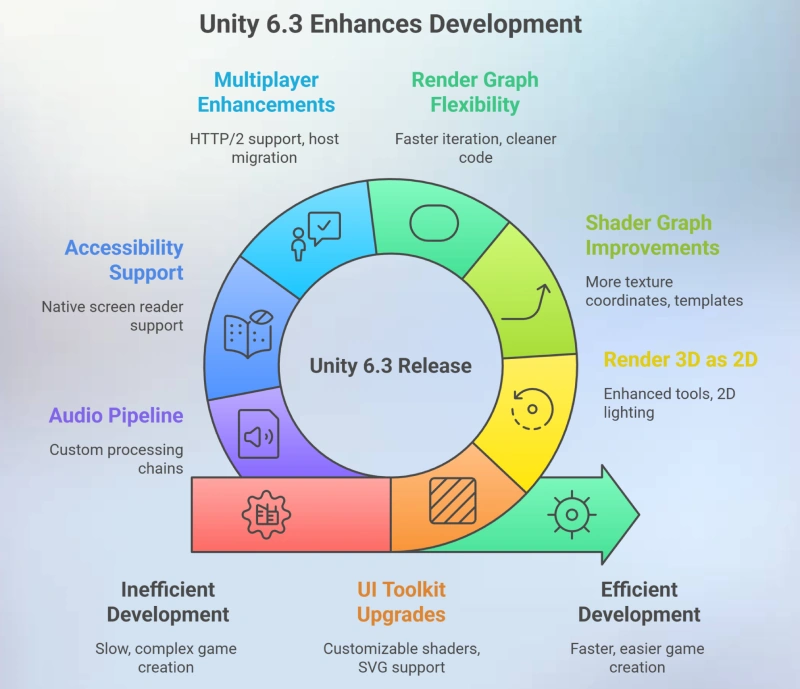
Now supports customizable UI shaders, UI post-processing filters, and Scalable Vector Graphics (SVG).
These features allow for easier development of advanced, dynamic user interfaces that scale nicely across devices.
You can combine vector-based visuals with lighting and post-processing for richer, more flexible UI designs.
Render 3D as 2D
Enhanced tools now allow 3D objects to be rendered with 2D depth and sorting rules.
Compatible completely with 2D lighting, sorting layers, sprite masks, and groups, enabling mixed 2D/3D scenes with smoother performance and visual consistency.
Shader Graph
Added support for up to 8 texture coordinates to enable complex terrains, stylized characters, and dynamic visual effects.
Introduced nested properties and keywords to easily create and manage SubGraphs.
New template browser helps you start shaders for various use cases - from unlit surfaces and decals, all the way to UI, particles, and post-processing.
Added terrain shader support and custom lighting samples to help users experiment with different visual styles.
Render Graph
Join the conversation! Your thoughts help the community grow.