

Introduction
Software has always been reactive. It waits for us to click, type, or trigger an event. Even intelligent applications of the past performed predefined actions in predefined sequences. But modern AI has changed the expectations. Systems no longer have to sit idle until a user gives a precise instruction. With the rise of AI agents, software has crossed a threshold into autonomy. It can observe the environment, understand goals, create plans, call tools, adapt its actions, and keep working until the job is done.
Agents represent a different category of software altogether. They are goal driven instead of input driven. They think instead of simply responding. They can take steps rather than wait for instructions. And they can collaborate with other agents, tools, or humans to deliver end to end outcomes.
Understanding what an AI agent actually is and how it functions is becoming a core skill for developers, architects, product leaders, and entrepreneurs. Inside companies, agents will soon run analytics, triage support tickets, automate operations, generate reports, summarize content, drive research, and power entire workflows. For consumers, they will manage travel, finances, communication, health coordination, learning, and everyday planning.
This article breaks down AI agents from the ground up. You will understand how they think, how they act, how they differ from chatbots, how they plan, and how they integrate with real systems. You will also find helpful resources for deeper learning, such as
What an AI Agent Actually Is
An AI agent is a software program capable of interpreting goals, reasoning through possible actions, choosing the best steps, interacting with external tools, evaluating outcomes, and adjusting its behavior as it works toward a result. While a traditional chatbot focuses primarily on conversation, an agent focuses on accomplishment. It receives a target or objective and moves toward it.
Think of it this way. A model answers. An agent executes. A chatbot needs constant prompting. An agent continues working even when you walk away. A workflow automation system follows the same path every time. An agent adapts its path based on context. In practice, this difference is enormous. It is the difference between a bot that says “Here is a list of flights” and an agent that handles the entire travel plan from search to selection to booking.
How an AI Agent Differs from a Chatbot
Although both may use large language models, they behave differently. A chatbot replies to messages. It stays inside the dialogue. It does not plan, act, or reason in a multi step process. Without special engineering, it forgets context easily and depends completely on human direction.
An agent interprets the existing situation, reflects on what needs to happen next, and makes choices. It treats tasks the way a human assistant would. It can search for missing information, ask clarifying questions only when necessary, call APIs, manipulate files, retrieve knowledge from memory, and continue progressing until the goal is complete.
Imagine you ask a chatbot to gather the best resources on LangChain. It will give you a list. But if you ask an agent to produce a weekly digest of LangChain updates, it will search the web, gather examples, extract ideas, produce summaries, clean up the output, and deliver it automatically every week.
A deeper comparison is available here
AI Agents vs Agentic AI
The Core Components of an AI Agent
Despite different frameworks and implementations, most agents share a similar internal structure. Understanding these components makes it easier to design your own.
The first component is perception. The agent must be able to receive information from its environment. That can be a user asking a question, a file being uploaded, a database returning values, or an application event. Without input, the agent has no foundation for reasoning.
Next comes interpretation and planning. This is where the intelligence lives. The agent evaluates the goal, breaks it into manageable pieces, identifies what must happen next, and decides which tools or actions to use. It may also recognize missing information and attempt to gather it before proceeding.
Then comes action. Agents rely on tool calling to interact with the world. That might involve hitting external APIs, querying a knowledge store, writing to a database, executing code, performing calculations, searching the internet, or reading and writing files. If an agent cannot use tools, it cannot accomplish much.
Memory is another essential component. Short term memory helps the agent stay oriented inside a task. Long term memory allows it to accumulate knowledge, user preferences, and history. This makes the agent progressively smarter each time it performs a task.
Finally, agents run on a loop. The sequence is simple but powerful. Observe. Think. Plan. Act. Review. Adjust. Repeat. This loop continues until the agent either completes the task or determines that human assistance is necessary.
How an AI Agent Works A Step by Step Look
Let’s walk through a realistic scenario so the mechanics become clear.
Imagine you want an analytics summary delivered every Monday morning without you doing anything.
You begin by giving the agent a goal. The agent analyzes it and determines everything required to fulfill it. It realizes it must gather traffic numbers, trends, sources, comparisons, anomalies, and insights. It also determines which tools to call. For example, it may need an analytics API, a reporting template, a writing module, and an email system.
Once the plan is set, the agent begins executing. It calls the analytics API. If the data looks incomplete, the agent may try a different range. If the request fails, the agent retries or adjusts. Once data arrives, the agent produces insights and transforms numbers into narrative text. If the writing seems unclear or repetitive, the agent refines it. After assembling the final report, it sends the email.
Each week the agent evaluates whether the previous report satisfied expectations. If a specific metric is always important or if you frequently ask additional questions, that preference becomes part of its memory. Over time, the agent becomes better at delivering exactly what you want with minimal instruction.
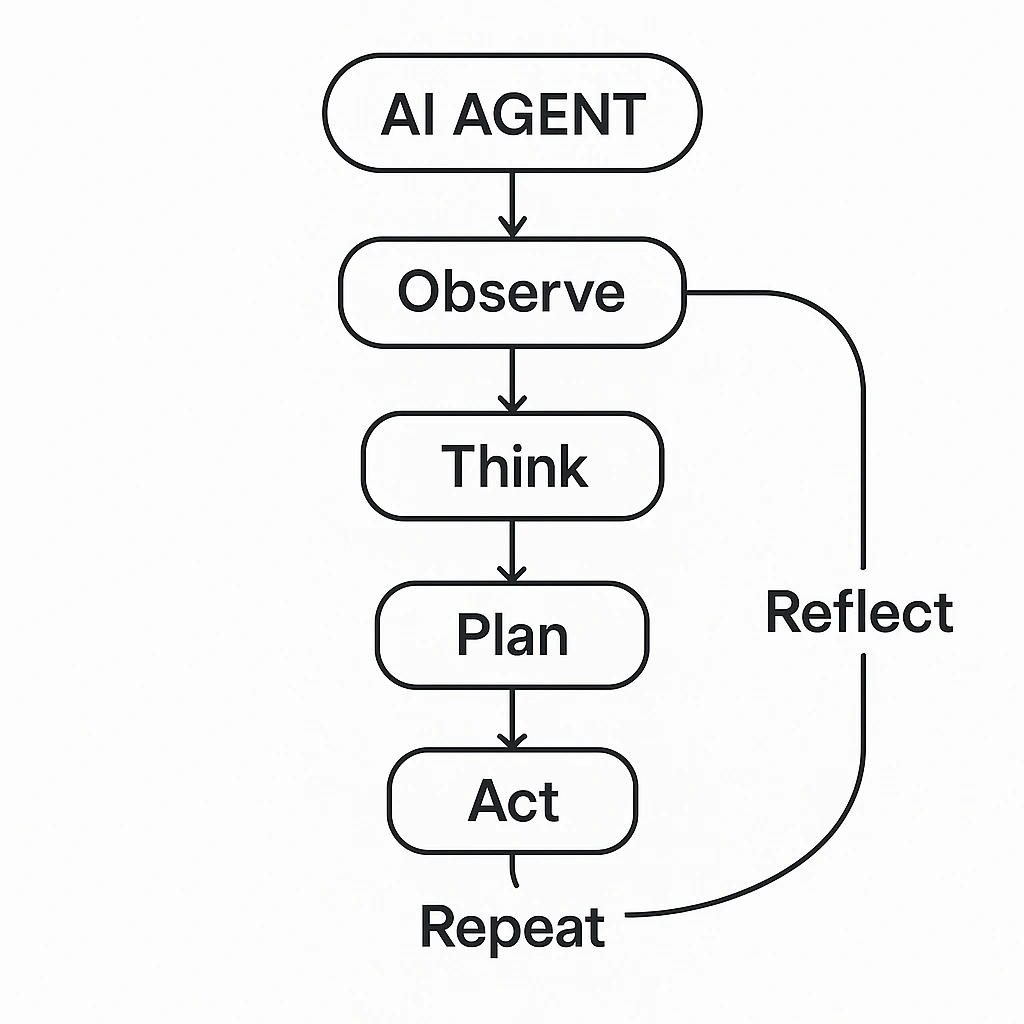
This is the difference between an automated script and an AI agent. The agent reflects, adjusts, and improves.
Real Examples of AI Agents in the World
AI agents are already emerging across many industries because they solve problems that traditional workflows cannot handle easily.
Travel agents powered by AI can evaluate dozens of flight combinations, apply rules about timing or price, compare hotel ratings, understand personal preferences, assemble itineraries, and finalize bookings in seconds. The user does not guide each step. They simply express the goal.
Research agents can scan through large bodies of text, pull out insights, compare expert opinions, analyze contradictions, and prepare well structured reports. This is already becoming a common tool for analysts, journalists, engineers, and students.
Coding agents are advancing quickly. They can read logs, identify issues, propose changes, modify code directly, create pull requests, document updates, and even carry out entire refactoring tasks. These agents reduce significant developer workload and accelerate product delivery.
Customer support agents can interpret user messages, detect sentiment, retrieve answers from documentation, classify issues, generate responses, and escalate only the complex cases. Teams that handle thousands of tickets per month are benefiting from this type of automation.
In healthcare, agents are simplifying scheduling, pre visit preparation, follow up communication, and educational explanations, all while reducing administrative burden. The doctor still makes decisions, but the agent handles tasks that take hours of staff time.
Across all these categories, the underlying pattern remains the same. The agent moves from intention to completion with minimal supervision.
Different Types of AI Agents
AI agents vary in complexity and purpose. Some handle a single operation repeatedly. They might summarize documents, format data, or classify inputs. Others manage multi step tasks, coordinating multiple tools. These are ideal for research, analytics, DevOps, and customer workflows.
More advanced systems operate as teams of agents. One agent may focus on planning, another on writing, another on data extraction, and another on verification. Together they behave like a team of specialists working on a shared objective.
Finally, some agents live inside applications. A project management system may include an embedded agent that assigns tasks based on workload patterns. A code editor may include an agent that automatically repairs errors or optimizes files. Email clients may include agents that draft replies or organize threads without the user asking.
At the enterprise level, agents may run continuously, monitoring systems, reacting to changes, updating records, or generating reports. These require strict governance, permissions, and safety checks because they interact with sensitive data and operational systems.
If you want a deeper overview of different agent development paths, explore
Frameworks and Tools for Building AI Agents
Developers today have multiple choices for building agents. Some prefer to build custom agent loops. Others use frameworks that provide built in planning and tool orchestration.
LangChain and LangGraph are popular choices because they simplify tool calling, reasoning, memory, and workflows. They are widely used in production environments. Guides like these provide a practical starting point Getting Started with LangChain and Implementing Agents in LangChain.
Top AI Agents Frameworks include LangChain, LangGraph, CrewAI, AutoGen, and Semantic Kernel. Here is a detailed article on this topic: Which AI Agent Framework Should I Use.
Cloud providers are also offering agent solutions. Azure provides patterns and templates that simplify deployment and scaling.
Build an AI Agent using Azure.
Copilot Studio offers a business friendly path for creating autonomous workflows with minimal coding while still supporting advanced customization.
Getting Started with AI Agents using Copilot Studio.
An Example Project Building a Real Agent
Let’s walk through a practical scenario so you can see how everything fits together.
Imagine you want to build a research agent that produces a technical digest on any subject. When given a topic, the agent would search online sources, gather the most credible information, summarize their key points, and compile everything into a cohesive document.
The agent begins by interpreting the topic. It understands the type of information needed. It constructs an initial plan that includes searching, filtering, summarizing, organizing, and producing the final digest. It selects the tools required, including search APIs, content retrieval modules, a text analysis model, and a writing model.
The agent initiates the search, analyzes the credibility of sources, extracts content, and condenses it into clean summaries. If early results are low quality, the agent adjusts the search query and tries again. After gathering enough evidence, the agent produces a structured document, refines it for clarity, and delivers it in the format you prefer.
This small example illustrates the general pattern of all agents. They move through cycles of reasoning, action, reflection, and refinement until they complete the assignment.
Why AI Agents Matter for the Future of Software
The arrival of agents marks a significant transition in how applications behave. Instead of interacting with software step by step, users will increasingly express goals while agents handle execution. This shift unlocks several advantages.
First, agents remove the burden of repetitive work. Tasks that used to demand hours of effort can now run in the background while humans focus on higher level decisions. Second, agents improve speed and accuracy. They can analyze logs, transactions, or documents continuously without fatigue. Third, agents expand what is possible. A single human cannot monitor a thousand signals and react instantly, but an agent can.
Fourth, agents reduce development friction. Instead of building complex workflow engines, developers can focus on defining tools, boundaries, and goals while agents handle orchestration. Finally, agents make software accessible to more people. When applications operate through natural language goals rather than complex menus and configurations, far more users can achieve meaningful outcomes.
These changes signal a shift similar to the early web or the rise of smartphones. The architecture of software is evolving toward autonomous digital workers.
Challenges and Risks Developers Must Consider
With autonomy comes responsibility. Agents require careful design to prevent unintended consequences.
Reliability is a major concern. If an agent enters an unexpected loop or misinterprets data, it may get stuck or produce incomplete results. This makes guardrails and evaluation steps essential.
Security is equally important. Since agents can call tools and APIs, they must follow strict permission rules. They should only access the data and capabilities they truly need. Input validation and prompt protection must be built in to prevent malicious users from influencing agent behavior.
Governance and observability matter because teams must understand what agents are doing. Logs, traces, event history, and versioning are critical. Business critical agents should include human review checkpoints.
Cost is another factor. Agents that plan extensively or make frequent tool calls can increase compute usage. Efficient design prevents runaway costs and unnecessary reasoning.
Finally, ethical considerations must always be present. If an agent misinterprets a goal or generates incorrect information, the impact can be serious. Designing clear boundaries and oversight prevents these issues.
How to Begin Your Journey with AI Agents
A practical path to mastering agents begins with understanding the fundamentals. These resources provide an excellent conceptual foundation
https://www.c-sharpcorner.com/article/what-is-an-ai-agent
https://www.c-sharpcorner.com/article/what-exactly-is-an-ai-agent-and-why-it-matters-for-every-developer
From there, study the internal mechanics and reasoning loops
https://www.c-sharpcorner.com/article/how-do-ai-agents-work-behind-the-scenes
Then compare available frameworks and decide which suits your environment
https://www.c-sharpcorner.com/article/which-ai-agent-framework-should-i-use
After selecting a framework such as LangChain, LangGraph, Azure agents, Google ADK, or Copilot Studio, build a small agent that performs a clear, valuable task. Even a simple summarization, reporting, or triage agent provides real insights into design decisions.
Once you are comfortable, expand into more complex workflows and multi agent systems. Explore context engineering, long term memory, and specialized tools. Add observability, permissions, and boundary rules. Over time, you will gain the intuition required to design agents that operate reliably in real environments.
This resource provides a technical overview of how agents manage context and memory
https://www.c-sharpcorner.com/article/how-ai-agents-use-filesystems-for-context-engineering
Conclusion
AI agents are rewriting how software behaves. Instead of waiting for instructions, they understand goals, create plans, make decisions, and take actions. They perform meaningful work with minimal human supervision and adapt as conditions change. They are not simply chat interfaces. They are becoming the operational backbone of modern applications.
From research automation and customer support to analytics, content creation, development workflows, and enterprise operations, agents will increasingly shoulder the repetitive and procedural parts of work. This frees people to focus on strategy, creativity, and critical thinking.
Mastering agents means understanding how they perceive, plan, act, and learn. It means knowing how to design boundaries, define tools, manage memory, evaluate outcomes, and safeguard interactions. It means understanding frameworks and deployment environments. But most importantly, it means shifting your mindset from interacting with software to collaborating with software.
Hire AI Agents Developer
If you need help choosing the right AI agent framework, designing the architecture, or training your team to build and operate AI agents in production, you can contact Mahesh Chand for guidance. Mahesh and the C# Corner team provide training, consulting, and implementation support for AI agents and modern AI applications.
To get in touch, visit the our Contact Us page and mention that you are interested in AI agent training or implementation.
Join the conversation! Your thoughts help the community grow.