


Rising Threats from AI-Powered Cybercrime
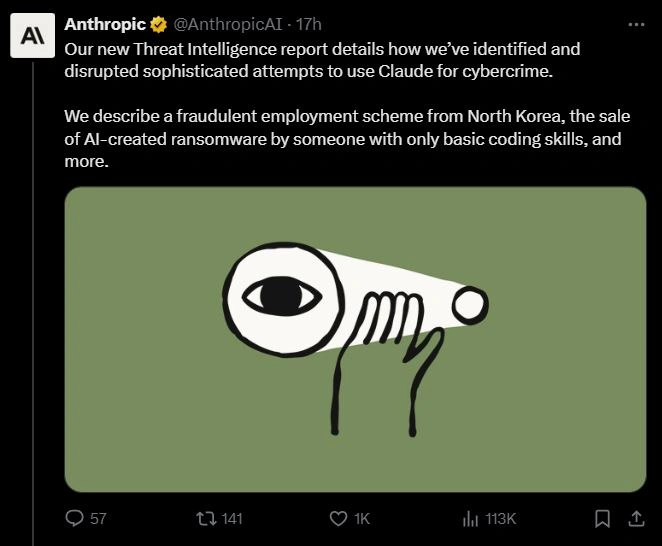
Anthropic has released a new Threat Intelligence Report detailing how cybercriminals are attempting to exploit advanced AI systems. Despite safeguards, malicious actors are adapting AI tools to carry out sophisticated cyberattacks, fraud schemes, and ransomware operations.
Key Findings from the Report
The report highlights three major developments in AI-enabled crime.
Weaponization of agentic AI: AI models actively executing complex cyberattacks.
Lowered barriers to cybercrime: individuals with minimal coding skills are creating ransomware.
Full integration of AI in criminal workflows: from victim profiling to data theft and fraud.
Case Studies of AI Misuse
1. Data Extortion Operations
Cybercriminals used AI to automate reconnaissance, steal credentials, and craft targeted extortion demands. One operation targeted at least 17 organizations across healthcare, emergency services, and government sectors.
AI used for decision-making: which data to exfiltrate and ransom strategies.
Psychological targeting: ransom notes tailored to victims.
Financial analysis: AI-calculated ransom amounts exceeding $500,000.
Response: Anthropic banned the accounts, deployed a tailored classifier to detect similar activity, and shared indicators with authorities.
2. North Korean Remote Worker Fraud
AI was leveraged to create fake professional identities, pass technical interviews, and deliver work for Fortune 500 firms. These schemes generated revenue for the North Korean regime, bypassing years of training typically required.
Response: Accounts were banned, indicators were stored for monitoring, and findings were shared with the authorities.
3. Ransomware-as-a-Service
A cybercriminal developed and sold AI-generated ransomware packages priced between $400 and $ 1,200 on dark web forums. Without AI, the actor lacked the technical skills to build malware.

Response: Accounts were banned, malware detection improved, and intelligence was shared with security partners.
Strengthening Defenses
The report emphasizes that AI-assisted crime is evolving rapidly. Anthropic has,
Introduced new detection and monitoring tools.
Shared intelligence with industry and government partners.
Expanded safeguards against fraud, ransomware, and nation-state exploitation.
Looking Ahead
Anthropic stresses that continued research, collaboration, and transparency are critical to counter AI-driven cybercrime. The company is committed to advancing safety tools and ensuring AI technologies are used responsibly and securely.
Join the conversation! Your thoughts help the community grow.