
How to use a combination number of non-recursive functions?
// Codes:
#include
void C(int a[],int n,int m){
// How to do it?
}
void C(char b[],int n,int m){
// How to do it?
}
void main()
{
int a[5]={1,2,3,4,5};
char b[]={"abcde"};
C(a,5,3); // It should be 10 combinations.
C(b,5,3); // Same as above.
}
Here is its formula:
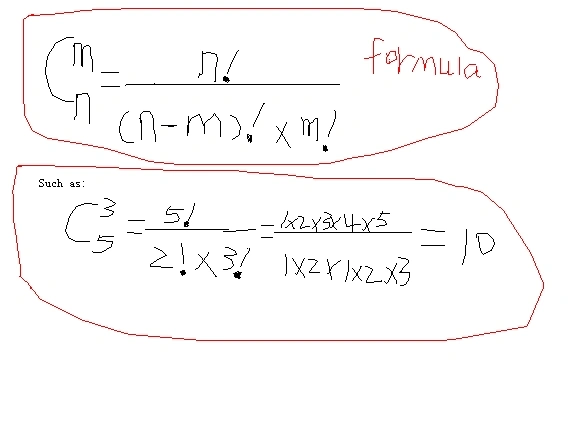
Such as:
C(a,5,3);
It will print the following information:
123
124
125
134
135
145
234
235
245
345
Total:10
C(b,5,3);
It will print the following information:
abc
abd
abe
acd
ace
ade
bcd
bce
bde
cde
Total:10
Please use a non-recursive method to solve it(Do not use the system to provide any built-in functions). And explain its problem-solving ideas.
Thank for you.:)
VulpesPosted Dec 21, 2013, 12:20 PM
The algorithm I've used is to consider all binary numbers less than 2^n which contain exactly 'm' non-zero bits. The positions of these bits are then used to generate a combination of the corresponding elements of the array:
#include
void C(int a[],int n,int m)
{
int x; /* stores binary number */
int c; /* counts non-zero bits */
int i; /* for statement variable */
int k; /* bit position */
int t; /* temporary variable */
int z; /* counts number of combinations printed */
int indices[1024]; /* stores indices of non-zero bits - EDITED */
int max = 2 << (n - 1); /* 2 to power n */
z = 0;
/* consider all binary numbers less than max with exactly
m non-zero bits
*/
x = 1;
while (x < max)
{
/* initialize indices to impossible value */
for(i = 0; i < max ; i++) indices[i] = -1;
t = x;
k = 0;
c = 0;
/* generate bits of binary number, x */
while (t > 0)
{
if ((t % 2) == 1)
{
indices[c] = k; /* if non-zero store the bit position */
c++; /* count it */
}
k++; /* increment bit position */
t /= 2; /* divide t by 2 */
}
/* if there are exactly m non-zero bits
print the corresponding elements of the array
*/
if (c == m)
{
for(i = 0; i < max; i++)
{
if (indices[i] > -1) printf("%d", a[indices[i]]);
}
printf ("\n");
z++; /* increment number of combinations */
}
x++;
}
printf("Total:%d\n", z); /* print number of combinations */
}
void C2(char b[],int n,int m)
{
int x; /* stores binary number */
int c; /* counts non-zero bits */
int i; /* for statement variable */
int k; /* bit position */
int t; /* temporary variable */
int z; /* counts number of combinations printed */
int indices[1024]; /* stores indices of non-zero bits - EDITED */
int max = 2 << (n - 1); /* 2 to power n */
z = 0;
/* consider all binary numbers less than max with exactly
m non-zero bits
*/
x = 1;
while (x < max)
{
/* initialize indices to impossible value */
for(i = 0; i < max ; i++) indices[i] = -1;
t = x;
k = 0;
c = 0;
/* generate bits of binary number, x */
while (t > 0)
{
if ((t % 2) == 1)
{
indices[c] = k; /* if non-zero store the bit position */
c++; /* count it */
}
k++; /* increment bit position */
t /= 2; /* divide t by 2 */
}
/* if there are exactly m non-zero bits
print the corresponding elements of the array
*/
if (c == m)
{
for(i = 0; i < max; i++)
{
if (indices[i] > -1) printf("%c", b[indices[i]]);
}
printf ("\n");
z++; /* increment number of combinations */
}
x++;
}
printf("Total:%d\n", z); /* print number of combinations */
}
void main()
{
int a[5]={1,2,3,4,5};
char b[]={"abcde"};
C(a,5,3); /* It should be 10 combinations. */
printf("\n");
C2(b,5,3); /* Same as above. */
}
The output is:
123
124
134
234
125
135
235
145
245
345
Total:10
abc
abd
acd
bcd
abe
ace
bce
ade
bde
cde
Total:10
Ken HPosted Dec 27, 2013, 8:05 AM
VulpesPosted Dec 26, 2013, 6:44 AM
The presence of a 1 or 0 at a certain position in the binary number determines whether the value at that index in the array appears in a combination or not.
So, there's only one combination which contains all 5 values which is represented by the binary number 11111 and there are 5 combinations which contain exactly 4 of the values which are represented by the binary numbers 01111, 10111, 11011, 11101 and 11110.
In the latter case, the presence of the 0 determines which value is to be omitted when determining combinations of the 4 other values.
Using similar logic, there are 10 numbers which contain exactly 3 of the values and so by iterating through all 5 digit binary numbers and finding those which contain exactly three 1's, we can generate the combinations themselves.
Ken HPosted Dec 24, 2013, 8:06 PM
Such as:
C(a,5,3);
int max = 2 << (n - 1); /* The max value will as 32. */
------------------
Decimal Binary
------------------
7 111
11 1011
13 1101
14 1110
19 10011
21 10101
And so on
... ...
VulpesPosted Dec 24, 2013, 9:46 AM
Seasons greetings to you too :)
Ken HPosted Dec 23, 2013, 9:58 PM
However, I still baffled why use '2 ^ n' can get the number of combinations.
So, I use another algorithm lexicography order.
I wish you a Merry Christmas.
Happy New Year. :)
VulpesPosted Dec 23, 2013, 3:32 PM
I've altered it now so it can deal with up to 10 numbers - probably as many as you'd want to do here - but, as you're own version (which uses a different algorithm), seems to be working fine and producing output in lexographical order, I'd go with that instead :)
Ken HPosted Dec 21, 2013, 8:23 PM
It has a runtime error:
Run-Time Check Failure #2 - Stack around the variable 'indices' was corrupted.
It will look more in line with the requirements (because it is the right order). :)